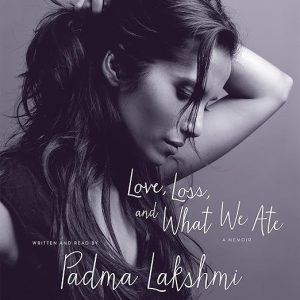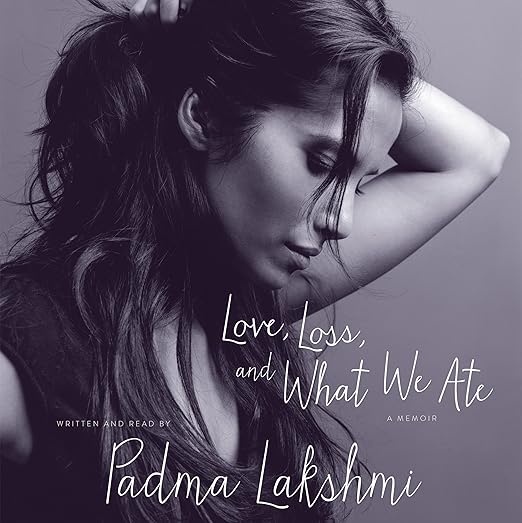
Padma Lakshmi's Love, Loss, and What We Ate sits in the tradition of food memoirs that use eating as a way of mapping a life, Ruth Reichl's Tender at the Bone and Nora Ephron's Heartburn are the comparisons the publishers reach for, and both are apt in different ways. But this audiobook, narrated by Lakshmi herself across twelve hours and thirty-seven minutes, has a particular texture that those comparisons do not fully capture. Lakshmi is writing from multiple dislocations at once: cultural, geographic, familial, and physical. The food in this memoir is not just about pleasure or memory. It is about finding ground when the ground keeps shifting beneath you, and about the specific flavors that can serve as anchors when almost everything else is in motion.
The structural spine of Love, Loss, and What We Ate is an immigrant childhood that kept moving. Lakshmi shuttled between continents as a child, accompanying her mother who left conservative Indian convention to build a life in New York. The instability that produced, never quite at home, always calibrating to a new set of expectations, became, as she describes it, a habit in adulthood. Against that background of perpetual motion, food offered continuity. The simple rice she first ate sitting on the cool floor of her grandmother's kitchen in South India reappears throughout the memoir as a fixed point, a flavor memory that the rest of her life could not dislodge or replace with anything more sophisticated.
Lakshmi's prose has a sensory precision that works particularly well in audio. She writes about food the way a thoughtful critic writes about wine, not just naming flavors but reconstructing the conditions that make those flavors meaningful in a specific life at a specific moment. When she describes her Brahmin grandfather, an engineer with an irrepressible sweet tooth, the description of the sweets he loved tells you more about him than any direct characterization could. That is the central technique the whole memoir relies on, and Lakshmi deploys it with real consistency across the twelve-hour runtime.
What Works
Self-narration is a genuine risk in memoir audiobooks. Authors are not always good readers of their own work, and the intimacy of their connection to the material can make them either too rushed or too emotionally unsteady in the difficult passages. Lakshmi avoids both traps. Her narration is calm without being distant, and she reads the more painful material, a complicated romantic history, the chronic illness that changed her relationship to her own body, a marriage that did not survive, with the poise of someone who has had time to genuinely understand what those experiences meant. The emotional honesty is present; it simply is not performed for the audience.
The reviewer who noted that Lakshmi's story as an immigrant is both inspiring and poignant captures one of the memoir's central registers accurately. The relationship between her mother's decision to leave India and the way Lakshmi herself eventually built a life from pieces gathered across multiple countries is one of the book's recurring preoccupations. The description of that life as a blend of food memoir and personal reckoning is fair, this is not a cookbook with a narrative attached, nor a purely confessional memoir that uses food as decoration. The two elements are genuinely integrated in a way that makes the food writing inseparable from the emotional content it carries.
Before You Commit to Love, Loss, and What We Ate
The memoir's sections on the remarkable women who shaped Lakshmi's early life deserve particular attention. Her grandmother's kitchen is not just a setting, it is an education in a set of values that the rest of the book keeps testing against the values of the various worlds Lakshmi moved through afterward. Her mother's headstrong determination to make a life outside the expectations of conservative Indian society reads, through Lakshmi's account, as both inspiring and complicated. The portrait does not flatten her into a simple symbol of immigrant courage.
The reviewer who arrived expecting substantial behind-the-scenes Top Chef material and found only two pages on the subject was disappointed, and that is worth knowing going in. Love, Loss, and What We Ate is not a television memoir. Top Chef is part of the context of Lakshmi's professional career as described in the book, but the memoir's primary interest is in the years and relationships that preceded that career and the private life that continued alongside it. Listeners who come initially for the culinary television world and stay for the immigrant story, the family dynamics, and the evocative recipes that punctuate the chapters will find the trade worthwhile. Those who cannot adjust expectations accordingly should know in advance what this audiobook is actually about.
Who It's For
Readers who love food memoirs and want something with more personal depth than a cookbook narrative will find this audiobook rewarding and textured. Those interested in immigrant experience, South Indian food culture, and the intersection of professional ambition with private life will find Lakshmi a precise and honest guide. The self-narration adds a dimension that makes listening the better format here, the audio version is specifically the one to choose over the print edition. Anyone arriving primarily for Top Chef behind-the-scenes content should calibrate expectations: this is a more wide-ranging and introspective book than that framing suggests, and it earns the length it takes to tell itself properly.
- Voice: Padma Lakshmi narrates her own memoir, and the result is exactly right, she reads with the authority of someone telling her own story, and the food descriptions carry a sensory weight that a third-party narrator could not replicate.
- Big ideas: Food as love and refuge, immigrant identity and dislocation, the families we are born to versus the ones we build
- Atmosphere: Rich and sensory, with genuine emotional weight beneath the surface elegance
- Worth it?: Love, Loss, and What We Ate is a memoir that earns its ambition, Lakshmi narrating her own life gives this audiobook an intimacy that makes the harder passages land with real force.
Before You Listen
Does Padma Lakshmi narrate the Love, Loss, and What We Ate audiobook herself?
Yes. Lakshmi narrates her own memoir across twelve hours and thirty-seven minutes. Her self-narration brings an authority and emotional directness to the material that makes the audio version a particularly strong way to experience the book.
Does this audiobook include the recipes mentioned in the memoir?
The memoir is described as punctuated with evocative recipes. How these are handled in the audio version, whether read in full or referenced, is worth checking in the product description, as recipes in memoir audiobooks are sometimes abbreviated or directed to a companion PDF.
How much does Love, Loss, and What We Ate focus on Top Chef compared to Lakshmi's personal life?
The memoir is primarily about Lakshmi's life before and beyond her television career, her childhood, immigrant experience, family relationships, and health challenges. Top Chef receives minimal coverage. Listeners expecting a television memoir should adjust their expectations accordingly.
Is this audiobook appropriate for listeners unfamiliar with South Indian food culture?
Yes. Lakshmi writes for a general audience and contextualizes food within her personal and cultural history rather than assuming specialized knowledge. The sensory descriptions are accessible and the cultural context is built into the narrative throughout.