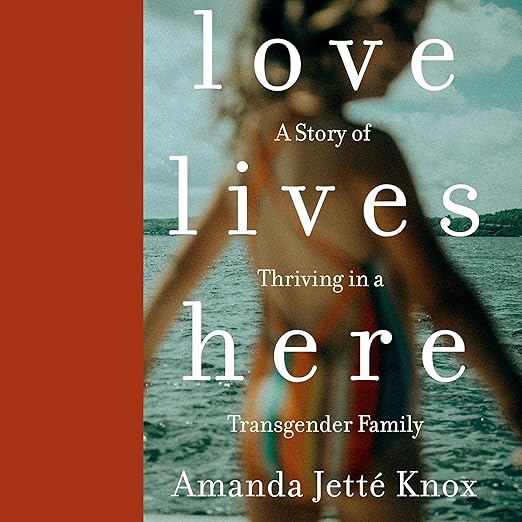
Rowan Jette Knox's audiobook Love Lives Here, narrated by Knox and running eight hours and seven minutes, is a Canadian national bestseller that tracks two overlapping transitions within a single family: first, when Knox's eleven-year-old child came out as transgender and she became an advocate for trans rights, and second, when her spouse of more than a decade came out as transgender as well. Knox approaches both with the kind of candor that does not soften the harder passages to make the story more comfortable for readers who might prefer a cleaner narrative arc. This is not a straightforward triumph story. It is an account of a family that chose to stay together through circumstances most families have no framework for, and it is specific about what that choosing required in practical, emotional, and relational terms.
The biographical context matters. Knox's own life before the family's transitions was not uncomplicated. She grew up without her biological father, navigated alcoholism as a teenager, and entered a counseling program for addiction at fourteen. She built the stability she craved through the family she formed at twenty. When that family began to change in ways she had not anticipated and had no roadmap for, the tension between her desire for stability and her commitment to the people she loved becomes the emotional engine driving everything that follows. Reviewers have described it as remarkable in its candor, and that assessment is accurate.
What Knox does particularly well is resist the tidying impulse that affects most memoir. She does not retrospectively flatten her initial shock and confusion into immediate acceptance; she describes the learning curve with enough awkwardness that readers who have experienced similar disorientation will recognize themselves without feeling judged for the recognition. The humor is real and not defensive; Knox is genuinely funny throughout, and the book uses that humor to make some of its harder truths approachable rather than as a protective distance from them.
The structural choice to narrate both transitions as part of a single family story rather than as separate events gives the book a cumulative weight. When Knox describes searching for positive examples of marriages surviving a partner's transition and finding almost nothing, the decision to make her family into the role model she could not find is treated as a specific act of will rather than as a given. What does it actually take to lead with love in practice, not as a slogan but as a series of specific daily choices? Knox answers that question in detail, including the parts that are neither simple nor pleasant.
Knox Sounds Like Someone Who Was Actually There
Knox narrating her own audiobook gives the material something a hired narrator could not provide: the sound of someone who was there. Her comedic timing is sharp enough that the funny sections are genuinely funny, not merely warm. Her emotional register in the harder passages is calibrated to honest grief rather than performed sadness, which is the distinction that makes a difficult subject bearable to listen to over eight hours. One reviewer described the result as easy for someone with no familiarity with the experiences shared to engage with, which is the specific achievement that makes this book valuable beyond the community it is most directly addressing.
The book's directness about the challenges faced by trans people, combined with Knox's perspective as a cisgender family member navigating her own learning process in public, gives it a dual utility. It functions simultaneously as a resource for families beginning to understand what a loved one's transition means, and as a document of advocacy work and its personal costs that readers already engaged with trans rights will find illuminating rather than introductory.
Canadian Specifics, Universal Emotional and Relational Truths
Knox writes from a specific Canadian context, and some of the advocacy and healthcare references are particular to that system. The emotional and relational content translates entirely across national contexts, but US listeners specifically seeking legal or medical resource guidance should verify country-specific details. This is a minor qualification that does not affect the book's primary value, which is the family narrative itself and the specific account of what active acceptance looks like from the inside.
The final chapters, which cover the family's public visibility as advocates and the pressures that come with becoming a public face for any cause, are among the most substantive in the book. Knox is honest about the difference between being a resource and being a symbol, about the cost of visibility when the people you love most are the subject of political debates they did not choose to enter. That conversation is more nuanced than most advocacy memoirs engage with directly.
Valuable for Families and Allies Navigating Acceptance
This audiobook is essential for families who have a transgender member and are navigating what acceptance looks like in practice over time rather than as a single moment of declaration. It is valuable for allies who want to understand the emotional and logistical complexity involved, not as theory but as lived specifics from someone still in the middle of it. Educators, counselors, and healthcare providers who work with trans youth and their families will find Knox's narrative more practically instructive than many professional resources, precisely because it does not resolve the complexity into guidance.
Listeners who want to understand how a family can emerge from significant change stronger than they began, through chosen commitment rather than through circumstances or ease, will find this account honest and ultimately, as its title promises, a story about what love actually requires when it is not convenient.
Questions Listeners Ask
Is this audiobook primarily focused on Knox's child's transition or her spouse's transition?
It covers both in equal depth, treating them as a connected family story rather than as separate events. Knox's own process of understanding and advocacy runs through both narratives as the central thread holding the book together.
Does the audiobook include practical resources for families of transgender people?
The book is primarily a memoir rather than a resource guide, but Knox's experiences navigating support systems, advocacy organizations, and public visibility provide practical context that families in similar situations consistently find directly applicable to their own situations.
Is this audiobook suitable for young adult listeners?
The book deals with addiction, depression, and gender identity with candor appropriate to adult memoir. Mature young adult readers navigating their own identity questions may find it meaningful, but parents should assess based on the individual reader's readiness for the emotional complexity involved.
Does Rowan Jette Knox narrate the audiobook herself?
Yes. Her narration is one of the audiobook's strongest assets; her comedic timing and emotional honesty come through clearly in the performance, and the intimacy of self-narration is well-suited to memoir material of this personal and specific nature.