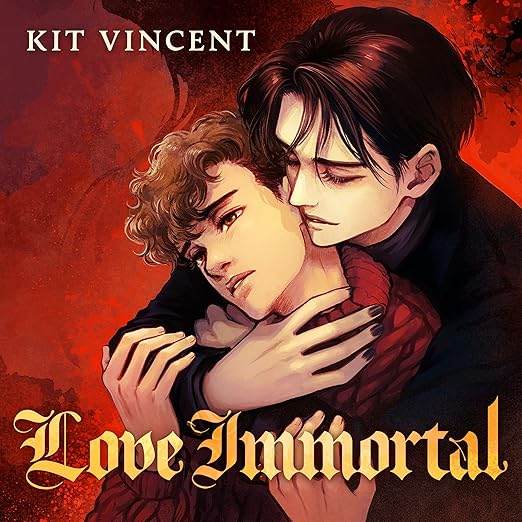
Quick Take
- Narration: James Fouhey handles the dual registers of dark academia atmosphere and emotional vulnerability well; his voice suits Jonathan’s interiority without overpowering the suspense.
- Themes: Queer identity and found family, vampire mythology as metaphor for hidden truth, the particular loneliness of chosen isolation
- Mood: Gothic and slow-burning, with warmth that accumulates under the darkness until the final act earns it
- Verdict: A debut that does more with the vampire romance premise than most, rooted in a Dracula retelling that takes both its genre influences and its queer characters seriously.
I have a complicated relationship with vampire fiction. In graduate school I wrote a seminar paper on the relationship between the undead and the hidden self in gothic literature, so I have read a lot of it and become particular about what I am willing to spend time with in the genre. Love Immortal landed in my queue last autumn, recommended by a colleague who knows my tastes and who said the phrase dark academia with genuine meaning rather than as a marketing shorthand. She was right about both the quality and the framing.
Kit Vincent’s debut is positioned as a Dracula retelling set in the 1980s, on the campus of a prestigious, isolated Vermont college. Jonathan Evergreen is a sophomore studying book conservation, disowned by his family after being discovered with another boy, scraping together tuition while navigating an institution run on old money and legacy connections. His advisor, his only institutional ally, disappears. A new professor named Dacian Bathory arrives to replace him. The surname is not subtle, and Vincent does not pretend otherwise. What the book does instead of pretending subtlety is something more interesting: it uses the known mythology as infrastructure so that the story can focus on the human and queer dimensions of the relationship rather than on the genre mechanics.
What the 1980s Setting Actually Does
The choice to set this in the late 1980s is deliberate and productive in ways that took me a chapter or two to fully appreciate. Before cell phones and the internet, the gothic isolation of a Vermont campus is architecturally plausible in a way it would not be today. The disappearances, the strange events, the nights when people simply vanish and no one can verify what happened, all require a pre-digital world to feel properly threatening rather than merely inconvenient. But the setting does something more important than provide gothic plausibility: it places a young gay man in a specific historical moment, after Stonewall and during the AIDS crisis, where queer identity carries very particular stakes and where the experience of being disowned and isolated by family is not a background detail but a defining wound.
Reviewers have noted that Jonathan’s experience echoes the voice of many queer people from his time, and that historical grounding is what separates this book from vampire romance that simply inserts LGBTQ characters into a setting without thinking about what that specificity means. Jonathan’s isolation is not just gothic atmosphere. It is a historically situated form of exclusion, and the warmth he finds in the rare books library job, in the friendships that form around it, and eventually in Dacian, is warmth that arrives against that specific background.
The Slow Burn and Whether It Pays Off
Multiple reviewers describe this as a slow burn, and that description is accurate and worth taking seriously before you start. The attraction between Jonathan and Dacian develops over most of the book’s ten hours through proximity, uncertainty, and Dacian’s oscillating hot-and-cold behavior, which one reviewer described as appropriately puzzling given what we eventually learn about him. The mystery plot runs in parallel: bodies turning up drained of blood, students behaving in increasingly disturbing ways, an antique book gone missing from the rare books collection that Dacian seems to have a particular interest in.
The convergence of the romance and the mystery in the final act is where Vincent earns the patience the slow burn asks of you. One reviewer described the plot as working its magic once the main characters reached a turning point, which captures what happens: the back half of the book picks up both pace and emotional intensity, and the resolution handles its genre inheritance, the Dracula retelling at its core, with enough originality to feel like something other than a transcription of the source material.
James Fouhey and the Requirements of Dark Academia
Dark academia as a literary mode has specific audio demands. The atmosphere depends heavily on interiority, on the quality of attention to detail in describing library stacks, old stone buildings, and the particular winter light of New England. Fouhey brings the right kind of careful attentiveness to those descriptive passages, which is not a trivial skill. Jonathan’s first-person narration is emotionally vulnerable throughout, and Fouhey conveys that vulnerability without making it the whole texture of the performance. The passages where Jonathan is most afraid are more effective for the relative restraint of his earlier readings.
One reviewer noted they had gone in hoping for hot vampire sex and little plot, and found instead excellent plot and angst with great characterization. That trade is a reasonable description of what the book offers. The physical relationship between Jonathan and Dacian is present but not graphic, which may disappoint readers coming from that direction but will suit readers who want the emotional development to do more work than the erotic.
What Love Immortal Offers the Genre and What It Does Not
If you are looking for a fast-paced vampire thriller with action in every chapter, this is not the book. The pacing is deliberate, the atmosphere dense, and the payoff requires investment in characters before the plot arrives to reward it. If you are looking for a queer gothic romance that takes its own mythology seriously, develops its historical setting with genuine thought, and ends in a place that several reviewers describe as beautiful or as making their hearts ache, this is the book. The series numbering (Book 1) suggests more is coming, and the ending, which one reviewer described as too quick rather than unsatisfying, suggests that Vincent has material to develop in a second volume.
Frequently Asked Questions
Is Love Immortal primarily a romance or primarily a mystery?
Both, with the romance as the emotional spine and the mystery as the plot architecture. The book is structured so that the mystery and the romance converge in the final act, which means the earlier investment in Jonathan and Dacian’s dynamic pays off through the thriller elements rather than despite them.
How explicit is the romantic and sexual content between Jonathan and Dacian?
The physical relationship is present but not graphically depicted. The book is oriented toward emotional and psychological intimacy rather than explicit scenes, which is consistent with the dark academia register of the narration.
Does the 1980s setting matter to the plot, or is it just atmosphere?
It matters significantly. The pre-digital setting makes the gothic isolation architecturally plausible, and the specific historical moment, post-Stonewall and during the AIDS crisis, gives Jonathan’s experience as a disowned gay man a historical grounding that shapes the emotional stakes of the book throughout.
Is James Fouhey’s narration effective for a first-person story with a male protagonist navigating vulnerability?
Yes. Fouhey manages the balance between Jonathan’s emotional openness and the external mystery effectively, keeping the vulnerability present in the interiority without letting it overwhelm the atmospheric passages. The dark academia mode requires a specific kind of careful attentiveness, and he delivers it.