Quick Take
- Narration: Chris Patton handles the Gothic register and the road-trip energy with skill, giving the nihilistic vampire trio a convincingly dangerous charisma.
- Themes: Queer identity and belonging, the seduction of the outsider, blood and music as intertwined forces
- Mood: Lush, dark, and drenched in early-nineties Southern Gothic atmosphere
- Verdict: A foundational text of queer horror that rewards listeners who can embrace its lyrical excess. Not for the faint-hearted, but essential for fans of the genre.
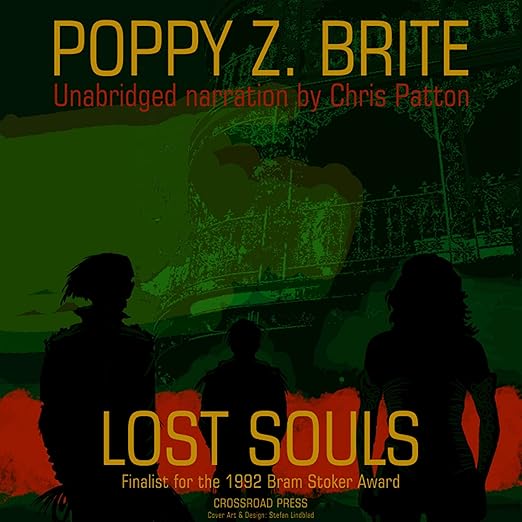
I read Poppy Z. Brite’s Lost Souls for the first time in a print copy that a friend pressed into my hands during a particularly gloomy autumn, and I remember thinking, about fifty pages in, that I had never encountered anything quite like it. Not because of the horror, though the horror is real. Because of the atmosphere, the specific way Brite renders the world of Missing Mile, North Carolina: the kids in black at the local club, the music that runs through every scene like a blood-tinged thread, the particular quality of being young and strange and looking for people who understand why you are the way you are. Coming to it again in audio, narrated by Chris Patton, was a genuinely different experience, and a worthwhile one.
Lost Souls was Brite’s debut novel, published in 1992. It arrived at a specific cultural moment, when queer horror was finding its footing, when vampire fiction was both at a commercial peak and ready to be pushed somewhere darker and stranger than Anne Rice had taken it. Brite pushed it very hard.
The Vampires Who Belong to No One’s Mythology But Brite’s
The vampire mythology in Lost Souls is deliberately distinct. Molochai, Twig, and Zillah are not the elegant courtly figures of Rice’s imagination. They are described by one reviewer as a dangerous rock band made up of murderers and thieves, wandering gypsy vampires on a quest to party, have sex, and kill. That is accurate and slightly undersells how genuinely menacing Brite makes them. Zillah in particular, with his green eyes and his ancient indifference to human feeling, is constructed as beautiful in the way that makes beauty itself feel threatening.
The character of Nothing, a teenager whose real name is a placeholder for belonging, sits at the center of the novel’s emotional architecture. He is drawn toward Zillah and his companions in ways he cannot fully understand, and Brite traces that attraction with a psychological honesty that distinguishes the book from simpler transgression narratives. Nothing’s story is about identity, about the catastrophic pull of people who seem to offer a version of yourself you did not know you were missing. That is not an exclusively queer experience, but it is one that queer readers have historically recognized with particular sharpness.
Ghost and Steve and the Other Side of the Story
Running parallel to the vampire road trip is the story of Ghost and Steve, the two characters anchored in Missing Mile whose friendship and musical partnership give the novel its human center. Ghost, who sees what others do not, functions as the novel’s conscience: empathetic in ways that are almost physically painful, pursuing across dark highway miles a destiny that the novel frames as inevitable without making it feel predetermined. His relationship with Steve carries the weight of a love story that the novel never quite names, which is part of its emotional power.
One reviewer notes that the novel’s genius is in the characterization of Nothing, and I agree, but Ghost is the element that makes the tragedy land. Without his particular quality of grief-in-motion, the vampire sections would be lurid without resonance.
Chris Patton and the Demands of a Gothic Register
Gothic fiction in audio requires a narrator willing to commit to lushness, to lean into the prose rhythms without tipping into parody. Patton manages this well. His rendering of the vampire trio has exactly the right combination of seduction and danger, and he keeps Ghost’s voice distinct from the atmospheric darkness around him: gentler, more searching, more present. The novel’s episodic structure, with its frequent shifts between Missing Mile and the road, could become disorienting in audio, but Patton maintains tonal consistency that makes the transitions readable.
The twelve-and-a-half-hour runtime fits the material. Lost Souls is a novel that needs to breathe. Brite’s prose is not economical, and it should not be. The excess is the point.
Who Should Listen and a Few Honest Warnings
Lost Souls is for listeners who want queer horror with genuine literary ambition, who are not frightened by darkness that is both beautiful and unflinching, and who can appreciate the specific atmosphere of early-nineties Southern Gothic without needing it explained. The violence and sexual content are real and not softened. This is not the place to start if you are new to horror or if explicit content is a concern. But for the listener ready for it, Lost Souls is one of the foundational texts of its genre, and Patton’s narration serves it with appropriate commitment.
The novel’s roots in the early-nineties music scene of the American South, with its specific subcultures and its particular aesthetics, give it a period texture that readers who lived through that moment will recognize and those who did not will find historically interesting. Brite captures something true about what it meant to be young and subcultural in that specific American geography at that specific time, and that authenticity extends the book beyond its genre. It is not just a vampire novel. It is a document of a particular kind of longing and belonging that the early nineties generated in specific communities.
Ghost’s psychic sensitivity, which in lesser hands could be a fantasy shortcut, functions here as an emotional metaphor: he feels too much, sees too much, and is helpless to prevent the worst outcomes even with full knowledge of what is coming. That is a specific kind of tragedy, and Brite handles it with genuine sorrow rather than genre convenience.
Frequently Asked Questions
How explicit is Lost Souls in terms of violence and sexual content?
Both are present and deliberate. Brite does not soften the vampire violence or the sexual content for a general audience. This is adult horror that takes its transgressive elements seriously. Listeners who are sensitive to graphic content should approach with that understanding.
Does the LGBTQ+ content in Lost Souls feel central to the story or incidental?
It is absolutely central. Queer identity, belonging, and the search for a community that accepts you as you are are woven through the entire novel. Nothing’s story in particular is deeply connected to questions of self-understanding that Brite renders through a queer lens. This is not incidental representation.
Is Lost Souls comparable to Anne Rice’s vampire fiction in tone and approach?
The comparison comes up often, and Brite deliberately distinguishes her vampires from Rice’s aristocratic, introspective figures. Where Rice’s vampires are brooding and philosophical, Brite’s are feral, road-worn, and genuinely threatening. The lushness of the prose has some similarities, but the emotional register is considerably darker.
Does the novel require prior knowledge of Brite’s other work?
No. Lost Souls is a standalone novel and Brite’s debut. It can be read entirely cold. Readers who want to go deeper into the Missing Mile world can seek out Brite’s story collection Drawing Blood afterward, but it is not required.