Quick Take
- Narration: Stacey Glemboski handles the dual-storyline structure and multiple POVs with skill, keeping each character’s voice distinct across a 55-hour listening commitment.
- Themes: Survival under collapse, moral ambiguity in crisis, the cost of vengeance, human connection as the last resource
- Mood: Tense and relentless, with enough character depth to keep the stakes personal rather than purely action-driven
- Verdict: A post-apocalyptic box set that earns its length through genuinely flawed, believable characters rather than relying on the disaster itself to carry the story.
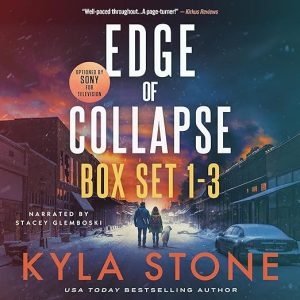
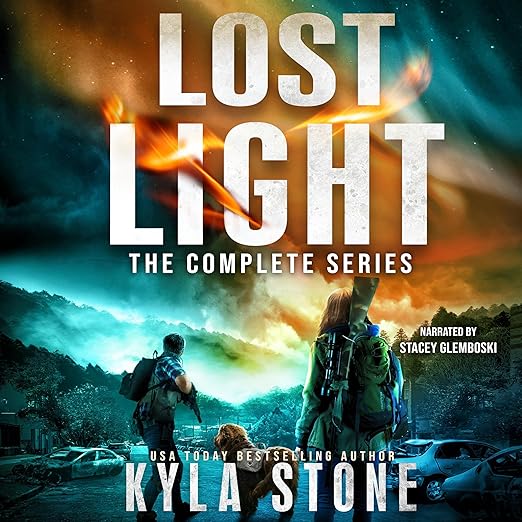
I started this one on a Friday evening, which turned out to be either a very good or very bad decision depending on how you feel about sleep. The Lost Light complete series box set from Kyla Stone, narrated by Stacey Glemboski and released through Paper Moon Press in late 2024, runs just under 56 hours. It covers the complete series in one listening block, and it has the specific quality of post-apocalyptic fiction that gets its hooks in during the first hour and doesn’t let go. By the time I was two episodes into Saturday morning I had a strong opinion about whether Jackson Cross was worth trusting.
The setup is familiar to readers of the EMP thriller subgenre: a catastrophic solar flare permanently takes out the power grid across half the planet. Transformers explode, communication networks fail, and the social infrastructure that keeps human behavior in check starts to crack. Stone’s series is set primarily in Michigan’s Upper Peninsula, a choice that matters, because the wilderness geography shapes the survival challenges differently than the urban post-collapse settings that dominate this genre. The U.P. is remote, cold, and forested in a way that makes both the threat and the possibility of survival feel tactile.
Three Characters Who Don’t Behave Like Heroes
What distinguishes the Lost Light series from the genre average is something one reviewer named directly: none of the main characters is without flaw. Stone runs three primary narrative threads. Rural sheriff Jackson Cross is trying to maintain order as the legal system collapses around him, but he is also the man who put Eli Pope in prison. Eli Pope, just released from prison at the moment the grid fails, is explicitly described as ruthless and hell-bent on vengeance against Cross. And Lena Easton, a search-and-rescue first responder, is making a harrowing 1,600-mile journey from Tampa to the Upper Peninsula with her Newfoundland rescue dog, Bear, a detail that I found both emotionally manipulative and completely effective.
The three threads create a structural tension that sustains the series well beyond what a single-protagonist survival story could. When one storyline reaches a temporary resolution, the others have momentum. And because Stone has made deliberate choices about character psychology, the decisions these people make under pressure feel earned rather than convenient. The reviewer who praised the “superb” character development and the ability to empathize with their decisions and dilemmas is responding to something real: these are not archetypes placed in crisis. They are people with histories that make their crises complicated.
Stacey Glemboski Across 55 Hours
Narrating a complete series box set of this length is a specific challenge. The narrator becomes the listener’s companion for roughly two-thirds of a week’s waking hours, and the consistency of that presence matters enormously. Stacey Glemboski holds up. She differentiates the three main characters clearly enough that point-of-view shifts land without confusion, and she matches the pacing of the action sequences with an urgency that the quieter, character-building scenes genuinely contrast against. Post-apocalyptic fiction has a rhythm, and Glemboski understands it: the calm is only calm because you know it won’t last.
At zero cost with an Audible membership, this free audiobook represents significant value for the genre. The comparable experience in print would require purchasing and reading multiple volumes. The audio format also has particular advantages for a series with the sensory qualities Stone deploys, the cold, the darkness, the sound of wilderness, which land more vividly when read aloud than on a page.
Where the Series Tests Your Patience
One reviewer noted that the series is “a little too heavy on the fighting and weaponry” for their preference, which is a valid signal for listeners who gravitate toward the human and social dimensions of post-collapse fiction rather than the tactical ones. Stone does not shy away from violence, and the action sequences are frequent enough that they constitute a significant portion of the listening. If the genre’s appeal for you lies in the logistical and interpersonal problems of rebuilding community rather than in combat, you will find the ratio here skews toward the latter.
There is also a death in the series, mentioned in one review, that provoked a strong enough reaction to be worth acknowledging: a reader expressed genuine frustration that Jackson died. Stone is willing to make choices that cost something, which is both what makes the series feel serious and what will occasionally feel like a gut punch. The series is compared to SILO and The Last of Us in the marketing, and both of those comparisons point accurately to the emotional register. This is not comfort fiction.
Who Should Commit to 55 Hours
Listen if you are an established reader of post-apocalyptic and EMP thriller fiction who has found the genre tends toward flat protagonists and wants a series that pushes back against that. Also listen if you are someone who prefers long-form immersive audio experiences and want a completed story without waiting for future installments. The complete series availability is a genuine advantage for listeners who resist starting a series before it finishes.
Skip if violence and weaponry are not things you want at the center of your post-collapse fiction, or if you are new to the EMP/solar-flare subgenre and want to start with something shorter before committing to a 56-hour block. Also skip if you are particularly averse to character deaths that the narrative presents as meaningful rather than heroic.
Frequently Asked Questions
Is the Lost Light series similar to the One Second After or SILO series in tone and content?
It sits between the two. It shares the EMP/grid-collapse premise with the One Second After tradition and the moral complexity and character focus that SILO readers expect. Stone’s comparisons to SILO and The Last of Us in the marketing are reasonably accurate in terms of emotional register.
How does Stacey Glemboski handle the three different POV characters across the full series?
Glemboski keeps the three primary voices, Jackson Cross, Eli Pope, and Lena Easton, distinct throughout. The differentiation is particularly important in the early books when the storylines are running in parallel before they begin to converge, and she manages the transitions without disorientation.
Is the complete series available in this box set, or does it cut off before the ending?
This is the complete series omnibus. All books in the Lost Light series are included in the 55-hour, 51-minute runtime, so listeners who commit to the box set get the full story arc including its conclusion.
The synopsis mentions Eli Pope as a villain and Jackson Cross as a hero. Does the series maintain that dynamic or does it complicate it?
Stone complicates it considerably. The reviews emphasize that none of the major characters is without flaw, and the antagonist-protagonist dynamic between Eli and Jackson develops in ways that challenge the initial framing. This moral complexity is one of the series’ most praised qualities.