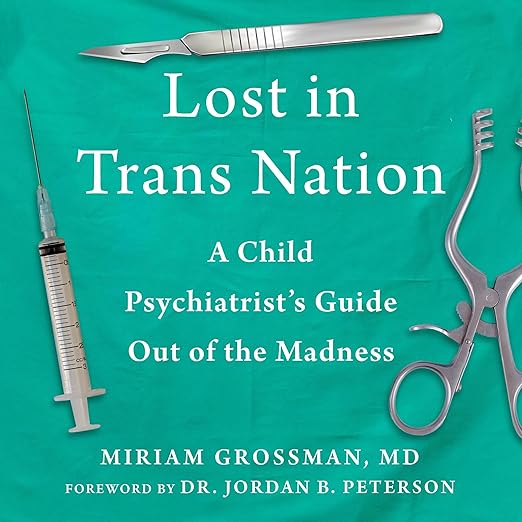
Quick Take
- Narration: Author-read by Dr. Grossman, whose clinical background shapes a measured, earnest delivery that serves her credibility aims while limiting emotional range.
- Themes: Medical authority and parental rights, gender medicine controversy, psychiatric critique of affirmation-only approaches
- Mood: Urgent and polemical, written from a position of deep professional concern
- Verdict: A book that will function as either a vital resource or an infuriating one depending almost entirely on where you stand on the underlying medical and ethical debates.
I want to approach this review carefully, because Lost in Trans Nation is a book that operates in contested territory, and reviewing it honestly requires acknowledging both what it does well and what it represents as a contribution to an active and painful cultural debate. Dr. Miriam Grossman is a child and adolescent psychiatrist whose clinical practice focuses on trans-identified youth and their families. Her book is not the work of an ideological outsider: she has clinical experience, she cites sources, and her concerns about specific medical interventions are shared by a number of European health authorities who have moved toward more cautious approaches, including Sweden, Finland, and the UK, all of which are referenced in the text.
That context matters, because this book is frequently received as either courageous professional dissent or as harmful anti-trans advocacy, and both framings miss something. The book is a polemical argument written by someone who has treated these patients and has concluded, on the basis of that clinical experience and her reading of the evidence, that the current standard of care in the United States is causing harm. Whether you find that argument persuasive depends on complex questions of medical evidence, professional ethics, and values that this review cannot resolve.
Our Take on Lost in Trans Nation
Grossman’s strongest chapters are the ones where she writes most specifically from clinical experience rather than from cultural critique. Her descriptions of how parents navigate school environments where their child is using a different name and pronouns without their knowledge, the practical and legal guidance she provides for navigating those situations, and her detailed account of what the research does and does not support regarding long-term outcomes from medical interventions are the portions of the book that will be most useful to the parents she’s addressing.
The book is weaker where it shifts from clinical argument into broader cultural diagnosis. Passages that move from medical evidence debates toward claims about ideological capture of institutions involve a level of certainty about causation that the evidence presented doesn’t always support. Several reviewers describe the book as comprehensively documented; others will find the rhetorical framework more absolute than the actual state of the research warrants. Both readings are available in the text.
Why Listen to Lost in Trans Nation
Dr. Grossman reads her own book, which is the right choice for this material. Her clinical authority and her genuine concern for the families she describes come through more clearly in her own voice than they would in a professional narrator’s interpretation. She reads with measured urgency rather than hysteria, which is important: the book’s effectiveness depends on being heard as a serious medical professional raising serious concerns rather than as an ideological partisan. At 15 hours and 8 minutes, this is a substantial commitment, and the author-read format makes the cumulative hours feel credible rather than performed.
For parents who are actively navigating a child’s gender identity questions and who have felt pressure, from schools, from medical professionals, or from their children’s peer groups, to move faster than feels right to them, this book will feel like permission to ask harder questions. That experience is described in several reviews with visible relief. Whatever one thinks of Grossman’s overall argument, the acknowledgment that parental concern is not the same as parental failure addresses something real.
What to Watch For in Lost in Trans Nation
This book is placed under the LGBTQ+ genre in the source data, which is accurate in terms of subject matter but may be unexpected for some listeners browsing that category. The book’s argument is critical of current gender-affirming care practices; it is not a supportive resource for transgender individuals or their allies. Listeners who are themselves trans, or who are looking for resources that affirm trans identity, will find this book actively antagonistic rather than informative.
The language Grossman uses throughout reflects her position: she consistently uses biological sex framing and is critical of gender identity as a category with the clinical weight she believes it is being accorded. This framing is central to her argument and is not separable from the rest of the book. Readers who fundamentally disagree with that framing will find the 15-hour runtime very long.
Who Should Listen to Lost in Trans Nation
This book is specifically written for parents who are concerned about their child’s gender journey and who feel they are not being heard by the medical and educational systems around them. Grossman is addressing that specific family experience, and the book’s practical guidance for those situations is its most clearly useful contribution. It is also relevant for healthcare professionals, educators, and policymakers who want to understand the clinical dissent perspective in this debate from an articulate advocate.
It is not suited for listeners seeking a balanced overview of the gender medicine debate, a resource for trans individuals or families who have made affirming decisions, or a book written with any significant engagement with the lived experiences of trans adults. The book’s frame positions gender dysphoria as primarily a psychiatric matter requiring different treatment approaches, and it stays within that frame consistently. Approach it knowing what it is rather than what it might have been.
Frequently Asked Questions
Is Dr. Grossman’s clinical position on gender medicine an isolated view, or are her concerns shared by other medical authorities?
Her concerns are shared by health authorities in several countries. Sweden, Finland, and the United Kingdom have all moved toward more cautious, evidence-review-based approaches to medical interventions for gender dysphoria in minors, and these policy shifts are cited in the book. The American medical mainstream currently holds different positions, which is part of what Grossman is arguing against. This is an active professional dispute, not a fringe versus mainstream situation.
How does Grossman handle the wellbeing and mental health of trans-identified youth in her arguments?
Grossman frames her concern as being for the mental health of these young people, arguing that the psychological distress driving gender dysphoria requires psychiatric treatment rather than medical transition. Her position is that affirming medical interventions do not resolve the underlying distress and may cause additional harm. Trans advocates would dispute both the framing and the evidence claims, and that dispute is central to the book’s contested reception.
At over 15 hours, is the full runtime necessary, or are there key sections for parents dealing with this situation specifically?
The practical guidance for parents is primarily concentrated in the later sections of the book, which cover what to say at home, how to navigate schools that may be supporting a different identity without parental knowledge, and how to find clinicians with a more cautious approach. The earlier sections establish Grossman’s clinical and philosophical framework. Listeners who want the practical material can navigate toward those chapters, but the earlier context shapes how the guidance is framed.
Is this book suitable for a teenager to read, or is it written primarily for parents?
Grossman addresses parents throughout and writes from the perspective of informing adults who are navigating this on behalf of their children. She explicitly advises against sharing some of her arguments with trans-identified youth directly, as she believes that confrontational framing can entrench identity claims rather than open dialogue. This is primarily a book for parents rather than a resource intended for young people themselves.