At a Glance
- Performance: Roger Wayne's measured, unsentimental delivery trusts the events to carry the tension, anchoring both survival accounts without theatrical emphasis.
- What it covers: Wilderness survival, cognitive failure under stress, human limits in remote environments
- Feel: Taut and methodically absorbing
- Our call: A rigorously researched dual survival narrative that renders the psychology of getting lost as carefully as the physical ordeal.
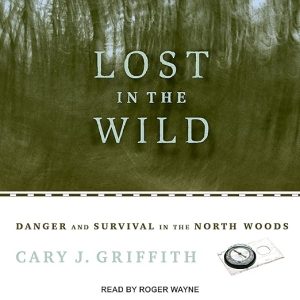
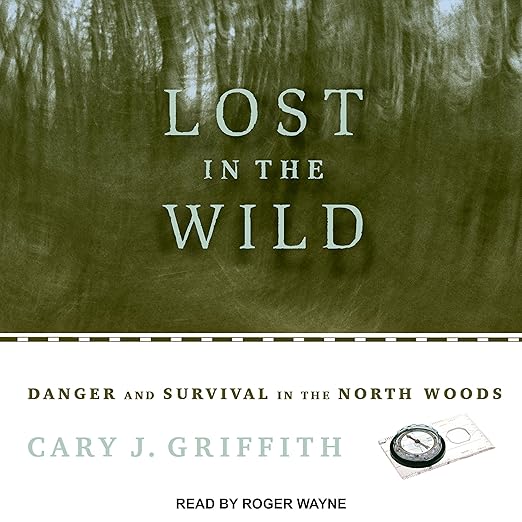
Quetico Provincial Park stretches across the Ontario wilderness as one of the most remote canoe country systems on the continent. It is the kind of place that demands competence because it will not supply what you forgot to bring. Dan Stephens was 22 and experienced when he stepped into a gap among cedar trees to sight the next portage on a summer afternoon in 1998. He did not return. More than four hours later, he woke up with a head injury and stumbled deeper into the forest, confused. This audiobook, Cary J. Griffith's Lost in the Wild narrated by Roger Wayne, opens with that disappearance and never fully lets you breathe again. Wayne's steady delivery provides the backbone for a book that could easily tip into melodrama but consistently refuses to.
The second story is Jason Rasmussen's. A third-year medical student who sought the solitude of the Boundary Waters Canoe Area Wilderness on a crisp fall day, he made a sequence of small, individually trivial mistakes that combined to leave him separated from his gear, wet, and lost as darkness fell. Griffith structures the audiobook so that both accounts unspool together, weaving between them in a way that amplifies the dread without artificially synchronizing the timelines.
Griffith's achievement in this book is the granularity of his research. Lost in the Wild is nonfiction, and its most affecting quality is the attention to the specific physical and psychological experience of being lost: the disorientation that follows a head injury, the rational calculation that gradually degrades into panic, the way hunger and cold compound every other difficulty. He is not working from imagination; he conducted extensive interviews with both Stephens and Rasmussen, and the result is a reconstruction that feels authoritative rather than speculative. A reviewer described the book as delivering the grit and mental fortitude of wilderness survival perfectly, and that assessment is accurate, though underselling how precisely Griffith renders the mechanics of deterioration. The book also functions as a careful examination of how the wilderness strips away the institutional competence that each man had relied on; both Stephens and Rasmussen were accomplished and experienced in their respective domains, and neither domain proved adequate preparation for what they encountered.
The dual narrative structure is the book's most deliberate craft choice. By interleaving the two stories, Griffith creates thematic resonance between very different personalities in different wilderness environments. Stephens is a young man with physical resilience and good instincts but a serious head injury undermining his ability to use them. Rasmussen is older, methodical, medically trained, and genuinely unprepared for how quickly cold water and wrong turns can remove his options. Neither story is simply the other told differently. Griffith is interested in the specific texture of each man's experience, not in producing a general theory of getting lost, and that specificity is what keeps the dual structure from feeling schematic.
Highlights
Roger Wayne's narration is well-calibrated for the material. The book's tension depends on restraint; a narrator who oversells the danger would undercut the authenticity that makes the accounts compelling. Wayne reads with a measured seriousness that trusts the events to do the work, and the result is that the moments of genuine crisis carry more weight than they would with a more theatrical approach. The 7-hour-and-47-minute runtime gives both narratives room to develop at the pace real experience demands rather than the compressed pace that dramatic retelling often imposes. For a book that depends on moment-by-moment psychological credibility, the audio format and Wayne's approach align particularly well; the linear experience of listening mirrors the forward movement of the men themselves, unable to pause or return to a previous moment once they are lost.
One reviewer called the book one of those where you really want to see what happens next and hard to put down despite being an easy read. That dual quality, gripping pace and accessible prose, is difficult to achieve in nonfiction adventure. Griffith manages it by trusting the structural momentum of two people in genuine danger and resisting the urge to editorialize or extract lesson-points from experiences that are already legible without authorial annotation. Wayne's consistent narration voice across both accounts helps listeners track the switching between stories without the transitions feeling disruptive.
What to Watch For in Lost in the Wild
The psychological dimension of both accounts is worth particular attention. Griffith traces the cognitive distortions that accompany physical stress and exposure with care, and the result is instructive in ways that go beyond the individual stories. The moments where Stephens and Rasmussen make choices that seem self-evidently wrong in retrospect are rendered with enough empathy that listeners understand how those decisions felt rational at the time. That understanding is more interesting, and more useful, than a simpler account of heroism or error.
The wilderness settings themselves are rendered with genuine specificity. Griffith knows these environments, and the Quetico and Boundary Waters receive the kind of descriptive attention that allows listeners unfamiliar with canoe country to understand precisely what each man was navigating. The geography is not mere backdrop; it is a character in both stories, with its own logic and demands, and understanding it is essential to following the decisions each man makes.
Is This One for You?
Readers and listeners drawn to survival nonfiction with strong narrative architecture will find this audiobook a compelling choice. Outdoor enthusiasts, particularly those familiar with canoe country, will bring additional context to the specific environments Griffith describes. Those who enjoy the psychological dimensions of crisis narratives, how people think under extreme stress, will find Griffith's treatment unusually precise. Roger Wayne's narration makes the audio format a natural fit for the dual-timeline structure, as his consistent voice anchors both accounts without blurring the distinction between them. The book works both as an adventure narrative and as a sustained examination of what the wilderness actually demands of the people who seek it out.