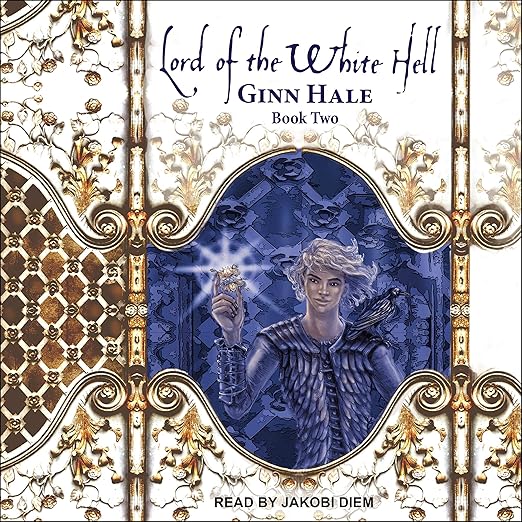
Quick Take
- Narration: Jakobi Diem brings measured warmth to both Kiram and Javier, navigating the class tension and growing tenderness with quiet authority, a strong fit for this layered fantasy romance.
- Themes: Forbidden love across cultural divides, power and superstition vs. intellect, the cost of dangerous alliances
- Mood: Rich and immersive, with a slow burn that earns every moment
- Verdict: A deeply satisfying conclusion to a two-part fantasy romance that rewards listeners who commit to both halves.
I came to Lord of the White Hell: Book Two on a rainy Thursday, already halfway through the week and craving something that would pull me fully out of my own orbit. Ginn Hale obliged. By the time I finished the last hour, it was past midnight and I had no regrets. This is the conclusion of what is functionally one novel split across two volumes, reviewers are right to note that the break between books reads less like a cliffhanger and more like a chapter break within a single, extended story. If you listened to Book One and felt incomplete, that incompleteness was entirely intentional.
The Cadeleonian Series sits in a space that fantasy romance rarely occupies with this much confidence: it cares as much about the political and supernatural architecture of its world as it does about the love story at its center. Kiram Kir-Zaki, still the only Haldiim student at the Sagrada Academy, carries the double burden of being intellectually exceptional in a world that undervalues his discipline of mechanistry, and emotionally exposed in a culture that sees his very existence as a provocation. His friendship, and gradually something more, with Javier Tornesal is built on a foundation of genuine mutual risk, and Hale never lets you forget that both characters have real skin in the game.
Our Take on the World Ginn Hale Builds
What distinguishes this duology from standard fantasy romance is the density of Hale’s world-building. The Cadeleonian social order, with its rigid hierarchies of faith, bloodline, and blade, feels genuinely inhabited rather than sketched in as backdrop. The White Hell itself, a supernatural force bound to Javier’s lineage, is handled with restraint that makes it more unsettling than any amount of dramatic revelation would. Hale understands that the most frightening things are those that cannot be fully explained, and she builds that ambiguity into the mechanics of Javier’s power in a way that shapes every scene he inhabits.
Kiram’s mechanist perspective offers a useful counterweight: he approaches the supernatural with a scientist’s instinct to categorize and understand, which gives their dynamic a productive friction. When his frameworks fail him, and they do, the emotional consequences feel earned rather than arbitrary.
Why Listen to the Duology as a Single Work
Several listeners have noted that Book Two functions as the second half of a novel, and I think that framing is both accurate and important for setting expectations. If you go in expecting a self-contained story, you will feel the seams. But if you treat the two volumes as a single listening commitment of roughly twenty-six hours combined, what you get is a genuinely complete narrative arc: Kiram’s coming-of-age, Javier’s reckoning with his own legacy, and a romance that develops at the pace of trust rather than convenience.
Jakobi Diem’s narration rewards this longer commitment. He does not rush the quieter scenes, and in a story where a great deal of meaning lives in what characters choose not to say aloud, that restraint matters. His differentiation between Kiram’s cautious idealism and Javier’s guarded intensity is subtle but consistent throughout.
What to Watch For in the Final Stretch
The last third of Book Two demands attention. Hale begins pulling threads that have been laid across both volumes, and the connections are not always announced, they require a listener who has been paying attention to the details of the Cadeleonian political structure and the lore surrounding the White Hell. This is not a novel that spells everything out, and that is both its greatest strength and the most likely source of frustration for listeners who prefer their resolutions explicit.
There is also a tonal shift in the climactic sequences that some listeners may find abrupt. The story moves from the intimate rhythms of academy life into something more openly consequential, and while Hale handles the transition competently, it requires an adjustment. The emotional payoff, when it arrives, is genuine, but it is not the crescendo of a genre romance; it is quieter and more complicated than that.
Who Should Listen to Lord of the White Hell
Listen to this if you want fantasy romance that takes its world-building as seriously as its love story, if you have patience for a slow-burning relationship built on genuine mutual understanding, and if you are willing to commit to both volumes as a single experience. The cultural specificity Hale brings to Kiram’s Haldiim identity and Javier’s Cadeleonian legacy gives the story a texture that repays attention.
Skip this if you need a romance that resolves cleanly within a single listening session, or if you find fantasy politics more frustrating than atmospheric. This is not a light listen, it is a rich one, and it asks something of you in return.
Frequently Asked Questions
Do I need to listen to Book One before Book Two of the Cadeleonian Series?
Yes, without reservation. Book Two is the direct continuation of Book One, and the two volumes are best understood as a single novel split in half. Starting with Book Two will leave you without essential character and world context.
Is Lord of the White Hell: Book Two primarily romance or fantasy?
It is genuinely both, with neither subordinated to the other. The love story between Kiram and Javier develops alongside a fully realized fantasy world with its own political tensions, supernatural lore, and cultural conflicts. Readers who prefer one element dominant may find the balance unexpected.
How does Jakobi Diem handle the dual-culture dynamic between Kiram and Javier?
Diem maintains consistent vocal distinctions between the two characters, Kiram’s cautious warmth versus Javier’s guarded intensity, without over-performing the contrast. The narration suits the story’s measured emotional register well.
Does the story end on another cliffhanger?
No. Book Two resolves the arcs begun in Book One. The duology reads as a complete story, and listeners who go in expecting a full resolution will find one, though it is more nuanced than a clean happy ending.