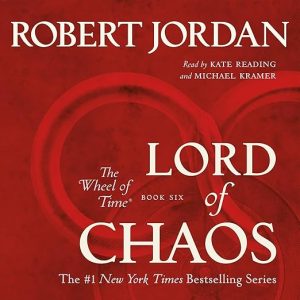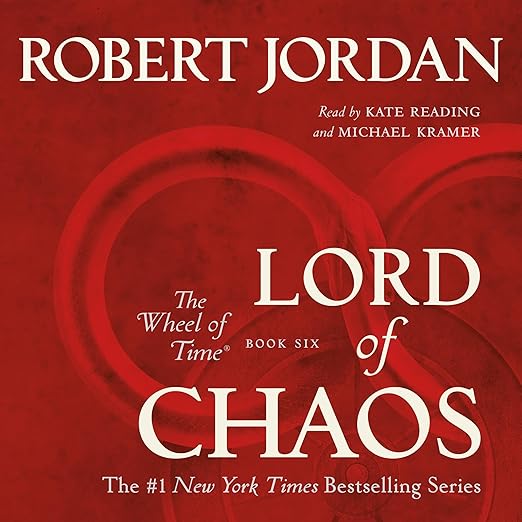
Lord of Chaos is, by the testimony of longtime Wheel of Time readers, the book where Robert Jordan's sixth entry either loses you entirely or locks you in for the remaining eight. The audiobook version, running just over 41 hours, is itself a commitment of the kind that separates casual listeners from the deeply invested. That context matters from the first sentence, because this audiobook does not exist in isolation. It is chapter six of a fourteen-volume work, and its power depends almost entirely on what came before. The Wheel of Time is now also an original series on Prime Video, which has drawn new readers to the books, but this entry is emphatically not a starting point.
Jordan's writing at its best has a quality that rewards the audio format specifically. The sheer density of his political maneuvering, the constant tactical thinking of characters like Rand al'Thor, Mat, Perrin, and the various Aes Sedai factions, plays differently when spoken aloud than when read on the page. The listener cannot skim. The detail lands at the pace Jordan intended, and the structural weight of that approach becomes something closer to an experience than a transaction between reader and text. Over 41 hours, that quality accumulates into something the shorter fantasy series cannot replicate.
This is the volume that earns its title. Chaos is not a backdrop here; it is the active mechanism of the plot. Rand is now ruling Tear, Andor, and Caemlyn, recruiting men who can channel into his Asha'man corps, and attempting to hold together alliances that none of his supposed allies actually want him to maintain. The two fractured halves of the Aes Sedai, the White Tower loyalists and the rebel contingent, are both maneuvering to control him. The Forsaken and the Dark One are operating in the margins. Everyone is lying to everyone else, and Jordan makes sure the reader knows it even when the characters do not. That dramatic irony, sustained across hundreds of pages of 41 hours, creates a specific quality of dread.
One reviewer captured the book accurately when they noted it can seem slow because it sits in the middle of a very long overall plot line. That is fair. The middle act of Lord of Chaos is genuinely demanding. Jordan is building pressure rather than releasing it, and listeners who came expecting the forward momentum of The Fires of Heaven may find themselves pushing through stretches where the political accumulation feels deliberate to the point of stubbornness. But this investment strategy pays a specific dividend. The ending of Lord of Chaos is among the most discussed sequences in epic fantasy, and the reviewer who described still reeling and earning an easy five stars just from that finale is pointing to what Jordan has been engineering for the preceding hundreds of pages. The restraint makes the release hit harder.
Highlights
Kate Reading's narration is the specific case for the audiobook format here. Over the course of six books she has become the authoritative voice of the series for a significant portion of its readership. Her command of the Aes Sedai characters is particularly strong in this volume, where the internal politics of the Tower and its rebel counterpart require precise tonal differentiation. Each faction has its own posture, its own register of manipulation and self-justification, and Reading keeps those registers distinct across a cast that runs into the dozens.
The Asha'man scenes, with Rand building this new force of male channelers under conditions that guarantee their eventual corruption, carry a specific dread that Reading locates without overdoing. Her restraint in those sequences is the right call. Jordan's horror in those passages is structural, not performed, and a narrator who played it too hard would undercut the precise way Jordan has embedded the danger into the institution Rand is building. Reading trusts the text, and after six books, that trust has been refined into something that feels like genuine interpretive intelligence.
Before You Commit to Lord of Chaos
At 41 hours and 32 minutes, this is not a book to start without a plan. Listeners who bounced off the middle books of the Wheel of Time due to pacing concerns will find Lord of Chaos follows similar structural patterns through its first two-thirds. The political maneuvering is meticulous, the subplot strands multiply before they converge, and the forward momentum can feel muted relative to the early books. The Shaido Aiel subplot, which carries over from earlier volumes, has divided readers who feel it functions more as a holding pattern than as active storytelling. That is a fair critique of certain passages.
Some threads in Lord of Chaos take longer to resolve than the payoff strictly justifies. Jordan's approach to subplot management across the series requires accepting that not every strand will resolve at the same pace, and Lord of Chaos is a book that asks more patience of that kind than most entries. Series newcomers should also be clear that this audiobook is not an entry point under any circumstances. The series must begin with The Eye of the World. Jumping in at book six means losing not just plot context but the entire emotional architecture Jordan has been constructing since Rand first left the Two Rivers, and the ending of Lord of Chaos has no meaning outside that accumulated investment.
Is This One for You?
This audiobook is for readers who have completed The Fires of Heaven and are committed to the full series. It is not an introduction to Jordan's world, and its rewards are not accessible to anyone who has not done the preceding work. Listeners who love the density of epic fantasy world-building, who find the political complexity of the Aes Sedai factions genuinely engaging rather than exhausting, and who can sustain attention across 41 hours will find this is the book where the Wheel of Time fully earns the scale it has been building toward. The ending alone justifies the patience the middle sections demand. Anyone starting fresh with Jordan should begin at The Eye of the World and trust that the investment compounds over time.
In Brief
- Narrator: Kate Reading handles the vast ensemble with authority, modulating the tension between the splintered Aes Sedai factions and Rand's increasingly strained perspective with clear commitment.
- Subjects: Political manipulation, the cost of power, fractured alliances
- Tone: Dense and mounting, with a climax that lands hard after a demanding buildup
- Bottom line: Lord of Chaos rewards readers who have stayed the course through five books, delivering a final act that earns the series' reputation in a single sequence.
Questions Listeners Ask
Can you listen to Lord of Chaos without having heard the previous five Wheel of Time audiobooks?
No. Lord of Chaos is the sixth book in a continuous narrative that builds on five previous volumes. The plot, character relationships, and emotional stakes all depend on what came before. The series should begin with The Eye of the World.
Is the audiobook's 41-hour runtime manageable, and how does it hold up over long listening sessions?
The runtime is demanding and best approached in extended sessions of two to three hours at a time. The novel's middle section is deliberately paced, which works better with immersive listening than with fragmented short sessions. Listeners who can commit regular blocks of time will find the experience accumulates properly toward the exceptional finale.