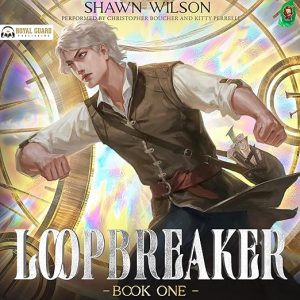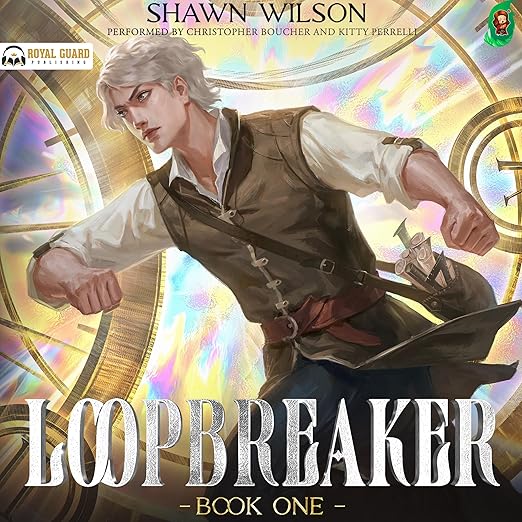
I picked up Loopbreaker on a Thursday evening specifically because I was in the mood for something with genuine momentum, not the contemplative kind of audiobook but the kind that moves. Twenty-two hours is a significant commitment, but I made it through the first six before I realized how late it had gotten. Shawn Wilson has built something here that understands what makes the time loop genre work at its best, which is not the repetition itself but what the protagonist does with each iteration, and how each cycle reveals something new about both the character and the world around him. That clarity of design is what separates Loopbreaker from weaker entries in the subgenre.
The premise is economical and effective. Francis Lancaster is the ninth son of a noble family, which in this world's hierarchy means he inherits nothing but military obligation. When he steps into his half-brother Michael's punishment on the blood-soaked fields of Reevotort, something shifts. From that moment, whenever Francis dies, he wakes a few days before his death, carrying every skill and stat he accumulated in the previous loop. The loop is a weapon, as the synopsis puts it, if he can stand the cost. That conditional clause is doing important work. The cost here is real, and Wilson doesn't let Francis off the hook for it.
Several reviewers have reached for Groundhog Day and Edge of Tomorrow as reference points, which makes sense given how few truly memorable works occupy the time loop space. One reader invoked Ken Grimwood's novel Replay and the LitRPG title The Stubborn Skill-Grinder in a Time Loop as closer analogues. What Wilson does that is specific to Loopbreaker is the military context. The loop is not occurring in a single location with a fixed cast of characters in a stable environment. It's playing out across an active war against a beastkin army, with opponents whose behavior can be tracked and mapped but not fully predicted or controlled. Each reset gives Francis more data, not more control, and that distinction keeps the loop from feeling like a pure optimization exercise without human stakes.
One of the more perceptive reviews raises the NPC problem, the question of what happens to the people in the world when Francis resets without them, and the effect that should have on any character with actual moral weight. Loopbreaker doesn't fully resolve this, but the fact that Wilson seems aware of it as a tension suggests later volumes may engage with it more directly. It's the kind of structural honesty that distinguishes genre fiction with ambition from genre fiction that's merely competent.
Why It Works in Audio
The narration is one of Loopbreaker's genuine strengths. Christopher Boucher voices Francis with the right combination of pragmatism and suppressed feeling. Francis is someone who must think strategically about his own deaths, who must calculate the value of each iteration against the accumulated trauma of dying repeatedly in service of keeping his brother alive. Boucher plays the calculation without losing the person underneath it. When Francis is exhausted or frightened, those states come through clearly even when the narration doesn't announce them explicitly.
That interiority is what separates good genre narration from merely competent genre narration. The tactical chapters, where Francis is mapping enemy patterns and planning his approach to the next iteration, land with genuine cognitive weight because Boucher delivers them as problem-solving rather than as recitation. The difference between a narrator who understands the logic of what a character is doing and one who is simply reading the words is audible in every chapter here, and it pays dividends across the full twenty-two hour runtime.
Weak Spots in Loopbreaker: Book 1
The loop mechanic necessarily involves returning to similar events with variation, which is structurally intentional. But one reviewer noted starting to skip sections and not missing much, which is a signal that the pacing isn't always efficiently managed. Wilson is better at accumulating progression than at using the loops to genuinely deepen character relationships in each iteration. The emotional stakes are clearest in the framing around Michael and the original moment of sacrifice. The middle loops sometimes feel like they're filling in tactical detail rather than advancing character understanding in a proportionate way.
At nearly twenty-two hours, this is a book that asks for patience as well as attention. The listeners who love it most are those who can immerse themselves in the iterative logic and find satisfaction in incremental progress. Those who need consistent narrative novelty across the entire runtime may find certain stretches in the middle slow going.
Who Will Get the Most From It
Listeners already invested in military fantasy, LitRPG progression mechanics, and time loop narratives will find this one of the more satisfying entries in the combined subgenre currently available in audio. The 4.7 rating from over three hundred listeners reflects a community that knows what it wants and found it here. Listeners unfamiliar with LitRPG conventions may find the stat and skill tracking system intrusive at first but will likely acclimate within the opening hours. Anyone who found Edge of Tomorrow satisfying as a concept will recognize the pleasure this book offers: watching someone get smarter and harder through iterations of loss, until the pattern finally breaks open into something worth surviving for. Wilson gives Francis enough humanity that the strategic accumulation never feels cold, which is the key achievement that makes this series worth following.
Key Details
- Performance: Christopher Boucher brings a grounded, pragmatic energy to Francis Lancaster that matches the character's strategic mindset perfectly.
- What it covers: time loops and iterative learning, brotherhood and sacrifice, the cost of survival
- Feel: Propulsive and tactically absorbing, with genuine emotional stakes beneath the progression mechanics
- Our call: A strong series opener in the military fantasy LitRPG space, with a loop mechanic that feels fresher than most and a protagonist worth following.