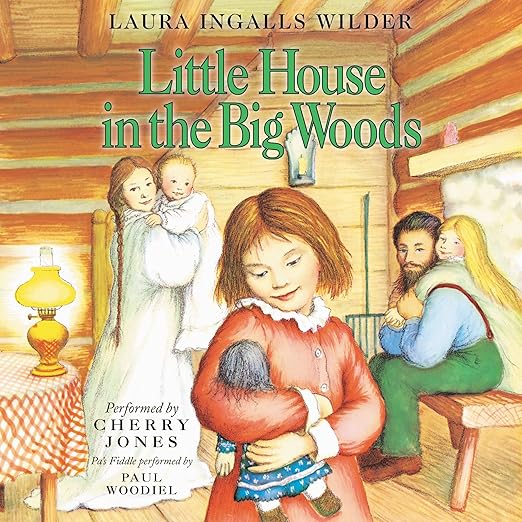
Laura Ingalls Wilder tells this whole book through the eyes of a four-year-old, and that single craft decision is why Little House in the Big Woods still works more than a century later. This audiobook runs a compact three hours and forty-one minutes, opening in 1871 in a log cabin at the edge of Wisconsin's Big Woods, where young Laura lives with her Pa, Ma, sisters Mary and Carrie, and their dog Jack.
No real plot exists here in the conventional sense, no villain, no central conflict to resolve, and that absence is entirely intentional. What replaces it is a year in the life of a family that grows and catches nearly everything it eats, and Wilder trusts that specificity completely to carry the listener's interest.
A Lifetime of Hindsight Behind a Child's Voice
The book moves through the seasons rather than through a storyline: preparing for winter, a Christmas built on homemade toys and treats, spring planting, bringing in the harvest, and the family's first trip into town together. Reviewer edwarde, reading it aloud with a third-grade daughter, notes she was genuinely in awe of the food preservation techniques described in such plain, exact detail, which is a good measure of how well Wilder's specificity lands with young listeners rather than boring them.
Pa's fiddle recurs throughout as a warm anchor, closing out hard days with music before the family settles in for the night, and that small domestic ritual does more emotional work than any invented dramatic subplot could. Reviewer The Procrastinator makes a sharp observation worth repeating: children may like these books, but adults often appreciate them considerably more, since so much of the writing's craft is visible only with an adult's hindsight.
Wilder herself is worth knowing a little about here. She was born in 1867 and did not begin writing the Little House books until her sixties, working closely with her daughter, journalist Rose Wilder Lane, as an editor and collaborator. That means the plainspoken, unsentimental voice on the page is the product of a lifetime of hindsight rather than a child's own contemporaneous account, even though it is written entirely from a child's perspective.
The first trip into town that closes out the book carries more weight than it might seem; for an 1871 pioneer family this deep in the Wisconsin woods, a visit to any town at all was a rare, carefully planned event rather than a routine errand, and Wilder's careful attention to what Laura notices there says as much about isolation as anything in the winter chapters.
Jones Never Layers Performance Onto Warmth
Cherry Jones brings restrained warmth to the reading, with no performance of emotion layered on top; the warmth is simply present in her pacing and tonal choices rather than pushed at the listener. That restraint is exactly right for an episodic, seasonal structure with no traditional plot arc, since a more theatrical reading would fight against Wilder's own quiet design instead of serving it.
Jones treats the food and domestic chapters with the same seriousness she brings to the book's handful of genuinely dangerous moments, which is accurate to how Wilder herself structured the material; nothing here is played for false stakes or sanitized for comfort. Across the wider Little House series, she differentiates Pa, Ma, and Laura through cadence and register rather than broad voice acting, which makes for a better match with adult co-listeners than a more theatrical reading would, while children still respond well to her clarity and steadiness.
It is worth knowing the later television adaptation, Little House on the Prairie, diverges substantially from these books in tone and plot, so listeners coming from the show should expect something quieter and far less melodramatic here. The books predate the series by decades and were never written with that kind of dramatic incident in mind.
Hunting and Butchering, Handled Matter-of-Factly
Three hours and forty-one minutes is genuinely short, appropriate for the format and age range but worth naming clearly so parents know what they are getting: a cozy short listen or two, not an epic. Some pioneer-era content, hunting, butchering, gun safety around Pa, appears matter-of-factly, handled with the same steady seriousness as everything else rather than sanitized or played up for shock.
This is scene-setting for a much longer series; readers wanting a strong dramatic arc or rising tension from book one specifically should recalibrate expectations, since Wilder is building a world and a family here before any larger series conflicts emerge in later volumes.
Why an Award Once Named for Wilder Was Renamed
The Christmas chapter in particular has become one of the most quoted passages in American children's literature, homemade rag dolls and a single stick of peppermint candy treated as genuine abundance, and it is worth listening for specifically as a measure of how well Jones's restrained delivery handles a moment that could easily tip into false sentimentality in less careful hands.
The American Library Association's Children's Literature Legacy Award was originally named the Laura Ingalls Wilder Award specifically because of this series' lasting influence on the field, later renamed to reflect evolving conversations about the books' portrayal of Native Americans and other groups, a worthwhile piece of context for any adult listener revisiting the series today with a more critical eye than they had as a child.
Consider pairing a listen with the real Wisconsin history it draws from; Wilder's own family left the Big Woods for Kansas not long after this book's events, and knowing that migration was coming adds a layer of quiet foreshadowing adults will catch that children generally will not.
Skip It If Fast Plot Is What You Need
This is for parents and grandparents wanting a classic, unhurried family read-aloud, for homeschool or elementary classroom use, exactly the context reviewer edwarde describes, and for adult listeners revisiting a childhood favorite, who by The Procrastinator's account often get more out of it the second time around.
Skip it if your child needs a fast-moving plot to stay engaged, or if you are looking for the most dramatically eventful entry point into the series; that tension builds gradually across the full nine books rather than arriving in book one.
Is Little House in the Big Woods a good audiobook read-aloud for very young children, or is it better for older kids?
It works well across a wide range, roughly preschool through elementary, since the prose is simple and vivid, though older elementary kids, like reviewer edwarde's third grader, get the most out of its specific pioneer detail.
Does Cherry Jones narrate the rest of the Little House series audiobooks?
Jones is an established narrator across the wider Little House on the Prairie series, bringing the same restrained, plainspoken warmth to the family's later adventures.
Is the Little House in the Big Woods audiobook a good starting point for the whole nine-book series?
Yes, it is the first book chronologically and the natural entry point, establishing the family and setting before the series' broader pioneer journey unfolds in later volumes.