Quick Take
- Narration: Rachel Leblang carries Lillith’s dual consciousness well, the adult intellect trapped in a child’s circumstances requires careful calibration, and Leblang gets it right.
- Themes: Hierarchy and resistance, isekai identity, self-taught power
- Mood: Dark in places, cathartic in others, intellectually engaged throughout
- Verdict: A portal fantasy that takes its anarchist premise seriously rather than using it as window dressing, fresh and occasionally dark, with a heroine whose intelligence drives the plot rather than decorating it.
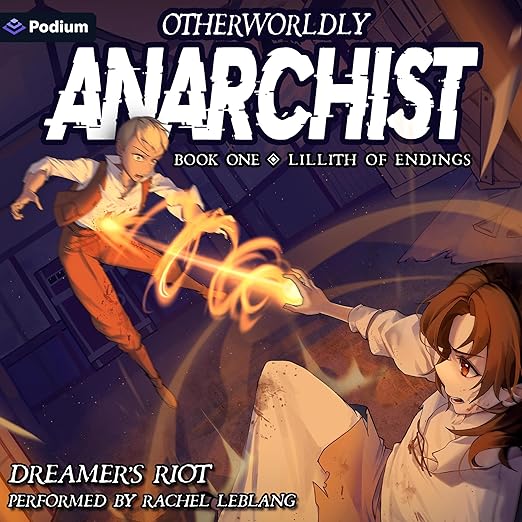
I picked up Lillith of Endings on a Tuesday night fully expecting to be asleep within twenty minutes. The isekai genre, portal fantasy, reincarnation, being transported to another world, has a well-worn problem: the protagonist is usually either helplessly naive or conveniently overpowered within the first chapter, and neither tends to make for interesting fiction. Dreamer’s Riot, the author collective behind this Podium Audio release, sidesteps both failures in a way that kept me listening past midnight. Annie, the graduate student from twenty-first century America, wakes up as a seven-year-old child named Lillith in a fantasy realm with a monarchy, a state religion, and deeply entrenched hierarchies. Her challenge is not learning to fight or discovering hidden magic powers. It is concealing the fact that she is an adult intelligence in a child’s body, with all the adult politics and convictions that implies.
The mantra introduced in the opening, no gods, no kings, no masters, is not decorative. One reviewer described the book as diving into the overwhelming battle against hierarchy itself, against kings, against capital, against the church. That is accurate. Lillith’s plan is not merely to survive or to find her way home; it is to change the realm she has landed in for the better, using the one advantage she has: knowing things a child in this world could not possibly know. The self-taught magic development that follows is genuinely original, and the magic system has internal logic that rewards sustained attention over the nearly eleven-hour runtime.
Our Take on Lillith of Endings
The book was originally serialized on Royal Road, where it accumulated close to a million views before the audiobook release. That background is visible in the structure, chapters have a satisfying individual completeness that suits serial consumption, and in the directness of the protagonist’s voice. Lillith says what she means. She stands up for herself with an explicitness that reviewers found refreshing, and her emotional reactions, while shaped by adult experience, are not used to make her precociously powerful. She makes mistakes. She misjudges people. She has to think carefully about who to trust and what she can actually accomplish given her age and circumstances. This is patient isekai storytelling, which is rarer than it should be.
Why Listen to Lillith of Endings
Rachel Leblang’s performance is the technical challenge here, and she meets it. Voicing a character who is simultaneously a seven-year-old and an adult graduate student requires moment-to-moment calibration, when Lillith is performing her expected childishness and when she is privately thinking in adult registers. Leblang makes that distinction audible without overplaying it, which requires considerable control. At nearly eleven hours, the book asks for real time investment, and Leblang’s performance sustains the listen throughout. The darker passages, and there are some, though reviewers note the balance between difficult content and payoff is maintained carefully, are handled with appropriate weight rather than glossed over.
What to Watch For in Lillith of Endings
This is book one of the Otherworldly Anarchist series, and it establishes rather than resolves. Listeners expecting a complete narrative arc may find the ending less conclusive than they wanted. The book is also genuinely dark in places, one reviewer flagged concern that the difficult content might overwhelm the story before noting that the balance is ultimately maintained. The political and philosophical framework (anarchism, skepticism of religious and state authority) is central rather than background; listeners uncomfortable with those themes in their fantasy fiction should know they are structural rather than decorative. A few reviewers found the prose slightly rough in places, consistent with its serialized web-fiction origin.
Who Should Listen to Lillith of Endings
Portal fantasy listeners who are tired of either helpless heroines or instantly overpowered protagonists will find something genuinely different here. The LGBTQ genre categorization signals inclusive content that is woven naturally into the world rather than foregrounded as plot. If you want intelligent, patient fantasy with political and philosophical weight and a heroine who earns her advantages rather than receiving them, this is for you. Skip it if you want definitive resolution in book one, if dark content is difficult for you, or if isekai premises leave you cold regardless of execution.
Frequently Asked Questions
Is this book really anarchist in its philosophy, or is that just marketing language?
It is genuinely engaged with anarchist ideas. The premise, an adult with anarchist convictions waking into a world with a monarchy, a powerful church, and hereditary hierarchy, is used to actually explore those convictions in practice rather than as flavor text. Multiple reviewers described the political framework as central to the story’s appeal.
How does Rachel Leblang handle narrating a character who is mentally an adult but physically and situationally a child?
With real care. Leblang distinguishes between Lillith’s public performance of childhood and her internal adult reasoning through subtle vocal calibration rather than exaggerated contrast. It is the performance equivalent of a difficult narrative technique, and most listeners found it convincing.
Is the magic system explained clearly in audio, or does it require reference to outside material?
The magic system is introduced and developed through Lillith’s self-teaching process, which means it unfolds gradually rather than being front-loaded with exposition. The logic is internal and consistent. No supplementary material is needed; the audiobook explains the system through the character’s experience of learning it.
Does book one end at a satisfying stopping point, or does it end on a significant cliffhanger?
It is somewhere between the two. The immediate story arc resolves, but the larger series threads are clearly just beginning. Reviewers who engaged with the material generally wanted book two immediately, which is a reasonable indicator of where the emotional landing point sits.