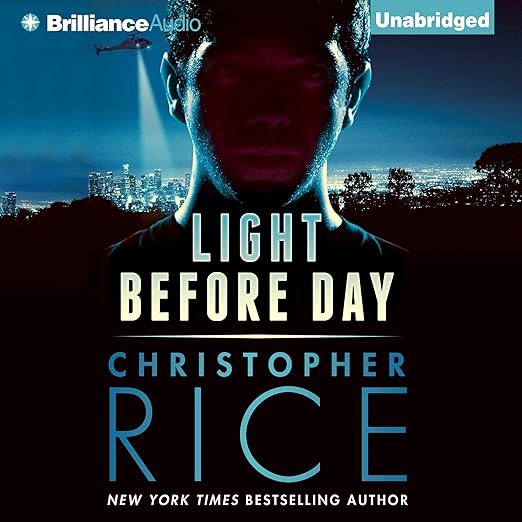
Quick Take
- Narration: Cole Ferguson captures the noir atmosphere and Adam Murphy’s morally compromised voice with real confidence; pacing stays tight throughout twelve hours
- Themes: LA’s queer underworld, the price of journalism, conspiracy layered over genuine human loss
- Mood: Dark, propulsive, and cinematically overlit
- Verdict: A well-constructed LA noir with a gay protagonist at its center, ambitious in its plotting and genuinely suspenseful, though it occasionally strains under the weight of its own machinery.
I listened to the first three hours of Light Before Day on a long flight back from a conference, headphones in, deliberately ignoring the inflight entertainment. By the time we landed I had already decided I was going to finish it before I unpacked. Christopher Rice has a gift for constructing Los Angeles as a place where glamour and squalor are not opposites but the same texture seen from different angles, and that gift is fully operational here.
Adam Murphy is a journalist covering ab-heavy lifestyle content for a gay magazine when a troubled porn star drops a tip in his lap about a deceased marine’s secret visit to a pimp who specializes in underage boys. Murphy pursues it despite explicit death threats, and what he uncovers involves runaway money, A-list parties, three missing young men, and his ex-lover Corey, who has secrets of his own. The synopsis is accurate in calling this a modern noir, and Rice’s handling of the genre’s basic architecture, the morally compromised investigator, the city that knows more than it tells, the danger that arrives from unexpected directions, is genuinely skilled.
The Architecture of the LA Underground
What distinguishes Light Before Day from more generically plotted thrillers is the specificity of its world. Rice spent real effort building the seedy underbelly of LA that Murphy has to navigate, and the result is a Los Angeles that feels researched rather than imagined. The parties, the sugar-daddy circuits, the ways that money and sex organize power in certain social ecosystems: these details accumulate into something that one reviewer described as a peek into the most sordid side of gay Hollywood. Whether shocking or familiar depending on your own context, the world Rice builds is consistent and internally coherent throughout the full twelve hours.
The three missing young men at the heart of the conspiracy are present mainly as absences, which is a classic noir technique and one that Rice handles with discipline. Murphy’s emotional investment in finding them is rooted partly in his specific history with Corey, his ex-lover, which gives the investigation personal stakes beyond professional ambition. That doubling of the personal and the professional is where Rice does his best character work, grounding a conspiracy of extraordinary scale in something small and human at its core.
Cole Ferguson Holds the Darkness Together
Noir lives or dies on the quality of its narrative voice, and Cole Ferguson delivers a performance that earns the material. He does not camp up Adam Murphy or soften the protagonist’s sharper edges. The first-person delivery feels inhabited rather than performed, and Ferguson sustains the tension of the plot’s escalation through twelve hours without letting the pace sag. The action sequences, which multiply as Murphy gets deeper into the conspiracy, are handled with a clarity that is harder to achieve in audio than it might seem.
One reviewer compared the book’s feel to a major motion picture script, and Ferguson’s narration leans into that cinematic quality without overdoing it. This is an audiobook that genuinely rewards the full audio experience rather than wishing it were a page-turner you could read faster. The long runtime never feels padded; each hour adds something to the conspiracy’s architecture that the final revelation requires.
Where the Plot Tests Its Own Credibility
The criticism that the novel is excessively overwritten, overloaded with adjectives and metaphors, and that its plot strains credulity is fair for certain sections. Rice has a tendency to reach for metaphor at moments when restraint would serve better, and the sheer quantity of plotlines in the final act requires the listener to hold more threads simultaneously than is always comfortable. One reviewer characterized the overall plot as highly incredulous. I would put that slightly differently: the coincidences required to bring the conspiracy into focus are the kind that noir has always licensed, but Rice pushes harder on that license than, say, Dennis Lehane would.
The darkness here is substantial and sustained. Pedophilia, organized sexual exploitation, addiction, and murder are not treated as backdrop but as the actual subject matter of the conspiracy Murphy is unraveling. Listeners who want noir without genuine menace should look elsewhere. For those who want the genre taken seriously and its moral weight felt, this delivers on those terms throughout.
Readers This Noir Will Serve and Readers It May Not
Light Before Day is for listeners who appreciate literary crime fiction with a gay protagonist at its center, written with genuine craft rather than tokenism. If you respond to early Andrew Holleran or Dennis Cooper’s darker fictional worlds, the register here is familiar though more genre-driven. The darkness is persistent and the violence is real, so skip this if either of those elements taxes your listening comfort. Fans of Rice’s earlier work will find this more cinematic and less lyrical than A Density of Souls, which is an accurate description of the shift between his two approaches. This is a thriller first and a literary novel second, and it succeeds clearly on those terms.
Frequently Asked Questions
Is Light Before Day part of a series, or does it stand alone?
It stands alone. Christopher Rice has other novels, including A Density of Souls and The Snow Garden, but Light Before Day is independent of them. No prior knowledge of Rice’s work is needed to follow the plot or invest in the characters.
How explicit is the sexual content given the subject matter, which involves a gay lifestyle world and sexual exploitation?
The sexual content is present but not gratuitously detailed. The exploitation elements are handled more as plot mechanics and moral stakes than as explicit description. The overall tone is noir rather than erotica, and the darkness serves the story’s purposes throughout.
The original publication was in 2004. Does Light Before Day feel dated as a portrayal of gay LA?
The specific cultural landscape Rice describes, the particular ecosystem of wealth, parties, and vulnerability he maps, does have a pre-smartphone quality. Some readers may find the period texture adds to the noir atmosphere rather than dating it. The human dynamics underneath are not time-specific.
Does Cole Ferguson’s narration work for a first-person male protagonist in a queer-specific environment?
Yes. Ferguson keeps Murphy grounded and avoids the camp register that could easily derail a first-person queer protagonist in this kind of material. His performance is controlled and credible throughout the twelve-hour runtime.