Quick Take
- Narration: Adriana Pascua’s performance captures the memoir’s breezy, episodic quality without overplaying the adventure material, lending Catalina’s voice a naturalistic swagger.
- Themes: Gender transgression, colonial adventure, identity and survival
- Mood: Picaresque and propulsive, with the dry humor of someone who has gotten away with everything
- Verdict: One of the most genuinely strange primary sources in the Western canon, and hearing Pascua read Catalina’s matter-of-fact account of her own extraordinary life is consistently surprising.
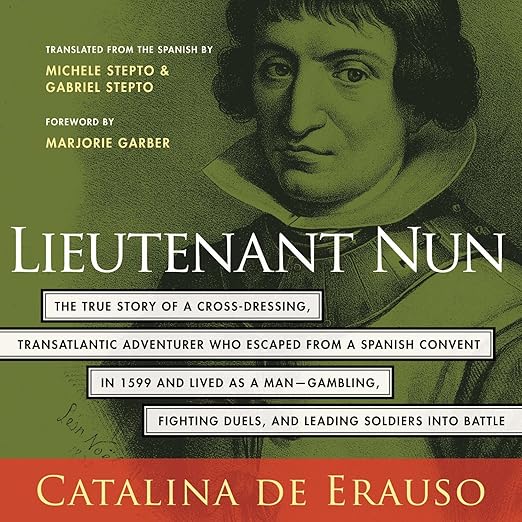
I had assigned a seminar paper on early modern gender and autobiography years before I ever actually listened to this text. Knowing about Catalina de Erauso is a staple of early modern studies curricula; hearing her words read aloud is a different experience entirely. Adriana Pascua’s narration of this Beacon Press edition turned a text I thought I knew into something that felt newly strange, which is high praise for any translation of a four-hundred-year-old document.
Catalina de Erauso escaped from a Basque convent in 1599 at the age of fifteen, cut her hair, fashioned her undergarments into boy’s clothing, and spent the next several decades living as a man. She joined the Spanish army, traveled to Peru and Chile, gambled, dueled, killed her own brother by accident in a fight she did not know was with him, and somehow survived to tell the story. She told it in a memoir that was later translated, debated as to its authenticity, and eventually recognized as one of the earliest known autobiographies by a woman. That the bishops, kings, and popes of her time believed her story when she was finally discovered says something about how thoroughly she had inhabited a masculine identity.
Our Take on Lieutenant Nun
The text reads, somewhat marvelously, like a picaresque novel that happens to be true. Or mostly true: reviewer Lewis Murphy noted that there are probably a tall tale or two in the mix, which is exactly what you would expect from an autobiography constructed by someone who had been performing a persona successfully for thirty-plus years. Catalina’s narrative voice is blunt, episodic, and entirely free of the kind of introspective apparatus that modern memoir expects. She records what happened with minimal psychological commentary. A duel ends. She moves on. She kills someone. She moves on. That flatness is not a literary limitation but a quality of the genre and the period, and Pascua’s reading honors it by not importing emotional texture that Catalina herself did not supply.
What makes this account more complex than straightforward adventure narrative is the question it continually raises without ever answering directly: what did it mean to Catalina to live as a man? The text does not provide a vocabulary for this. Catalina’s age had no framework for gender identity as a concept separate from biological sex, and she does not theorize herself. She simply describes what she did. That restraint creates an enormous amount of interpretive space, which is why scholars across several disciplines have returned to this text for decades.
Why Listen to Lieutenant Nun
Pascua’s narration gives Catalina a voice that is confident without being self-congratulatory, which suits a person who describes committing considerable violence with no particular ceremony. The memoir is short, and at three hours and twenty-five minutes the audiobook is a single sitting experience for most listeners. That brevity is appropriate to the source text, which does not linger. Reviewer Silver Button observed that Catalina offers an eye-level view of Spanish society in Peru in the 1600s, and Pascua’s reading delivers that quality: not an academic overview but the texture of daily life in a colonial military context as experienced by someone living inside it with a secret.
The Beacon Press edition was released in February 2024, suggesting this is among the more recent translations, which means the English has been updated for contemporary readability without losing the period flavor. That balance is essential for a text like this.
What to Watch For in Lieutenant Nun
Listeners looking for psychological depth or character development in the contemporary memoir sense will be disappointed. Catalina does not reflect on her own inner life in ways that modern readers have been trained to expect. The memoir is also structured episodically rather than as a sustained narrative arc, which means it reads more as a sequence of encounters than as a story with traditional rising and falling action. This is not a flaw but a feature: it is how people wrote about their lives in the early seventeenth century, and appreciating that structural difference is part of what makes the text interesting rather than frustrating.
Who Should Listen to Lieutenant Nun
This is essential for anyone interested in early modern history, the history of gender and sexuality before contemporary frameworks, colonial Latin American history, or genuinely unusual primary sources. Listeners who enjoy picaresque fiction by writers like Defoe or Fielding will find the structural parallels interesting. Readers who want a fast, surprising audiobook experience that covers entirely unfamiliar territory will find this one of the most efficient three-and-a-half-hour listens in the catalog. Those who need their biographical subjects to be entirely admirable should probably look elsewhere: Catalina killed people and rarely seemed troubled by it.
Frequently Asked Questions
Is this audiobook a translation, and which translation is used in this edition?
Yes, this is a translation from the original Spanish. The 2024 Beacon Press Audio edition suggests a recent translation aimed at contemporary accessibility. The Beacon Press edition has a strong reputation for scholarly quality.
Does Adriana Pascua’s narration adjust for the episodic, flatly-described nature of Catalina’s original prose?
Pascua reads the material with a naturalistic quality that honors the text’s own lack of emotional amplification. She does not over-dramatize the violence or the adventure material, which is the correct interpretive choice for a seventeenth-century voice.
How does Catalina de Erauso’s memoir speak to contemporary questions about gender identity?
The text has become significant in gender history precisely because it predates any conceptual vocabulary for what Catalina was doing. She describes her life in purely behavioral terms, creating a record that contemporary readers can engage with across multiple interpretive frameworks without the text imposing any single one.
Is the memoir’s authenticity well established, or is there ongoing scholarly debate?
There is consensus that the core of the memoir is substantially authentic and likely written by Catalina herself, though the question of literary embellishment is real. Historians treat it as a credible primary source with appropriate caution about its more spectacular claims.