Quick Take
- Narration: Joel Leslie is exceptional, he differentiates a wide cast of perspectives without losing coherence, and his restraint with the slow-burn emotional tension is precisely calibrated.
- Themes: Discrimination against superpowered minorities, moral ambiguity in law enforcement, slow-burn queer romance
- Mood: Tense and layered, with dark urban atmosphere and flashes of dry wit
- Verdict: A confident debut for the Sugar and Vice series that builds its world and its central relationship with real patience, Joel Leslie’s narration turns an already strong thriller into a standout listen.
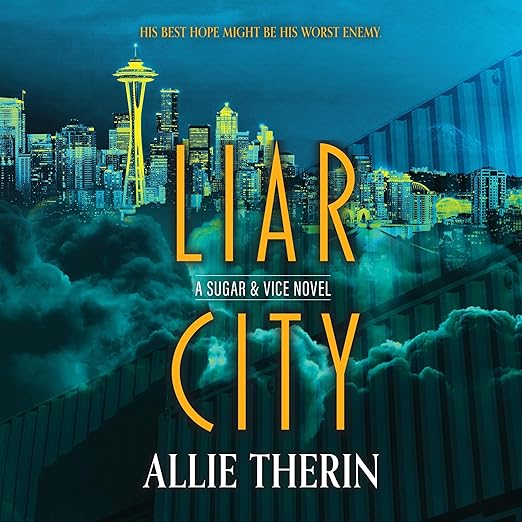
I was halfway through a rainy Seattle afternoon, which felt appropriate, when I started Liar City. I’d seen it mentioned in several LGBTQ+ fantasy reading groups as an example of speculative fiction that takes its political metaphor seriously without letting it overwhelm the plot. That’s a delicate balance to strike in a genre where allegory can easily become sermon. Allie Therin mostly strikes it.
The setup is precise: Seattle is a city on edge because empaths, people who sense and sometimes influence the emotions of others, exist in the world, and the country is days away from passing the harshest anti-empathy legislation in American history. Into this climate comes a triple murder at a waterfront marina, with the victims including the bill’s primary author. Reece, a part-time police consultant and empath, gets pulled in by an anonymous tip. The agent who arrives to take over the investigation, a figure known only as The Dead Man, is rumored to deal exclusively in empathy-related cases. He takes over the case and, for reasons that slowly become clearer, keeps Reece close.
Our Take on Liar City
What Therin does well is refuse to simplify her metaphor. Empaths in this world are not uniformly sympathetic, Reece himself begins to question whether his instinct toward pacifism is principle or conditioning, and the novel is genuinely interested in that question. The political situation is drawn with enough specificity that it reads as a functioning imagined world rather than a thin allegory. The multiple third-person perspectives that worried some readers before they picked the book up, including Reece, the Dead Man, Reece’s detective sister, and several others, actually serve the thriller structure well, giving us information that no single character could possess while maintaining genuine suspense about who did what.
The romance is not the book’s primary engine, and readers who approach it as such will be frustrated. This is, without question, a slow burn. The sparks between Reece and the Dead Man are present and real, but Therin is building a relationship across what is clearly designed as a series, and she takes the time that requires. By the end of Book One, you understand exactly why these two people are drawn to each other, and you believe the connection, which is more than most series romances manage by their third installment.
Why Listen to Liar City
Joel Leslie. I want to be direct about this: Leslie’s narration is a significant part of why this audiobook works as well as it does. He earned the AudioFile Earphones Award for this production, and listening, you understand why. The Dead Man is a character defined by the absence of readable emotion, no expression, no vocal tells, no body language that Reece can interpret. Leslie manages to make that blankness feel charged rather than flat, which is technically difficult and dramatically essential. He also handles the multiple POV structure with clarity, differentiating voices without resorting to exaggerated character voices that would undercut the thriller’s tone.
The Seattle setting is one of the book’s quieter pleasures. Therin knows the city well enough that the geography feels grounded, specific neighborhoods, the waterfront, the texture of Pacific Northwest weather, and this specificity enriches the world-building without slowing the plot.
What to Watch For in Liar City
The pacing in the middle third is genuinely dense. Multiple POV threads, an expanding investigation, and careful relationship development all happening simultaneously means that listeners who want a more streamlined thriller experience may find themselves occasionally impatient. This is a book that rewards attention and repays it, but it asks for patience upfront.
The first book also functions very deliberately as setup. The mystery resolves, the immediate threat is addressed, but several significant questions about the Dead Man’s history and the broader political situation are left open for Book Two. One reviewer described this as not quite a cliffhanger but impossible to put down, which is accurate, the book ends in a way that feels complete but clearly has more to say.
Who Should Listen to Liar City
Listen if you enjoy speculative mysteries with political teeth, slow-burn queer romance built on genuine character depth, or Joel Leslie’s narration specifically. This is also a strong choice for readers who responded to books like Ginn Hale’s Wicked Gentlemen or KJ Charles’s work, the tone and commitment to both the romance and the world-building sit in similar territory.
Skip it if you need romance to be the central focus from the opening chapters, or if multiple concurrent POVs frustrate you in thriller plots. Also consider waiting until Book Two is in your queue, the series rewards binge reading, and having to wait between volumes is genuinely difficult.
Frequently Asked Questions
Does Liar City work as a standalone, or does it end on a cliffhanger that requires Book Two?
The central mystery is resolved by the end of Book One, and the immediate threat is addressed. However, significant character questions, particularly around the Dead Man’s past and the broader political situation with empathy legislation, are deliberately left open. Most readers describe it as complete but with clear threads pulling toward the sequel rather than a frustrating cliffhanger.
How much romance is in Book One, and how explicit is it?
The romance between Reece and the Dead Man is built primarily through charged tension, reluctant proximity, and growing trust. Therin describes this as slow burn, and reviewers confirm: Book One lays the groundwork without payoff. The content is not explicitly sexual in Book One, keeping the focus on emotional and psychological connection.
Is Joel Leslie’s narration suitable for the female characters’ perspectives?
Yes. Leslie handles the multiple third-person POVs, including Reece’s detective sister and other female characters, with consistent competence. He differentiates characters through subtle vocal shifts rather than exaggerated performance, which keeps the thriller tone intact across all perspectives.
Does the empathy-as-minority metaphor hold up throughout the novel, or does it become heavy-handed?
Reviewers consistently note that Therin manages the metaphor with care, grounding it in the novel’s specific political situation rather than letting it become a direct one-to-one allegory. The moral complexity, including the question of whether empaths like Reece are fully innocent, prevents the simplification that can make political fantasy feel didactic.