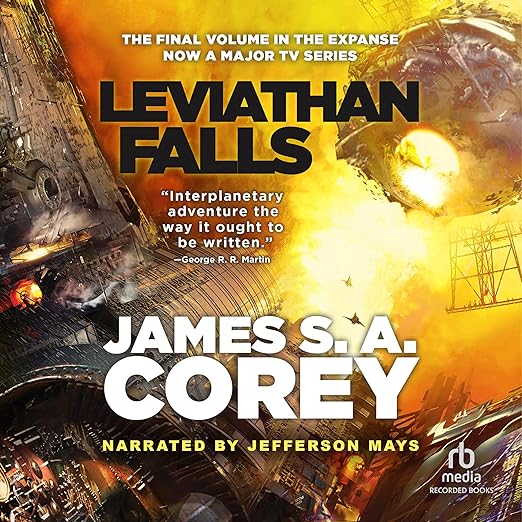
I finished Leviathan Falls on a Saturday that I had set aside for exactly that purpose. I had already reread most of the series over the previous months, and by the time I reached the ninth and final book, I was listening to the audiobook while doing very little else, which is how I know the ending worked. You do not stop what you are doing for something that has not earned your full attention.
Series finales have an almost impossible job. They carry the accumulated weight of reader investment across years, sometimes decades, and they have to resolve conflicts whose complexity has compounded with each installment. James S. A. Corey, the pen name for Daniel Abraham and Ty Franck, have been threading the protomolecule mythology through nine novels without losing the human scale of the story. The miracle of Leviathan Falls is that they managed the ending without sacrificing either.
A Closer Look at Leviathan Falls
The plot picks up with the Laconian Empire in ruins. Winston Duarte's experiment at galactic authoritarianism has collapsed, but the ancient enemy that destroyed the gate builders has woken again, and the war against our universe has resumed. The three narrative threads, Elvi Okoye's scientific mission in the Adro system, Colonel Aliana Tanaka's hunt for Duarte's missing daughter, and Holden and the Rocinante crew piecing together humanity's future, operate at very different scales. The genius is how Corey holds all three in tension without flattening any of them into mere plot mechanics.
The Rocinante storyline is the emotional spine of the book, as it has been across the series. Holden and his crew have been the reader's anchors through everything that followed from the initial discovery of the protomolecule, and this book finds them doing what they have always done: trying to make the right call when every choice costs something. One reviewer described it as a bid to unite humanity and save it from the unknown, and of course from ourselves. That self-referential quality, humanity as its own obstacle, has always been The Expanse's most persistent theme, and the finale does not abandon it.
What Makes Leviathan Falls Worth Hearing
Jefferson Mays has narrated The Expanse since the beginning, and his performance across nine books constitutes one of the great sustained collaborations between narrator and author in contemporary science fiction audio. He manages a cast of characters with distinct enough vocal signatures that returning listeners can identify who is speaking without the text telling them, and that fluency matters enormously in a finale where emotional payoffs depend on recognizing voices you have listened to for hundreds of hours.
The book is 19 hours and 40 minutes, and there are stretches, particularly in the Tanaka chapters, where the pace broadens to accommodate necessary context for the climax. One reviewer noted that those sections felt a little stretched. Mays navigates that unevenness well. He does not rush passages that need patience, and he does not let the denser expository sections drag. It is the kind of professional calibration that only comes from understanding the full shape of a story.
Things to Know Before Starting Leviathan Falls
The book's central gamble is that the price of victory, which I will not detail, is genuinely uncomfortable. This is not a triumphalist ending. Reviewers who loved it describe it as satisfying and fitting but also acknowledge the bittersweetness that comes with any conclusion that takes its own logic seriously. The series has never promised that humanity deserves to survive; it has only suggested that the effort to survive is meaningful regardless. The ending is consistent with that philosophy.
There is also a subplot involving Kit and Rohi Kamal that some listeners found peripheral. It serves a purpose in humanizing the generational stakes of the finale, showing what the Rocinante crew's sacrifices mean in terms of ordinary human futures, but listeners impatient with character quietude may find those sections slow relative to the main action.
Who James S. A. Corey Is Writing For
This is emphatically not a standalone entry point. Listeners who have not read the preceding eight novels will not only be lost on plot but will be deprived of the emotional context that makes the ending land. This is a book for people who have invested in Holden, Naomi, Amos, Clarissa, Elvi, and the broader world of the series, and who are ready to say goodbye properly.
For Expanse readers who have not yet listened to the audiobooks in Mays's narration, the final book is an argument for going back and restarting the whole series in audio form. And for anyone who gave up on the series midway, this finale is not going to retroactively fix whatever frustrated you earlier. But for those who made it this far: this is the ending the series deserved.
Questions Listeners Ask
Do I need to have read all eight previous Expanse novels before listening to Leviathan Falls?
Yes, without exception. This finale is built on nine books worth of character relationships, plot threads, and world-building. Starting here would be like watching the final episode of a decade-long television series without having seen any previous episodes.
How does Jefferson Mays handle the multiple POV characters, and are they distinguishable by voice?
Mays has narrated the series since Leviathan Wakes, and after nine books he has distinct vocal signatures for the major characters. Long-time listeners will recognize POV characters by voice alone. His handling of Elvi Okoye and Aliana Tanaka, two female leads, is particularly strong in this installment.
Does the TV series ending line up with the novel's ending?
No, they diverge significantly. One reviewer specifically noted that the authors kept the novels independent of the show, including not killing Alex in the books as happened on television. The novel ending is its own complete conclusion and should be judged separately from the Amazon Prime adaptation.
Is the finale emotionally satisfying, or does it feel like it sacrifices resolution for ambiguity?
It is more emotionally honest than emotionally comfortable. The conclusion resolves the major story arcs and provides genuine closure for the Rocinante crew, but the price of that resolution is real and deliberately uncomfortable. Readers expecting a tidy triumphalist ending will be surprised, but most find the bittersweet quality appropriate for what the series has always been about.