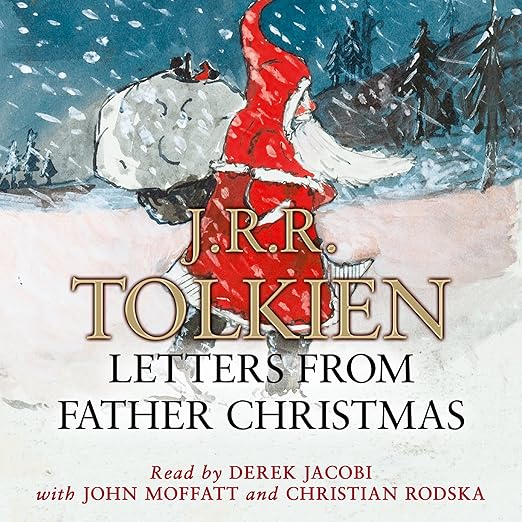
I came to Letters from Father Christmas for the first time not at Christmas but in early autumn, when I was working through a collection of literary ephemera and family letters. Coming to it outside its intended season turned out to be revealing: stripped of the pressure of holiday listening, I could appreciate the object on its own terms, which is something between a collection of illustrated stories and a record of extraordinary parental devotion.
The premise is both simple and, when you think about it for a moment, astonishing. Every year, from 1920 to 1943, J.R.R. Tolkien wrote a letter to his children from Father Christmas, hand-illustrated, delivered as though from the North Pole. The letters built a mythology: the accident-prone Polar Bear who climbed the North Pole and fell through the roof of Father Christmas's house, the Goblins who had to be repelled, the reindeer who escaped and scattered presents across the snow. Over twenty-three years, these letters accumulated into something, not a novel, not a children's book in the conventional sense, but a private mythology created by one of the twentieth century's greatest mythmakers for an audience of four.
The Verdict, Briefly
The audiobook, at just over two hours, presents the letters with specially arranged holiday music, and Derek Jacobi reads Father Christmas with exactly the right register: warmth without sentimentality, authority without pomposity, and a quality of benevolent confusion when the Polar Bear has once again caused chaos. It is the kind of casting decision that seems obvious in retrospect but required someone to recognize that this material needed a voice capable of both gravitas and delight without letting either overwhelm the other.
What makes the letters remarkable as literature, rather than merely charming as a family artifact, is the level of imaginative investment Tolkien brought to them across two decades. This is the creator of Middle-earth devoting the same quality of creative attention to a private mythology for his children that he was simultaneously pouring into The Lord of the Rings. The letters develop characters, maintain continuity, acknowledge the events of the actual world, including, poignantly, World War Two in the later letters, and never break the frame of their fiction even as the children who received them were growing out of belief in Father Christmas.
Why Listen to Letters from Father Christmas
For Tolkien readers, this is essential context for understanding how his imagination worked. The same impulse that drove him to construct languages, genealogies, and cosmologies for Middle-earth is visible here in miniature: the Polar Bear has a history, the Goblins have a society, the North Pole has physical geography. The scale is domestic rather than epic, but the creative habit is identical. One reviewer described it as an intimate view into a great writer, and that is exactly what it is.
For listeners who want a seasonal audiobook that does something more interesting than read a standard Christmas story, this is a genuinely unusual option. The holiday music accompaniment is warmly done and does not overwhelm the letters themselves. At two hours, it fits easily into a December evening or a long drive.
Points to Consider
The print edition of the letters is heavily illustrated with Tolkien's own drawings, and those illustrations are not present in the audio format. Listeners who find the letters charming will likely want to seek out the physical book to see the hand-drawn images that accompanied the text when the letters were delivered. The audio version is complete as a listening experience, but it represents only part of the original object.
Some of the letters are quite short, and the collection has the natural unevenness of material created over two decades for an audience whose ages and interests shifted. The middle letters, when the Tolkien children were in the prime ages for this kind of gift, are generally the richest. The later letters, as the eldest children aged out of the fiction and World War Two arrived in the background, carry a different and more complex emotional weight.
Who Should Pick Up Letters from Father Christmas
Tolkien readers of any age who want a personal and unusual angle on his creative imagination. Families with children in the seven-to-twelve range looking for a distinctive holiday listen that parents will not find tedious. Anyone who has ever given a piece of sustained imaginative work as a gift and understands the particular love that involves. This is for the season, but it is also for any time you need reminding of what careful, loving attention to someone else's delight can produce.
Common Questions
Is Letters from Father Christmas appropriate for young children as well as adults?
Yes, the letters were written for Tolkien's own children, ranging from young to early-teen ages, and they are accessible to children in that range. Adults who know who Tolkien was and what he was creating simultaneously will find additional layers of meaning.
Does the audiobook include Tolkien's original illustrations?
No. The illustrations are a significant part of the print edition but are not reproducible in audio format. Listeners who fall in love with the letters through this version will want to seek out the illustrated book.
Why is Derek Jacobi considered good casting for this particular narration?
Jacobi brings both warmth and theatrical authority to Father Christmas without letting either quality dominate. The role requires someone capable of dignified bumbling, Father Christmas is loving but the Polar Bear keeps creating disasters, and Jacobi navigates that tonal balance precisely.
Do the letters need to be listened to in order, or can they be approached individually?
The letters are best experienced in order because Tolkien maintained continuity across decades, the Polar Bear's mishaps accumulate, characters develop, and the later letters reference earlier ones. The overall arc adds to the experience of any individual letter.