Quick Take
- Narration: Greg Boudreaux handles the cozy paranormal register with ease, keeping the comedy light and the mystery sequences tense without overcorrecting in either direction.
- Themes: Cozy mystery, MM romance, paranormal small-town community, found family
- Mood: Warm and slightly off-kilter, like a Southern Gothic with the lights left on
- Verdict: A satisfying series closer that rewards readers who came for the relationship as much as the mystery, though newcomers should start with the first book.
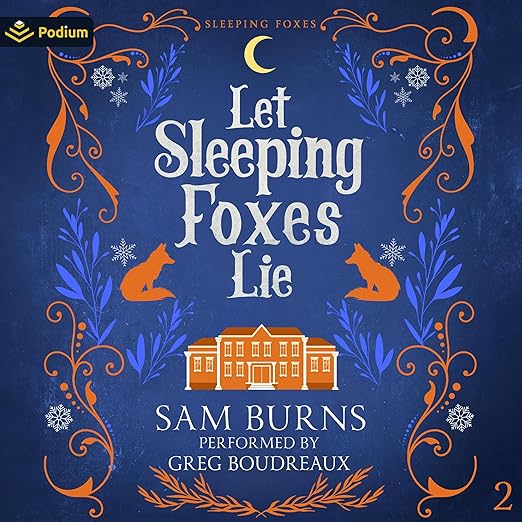
I started Let Sleeping Foxes Lie on a Tuesday evening when I had about two hours to spare and no intention of staying up until one in the morning. The book had other plans. By the time a body turned up in the Irish manor’s cellar and I was ninety minutes in, the rest of the evening was committed. Sam Burns writes cozy mysteries that operate on a light surface and hide a genuinely competent puzzle underneath, and this final entry in the Sleeping Foxes duology demonstrates that the approach is more skilled than the comfort aesthetic suggests.
The setup is compact and well-constructed. Max, a screenwriter who has built a quiet life with his boyfriend Gentry in the small town of Welling, has managed to attract a Hollywood director interested in his new screenplay. The director’s solution is a two-week creative retreat at Max’s home, complete with the cast, the director herself, and the inevitable eruption of ego, romantic entanglements, and family complications that follow when creative professionals are confined together. Max wants to use the timing to propose to Gentry. What he gets instead is a murder, a locked-room problem in a town with a sheriff who is more liability than help, and a deadline that does not care about his personal life.
Frankie, the Ghost Gangster, and the Southern Gothic Problem
The paranormal element in these books is consistently the most distinctive feature, and Burns handles it with a specific lightness that prevents the ghost from overwhelming the cozy register. Frankie, Max’s spectral companion with an Irish Crown Jewels obsession and a sideline in providing unreliable moral support, is the kind of character that should not work and consistently does. His presence introduces a slight unreality that stops the cozy from tipping into the purely domestic and keeps the stakes feeling genuinely strange. One reviewer described the ghost as just the right amount of off-kilter as to make the whole thing authentically Southern, which captures something true about how Burns uses the paranormal as a tonal device rather than a plot engine.
The baby surprise subplot, which involves Gentry’s family rather than Max’s, gives the book emotional weight that the mystery plot alone would not supply. Burns is careful not to let the domestic complications crowd out the murder investigation, but the way she weaves them together so that the emotional resolution and the plot resolution land in the same space is the mark of a writer who understands that cozy mysteries live or die on whether readers care about the characters when nobody is being murdered. The relationship between Max and Gentry is warm and specific enough by this point in the series to carry that weight.
Greg Boudreaux and the Cozy Paranormal Register
Boudreaux is the right choice for this material. He brings a lightness to Max’s narration that prevents the comedy from feeling labored and a seriousness to the mystery sequences that prevents them from feeling perfunctory. The cast of Hollywood types, several of whom are drawn with affectionate sharpness, are differentiated clearly enough to track without the kind of elaborate vocal performance that would push the material toward farce. His delivery of Frankie’s dialogue is particularly well-calibrated: the ghost’s combination of 1920s gangster affect and contemporary sensitivity lands consistently without becoming a running joke that wears out its welcome.
At five hours and forty-eight minutes, the book is genuinely short for a mystery, and Burns uses the space efficiently. There is no significant padding, the red herrings are placed cleanly, and the reveal does not require the kind of retrospective revision that some cozy mysteries demand. One reviewer mentioned not figuring out the solution before the characters did, which is the appropriate benchmark for this genre and not always as easy to achieve as it sounds.
Series Entry Point and Prerequisites
This is the second and final book in the Sleeping Foxes series, and it is written with the assumption that you know Max, Gentry, Frankie, and the town of Welling from the previous entry. Burns provides enough context that newcomers can follow the plot, but the emotional payoff of the relationship arc, including the proposal that Max has been planning throughout, requires the accumulated investment of the first book. The synopsis describes it as largely standing alone, and that is technically true, but largely is doing significant work in that sentence. Start with Where Foxes Say Goodnight if you can.
For readers who are already in the series, this delivers everything a series finale should: the central relationship resolves in a way that feels earned rather than convenient, the mystery is satisfying on its own terms, and the secondary characters, including Lucy the skunk and the various family members who complicate the retreat, get their own moments. Burns does not overstay the welcome. The ending is clean and appropriately warm without spilling into sentiment, which is the correct choice for a series that has always been more interested in character than atmosphere.
A Free Audiobook That Closes the Door Properly
This free audiobook is available on Audible and represents a well-produced, correctly paced finish to a series that knew what it wanted to be. Boudreaux’s narration is consistently pleasant, the mystery is fair-play, and the romance delivers its satisfactions. Readers who came for the ghost gangster and stayed for the relationship will not be disappointed. That is as much as a series closer needs to accomplish, and Burns manages it without making it look like work.
Frequently Asked Questions
Can I listen to Let Sleeping Foxes Lie without reading the first book?
You can follow the plot, but the emotional payoff of Max and Gentry’s relationship arc, including the central proposal storyline, requires the accumulated context of Where Foxes Say Goodnight. The author describes it as largely standalone, but starting with book one is strongly recommended.
How prominent is the paranormal element compared to the mystery and romance?
The ghost Frankie is a consistent presence but functions more as a tonal device than a plot driver. The mystery is solvable through conventional detective work, and the romance is the emotional center. The paranormal element gives the book its distinctive flavor without overwhelming either.
Is Greg Boudreaux the same narrator from the first book?
Yes. Boudreaux has narrated the series consistently, which means the character voices and register are established and seamless by this second entry.
Does the book handle the cozy mystery’s requirement for a fair-play puzzle?
Yes. Reviewers specifically noted not solving the mystery before the characters did, which suggests Burns plants clues cleanly. The reveal does not require significant retrospective revision of earlier scenes.