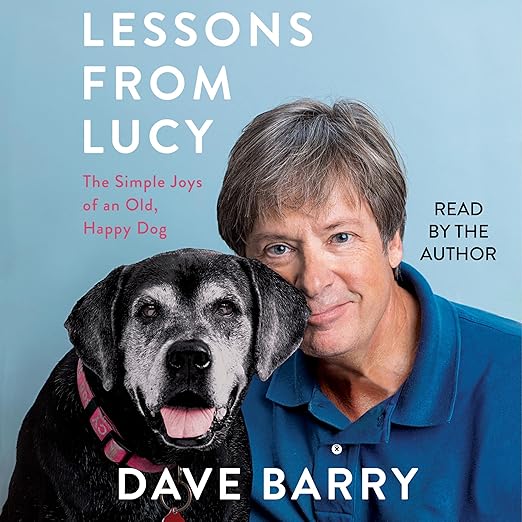
Dave Barry turning seventy is the premise and the engine of this audiobook, and he announces early that he is not handling it gracefully. Lessons From Lucy, narrated by Barry himself, is a four-hour self-examination in which Barry uses his rescue dog's untroubled joy as a mirror for his own creeping cynicism. His dog Lucy has more friends, fewer worries, and considerably more fun than he does. Lucy does not worry about things she cannot control. Lucy finds every walk, every meal, and every belly rub to be a full and sufficient occasion. Barry (Pulitzer Prize winner, New York Times bestselling humorist, and by his own candid admission someone who likes people a lot less than Lucy does) decides to investigate how a twelve-year-old dog manages to live better than he does. It is one of the more honest accounts of aging I have encountered in the humor category.
Self-narration is not automatically an asset. Plenty of authors who are excellent on the page are uncomfortable or pacing-impaired in front of a microphone. Barry is the exception that validates the rule. He has spent decades writing jokes that depend on precise comic rhythm, and that rhythm is fully present in this recording. The lines that work on the page work even better in his delivery, and the moments where the book shifts from comedy to something more genuinely reflective land with more weight because you are hearing the authentic register shift rather than a narrator's interpretation of one. The seven lessons Barry extracts from Lucy are structured comedy and real life observation at the same time.
Where This One Lands
The book is structured around seven lessons Barry extracts from observing Lucy's daily life, and the framing is genuinely ingenious rather than a marketing convenience. Each lesson functions as both a comedic premise and a real piece of life observation. Make friends becomes the occasion for Barry to document his deeply awkward attempts to initiate conversations with strangers, a skill he has not exercised since the social fluidity of youth. The Lawn Rangers episode (a group of men who march in parades pushing lawnmowers and twirling brooms, alcohol involved) is exactly as absurd and charming as it sounds. The Rock Bottom Remainders section, covering his time with the all-author band, is equally good, and longtime Barry readers who know those stories will find they improve in his direct telling.
What one reviewer called the book being touching and sentimental, but still with a laugh on every page, is accurate. There are genuinely more laughs than touches of sentiment, but the touches land hard precisely because Barry earns them. The chapter about his daughter, which at least one reader flagged as unexpected, is handled with a directness that suits the honesty of the book's project. The subject is aging and connection and what you want the last third of your life to look like, and Barry does not exempt his family relationships from that examination.
What Makes Lessons From Lucy Worth Hearing
At four hours, this is the audiobook equivalent of a very good essay collection. You can complete it in an afternoon or spread it across a week, and either approach works. The lessons are short enough to be individually satisfying but connected enough by theme and tone that the full listen has cumulative effect. For anyone who has been a Dave Barry reader over the years (his newspaper columns, Dave Barry Turns 50, his collaborations with Ridley Pearson) this audiobook fits naturally into that catalog. For readers who are new to him, it is a better entry point than some of his more joke-dense earlier work, because the mix of humor and genuine reflection gives the material a wider range.
The dog-as-life-instructor premise is not especially original as a concept, but what Barry does with it is original. Lucy does not represent sentimental dog wisdom; she represents the specific version of unselfconscious joy that Barry diagnoses himself as having lost somewhere in the process of becoming a moderately cynical seventy-year-old. That diagnosis is honest, and the audiobook's best moments are the ones where Barry is genuinely surprised by what he discovers when he follows Lucy's example. His reconnection with the Lawn Rangers is funnier and warmer in execution than the setup suggests, and his meditations on what it means to make new friends at seventy are some of the most unexpectedly true things in the book.
What Gives Us Pause
The sections on worry are where Lessons From Lucy earns its quiet depth. Barry is not a natural optimist, and his account of trying to stop catastrophizing (a habit Lucy does not share because she understands at some fundamental level that worrying about scallops is both futile and beneath her) is more psychologically honest than the comic framing suggests. Watch also for the moments where Barry's affection for Lucy supersedes the joke-making machinery entirely. They are brief, but they clarify what the book is actually about: not lessons from a dog, but a human using a dog's uncomplicated joy as a mirror for what he has let atrophy in himself.
The Right Listener for Lessons From Lucy
Anyone approaching or navigating their 60s and 70s who is tired of self-help that takes itself too seriously will find this audiobook a relief and a pleasure. Dog owners across any age range will connect with the premise immediately, and the Barry-reading-his-own-work experience is genuinely different from reading him on the page. New Dave Barry readers will find this a warm entry point. Anyone who has read his earlier books and wants to know what that voice sounds like when it is being earnest rather than purely comic will find the answer here, and it sounds good.
Frequently Asked Questions
Do you need to be a long-time Dave Barry reader to enjoy this audiobook?
No. Lessons From Lucy works well as an entry point to Barry's work. The balance of humor and genuine reflection is more accessible than his earlier joke-dense columns, and the subject of aging with intention gives new readers an immediate emotional stake even without prior familiarity.
Is this audiobook more comedy or more self-help?
Firmly comedy in mode, self-help in intent. The seven lessons Barry extracts from Lucy are real (make friends, be present, stop worrying) but the delivery is always humorous first. Think of it as wisdom by way of jokes about lawn mower parades.