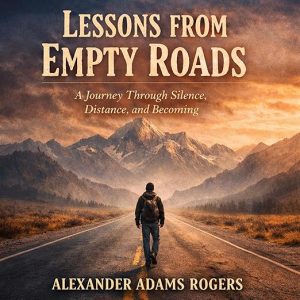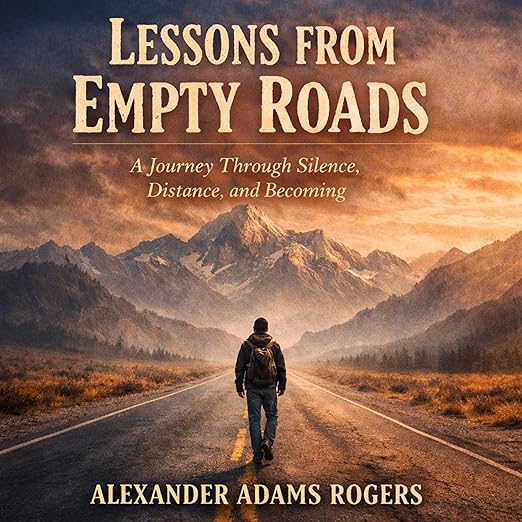
Publisher copy usually sells a book. This one is the book, or a piece of it: the description on this audiobook listing is not a summary but a stretch of first-person prose, apparently taken from the opening, running most of a page without ever saying where the road goes. Alexander Adams Rogers self-published it in February 2026. Jimmy Trisler reads it. The whole thing lasts an hour.
Is Lessons from Empty Roads Worth Your Time?
Read a few of those sentences aloud and something is plainly wrong with them. Acts are sometimes the only things that can speak. It was brave of me to stay. I didn't want to stay, though, so I left. I brought light. The weight of unmet standards and the different sides of yourself that you see can be the problem at times. They read less like a writer being deliberately oblique than like sentences rewritten by something that did not know what they meant.
Geography is absent entirely, which on a travel book is not a small omission. No country appears in this copy, no state, no city, no highway, no border, no season. The city being left is only the city. The map is described as one the writer was not sure of. Somebody browsing the travel shelf is looking for a place to go, and this page hands them a mood instead, then files itself under Travel Writing and Commentary.
Ambition is visible under the damage, and it deserves saying. The passage is reaching for something specific: the difference between escape and departure, the loneliness that has nothing to do with being alone, the weight of standards nobody else set. That last idea is genuinely good. Loneliness is often linked to empty roads, the copy says, but it's not always about not having anyone else around. A real thought sits in there and the sentence around it did not survive.
Lessons is the word the title puts first, and the description never arrives at one. What the page delivers is the hour before a journey rather than anything learned during it: the city, the exhaustion, the decision, the engine turning over. Whether the lessons come later in the hour is unknowable from here, and a title promising instruction while the copy delivers atmosphere points a buyer at the wrong book.
The Best Parts of Lessons from Empty Roads
An hour is exactly the right length for this. Interior travel writing thins out fast, and a book circling one feeling for eight hours is unbearable, while a book circling it for sixty minutes is a recognized form: the long essay, read aloud, finished at a sitting. Anyone who listens to essay podcasts already knows the shape and will know inside ten minutes whether this is a voice they want in their ear.
Subject matter is more interesting than the copy manages to convey. Leaving without a destination, telling few people your plans because naming a place makes other people expect things of you, an engine that sounds very old the first time it turns over: those are the observations of somebody who did this rather than somebody who wrote a travel book. The description puts it plainly enough. The road was not an escape and not a quest but a place, chosen for being one.
Trisler's credit raises the question memoir always raises in this format. The writing is confession, first person, about a private decision, and the voice delivering it belongs to somebody else. Author-read memoir carries the weight of testimony; a hired reader turns identical words into a performance, which is not worse, only different in kind. Across an hour of interior monologue that choice matters more than it would in a longer book with events in it.
Before You Commit to Lessons from Empty Roads
Understand what you are buying, because the page will not spell it out. No chapters are listed, no route, no cast, no destination, no indication of whether this is one continuous essay or a set of short pieces. The description occupies itself wholly with the departure and never reaches the journey. On a one-hour file that may be the entire structure, and no buyer can check before purchase.
Self-publication is what the record shows, author and imprint being one and the same name, so the prose you sampled in that description went out without anyone standing between the writer and the file. On a book whose problems are sentence-level, that is the relevant fact. An editor is precisely what would have caught I brought light, a phrase that means nothing at all as it stands.
Expectations set by the shelf will not be met. Travel Writing and Commentary implies places observed and cultures reported; what the copy promises is a person driving away from a city and thinking about it. Both are legitimate books. Only one of them matches the category tag, and the mismatch disappoints listeners on both sides, the ones who wanted a destination and the ones who would have found this had it been filed as memoir.
Should You Listen to Lessons from Empty Roads?
At an hour, this asks very little, and the listener it fits is the one who reads travel writing for the leaving rather than the arriving. If the passage in the description sounds like your kind of interior weather, and its awkwardness registers as strangeness rather than error, sixty minutes is a small bet. Sample it first regardless, and note that here the description doubles as the sample, which is the single advantage of a listing built this way.
Bypass it if you want a place. Bypass it too if damaged prose stops you cold, since the specimen on the page is representative of something and nothing there says what. Anyone shopping for narrative travel, the kind with roads, meals, borders and people in it, will find nothing here to hold on to, and the sixty minutes will feel a good deal longer than sixty minutes.
Good to Know
Is an hour-long audiobook enough for a travel memoir?
It is enough for one long essay, which appears to be the shape here. Nothing on the page lists chapters or stages, so plan on a single continuous piece rather than a journey with sections. Sixty minutes fits an evening comfortably and will not sustain a week of listening.
Where does the journey in this audiobook actually go?
The listing never says. No country, city, road or region is named anywhere in the description, which concentrates entirely on the decision to leave and the state of mind behind it. If a specific destination is what you want from travel writing, this record gives you nothing to check.