Quick Take
- Narration: David Lee Huynh brings a light touch to Hongjun’s sheltered naivety and Li Jinglong’s hapless authority, capturing the comedic chemistry that reviewers consistently highlight.
- Themes: identity concealment and trust, found family among misfits, slow-burn romance in a fantastical bureaucratic setting
- Mood: Light, humorous, and warmly atmospheric with genuine stakes underneath
- Verdict: A genuinely enjoyable opening volume that earns its considerable fandom, strongest for listeners who want their fantasy comedy to carry emotional weight alongside the hijinks.
I came to Legend of Exorcism knowing nothing about the danmei genre and finished it wanting more, which is probably the best thing I can say about a volume one. Fei Tian Ye Xiang has built a world where the Tang Dynasty government runs a Department of Demonic Exorcism staffed entirely by people who probably should not be there, and that premise alone carries enormous comedic potential. But what surprised me was how much genuine feeling the author gets out of what could easily have been pure farce.
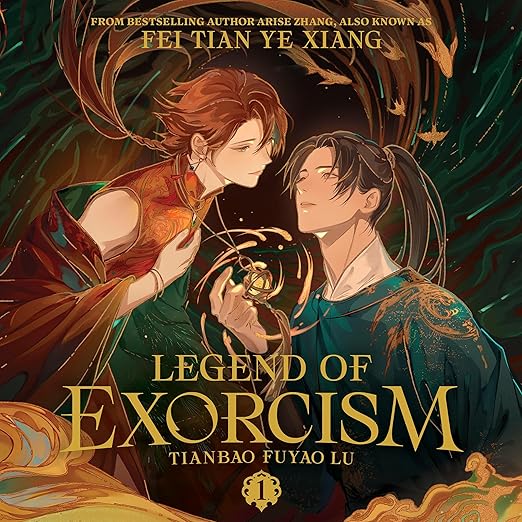
The setup is elegant: Hongjun, a half-yao who has grown up in the mystical Taihang Mountains sheltered from human society, is sent undercover to Chang’an to infiltrate the exorcism department. His handler is Li Jinglong, a soldier with no spiritual power who has somehow been assigned to lead a team of extraordinary exorcists. Neither of them is remotely suited to their responsibilities. What follows is exactly the kind of comic disaster you would expect, but Fei Tian Ye Xiang uses the chaos to build something real between the two leads. The question of whether Hongjun can trust Li Jinglong with the truth of his nature is the emotional engine of the volume, and it is handled with more care than the breezy tone might suggest.
Our Take on Legend of Exorcism: Tianbao Fuyao Lu, Vol. 1
The danmei genre, for those unfamiliar, refers to Chinese romantic fiction centered on male-male relationships, and Fei Tian Ye Xiang is one of its better-known practitioners. This series exists in the same universe as Dinghai Fusheng Records and has generated anime adaptations, which gives it the kind of proven narrative architecture that first volumes sometimes lack. The world feels lived-in and internally consistent, even for readers coming in cold.
David Lee Huynh’s narration captures the tonal balance that makes the series work. Reviewers have described the mood as light and humorous, and Huynh earns that description without sacrificing the emotional moments. Hongjun’s sweetness and innocence, which multiple reviewers specifically mention, requires a voice that plays it straight rather than broad, and Huynh manages that calibration. The ensemble at the Department of Exorcism, who spend most of the volume driving Li Jinglong to distraction with their antics, come through as individually distinct rather than a generic comic mob.
Why Listen to Legend of Exorcism: Tianbao Fuyao Lu, Vol. 1
The pacing in this volume is unusually confident for a series opener. Fei Tian Ye Xiang does not spend excessive time on world-building exposition; instead, you learn the rules of the Tang Dynasty supernatural order through what Hongjun discovers alongside the reader. That approach keeps the plot moving while gradually building genuine tension around Hongjun’s concealed identity. The dynamic between Hongjun and Li Jinglong develops through situation rather than declaration, which is the harder and more rewarding way to build a central relationship.
Readers familiar with the Seven Seas Entertainment translation of other danmei works will find this consistent in quality. The publisher’s handling of the genre has been reliably strong, and this translation does not feel like a compromise between the source material and English-language accessibility. The comedy in particular lands cleanly, which can be one of the harder things to preserve in translation.
What to Watch For in Legend of Exorcism: Tianbao Fuyao Lu, Vol. 1
This is volume one of an ongoing series, and it ends with significant threads deliberately left open. Listeners who need narrative closure from a single installment will find the stopping point frustrating. The romantic relationship between Hongjun and Li Jinglong is at an early stage, and the volume is careful not to resolve the central question of disclosure and trust in a way that would remove the dramatic tension for future volumes. Patience is required, and it is rewarded in the long term rather than the immediate.
The setting, ancient Tang Dynasty China with a supernatural bureaucracy overlay, is rich but assumes some reader willingness to immerse without hand-holding. The terminology and social structures are introduced naturally but densely. This is not a problem for the genre’s established readership, but listeners entirely new to historical Chinese fantasy may need a moment to orient.
Who Should Listen to Legend of Exorcism: Tianbao Fuyao Lu, Vol. 1
Listeners who enjoy their fantasy with a strong comedic register and a slow-burn romance at the center will find this one of the more pleasurable series openers in recent years. It rewards those already familiar with the danmei genre, the Dinghai Fusheng Records universe, or Fei Tian Ye Xiang’s work. It is also genuinely accessible to newcomers willing to embrace an unfamiliar setting. Skip it if you need standalone narrative resolution, if ensemble comedy is not your preference, or if romantic tension without payoff is not something you enjoy sustaining across multiple volumes.
Frequently Asked Questions
Do I need to read Dinghai Fusheng Records first since this is set in the same universe?
No. Legend of Exorcism: Tianbao Fuyao Lu is self-contained as a series and does not require prior knowledge of the Dinghai Fusheng Records universe. Shared-universe elements enrich the story for existing fans but are not necessary for new readers to follow the plot.
How explicit is the romance between Hongjun and Li Jinglong in volume one?
Volume one establishes the emotional foundation of the relationship rather than developing it into explicit romance. The central question is whether Hongjun can trust Li Jinglong with the truth of his half-yao nature. The romantic development is gradual and this volume is firmly in the slow-burn territory.
Is David Lee Huynh’s narration well-suited to the comedic tone?
Yes. The series is described by reviewers as light and humorous, and Huynh handles that register without losing the sincerity that makes the emotional beats land. His handling of Hongjun’s innocence and Li Jinglong’s hapless authority is particularly effective.
Does the volume end at a satisfying stopping point or does it cut off mid-story?
The volume ends with significant narrative threads open, as is standard for a serialized series. Listeners expecting full resolution will be disappointed, but there is enough structural closure to feel that a meaningful chapter has concluded. The ongoing romantic and identity tension is the deliberate hook for volume two.