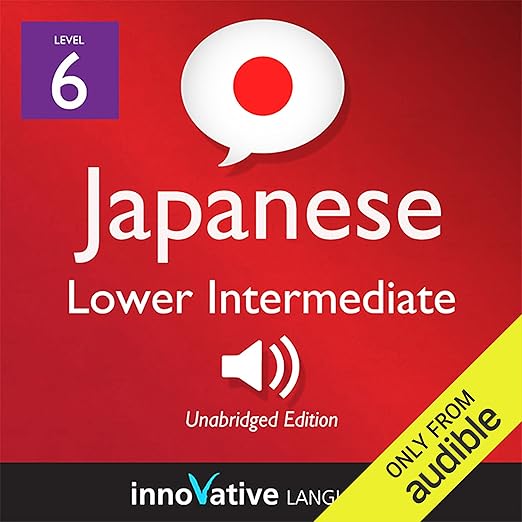
Innovative Language Learning's JapanesePod101.com program delivers 25 lessons of lower-intermediate Japanese instruction in this audiobook, running a total of 6 hours and 26 minutes across lessons built on the same core principle as every entry in the series: spoken production first, written comprehension second. Learn Japanese - Level 6: Lower Intermediate Japanese, Volume 2: Lessons 1-25 is not an entry-point product. It is a curriculum position, and its value depends entirely on whether the listener occupies the level it is designed for. Arriving here with a genuine lower-intermediate foundation in Japanese produces a structured, efficient learning experience. Arriving without that foundation produces confusion.
The audiobook opens with a clear statement of intent: this is not a vocabulary list read aloud, but a structured lesson sequence taught by a bilingual, bicultural host. That claim is mostly accurate. Each lesson follows a disciplined format: an introductory conversation in natural Japanese between native speakers, syllable-by-syllable breakdown of key vocabulary and phrases, a repeat-after-me pronunciation practice segment, and a brief cultural tip woven into the lesson content. The formula is consistent, and at the lower-intermediate level, that consistency is a feature. The learner is not spending cognitive bandwidth on decoding a new format with every lesson. The familiar structure lets them direct attention toward the language itself.
From Restaurant Vocabulary to Real Social Navigation
The JapanesePod101 curriculum is designed for cumulative acquisition, which means this volume assumes familiarity with the earlier Level 6 content and the five levels preceding it. For listeners who are genuinely at the lower-intermediate stage, the progression is well-calibrated. The lessons move from restaurant and transportation vocabulary toward more nuanced social navigation, including the etiquette and manners content that the program rightly treats as integral to communicative competence in Japanese rather than supplementary. Understanding how to order food matters. Understanding the social register in which you order it matters equally.
The bilingual host format works well at this level because Japanese at lower-intermediate requires code-switching between English explanation and Japanese demonstration in a way that benefits from a guide who is genuinely comfortable in both. The cultural commentary integrated into each lesson is one of the program's real distinguishing features. At earlier levels, those tips are survival basics. At Level 6, they start to address the more subtle social dynamics that actually determine whether a learner can navigate Japan with confidence rather than just exchange pleasantries. The discussions of keigo, of situational formality, and of the etiquette governing interactions in taxis, trains, and restaurants reflect native speaker knowledge rather than guidebook generalization.
Eight-Minute Lessons Reward Consistent Daily Listening
The eight-minute lesson format is the program's most practical design decision. At lower-intermediate level, the cognitive load per lesson is significant enough that longer sessions produce diminishing returns. The audiobook format is genuinely useful here, because repetition-based language acquisition works best when the material can follow the learner rather than requiring the learner to sit at a desk. Commuting, exercising, and household tasks are all viable listening contexts for this program, and the audio-first design accounts for that. One listener noted finding the program significantly easier to follow than other language courses they had tried, which reflects both the method's design clarity and its calibration for the learner's confidence at each stage.
The companion PDF download, which includes over 100 pages of lesson notes, transforms the audio-only experience into a more complete learning system. The notes provide the visual reinforcement that Japanese, with its multiple writing systems, particularly benefits from. Listeners who engage seriously with both components will progress more efficiently than those treating it as audio-only. For Finnish or Spanish, the audio alone is a reasonable foundation. For Japanese, the gap between what you can hear and what you can read is wide enough that the companion notes are close to essential rather than merely helpful.
Repeat-After-Me Segments Fix Pronunciation Habits Early
The syllable-by-syllable pronunciation breakdowns are the most technically valuable segments of each lesson, and they deserve active participation rather than passive listening. The program includes dedicated repeat-after-me segments, and actually voicing the responses rather than mentally following along produces measurably better retention. At lower-intermediate level, the pronunciation habits formed in these lessons will either accelerate or limit progress in natural conversation. Japanese phonology is unforgiving of habits formed on incorrect foundations, and the native speaker demonstrations in this audiobook are the clearest corrective available in a mobile format.
The cultural tips embedded in each lesson are not filler. At Level 6, they address etiquette around formal and informal registers, contextual use of keigo, and the social norms that govern situations a traveler or long-term resident will encounter. These are exactly the gaps that classroom Japanese programs often leave unaddressed, and JapanesePod101 handles them with native-speaker authority and specific situational detail rather than generalized advice.
Six Hours Across Twenty-Five Lessons of Consolidation
This audiobook is specifically built for learners who have completed at least the equivalent of five levels of Japanese instruction and are consolidating their lower-intermediate skills. It is not an entry point into Japanese, and it will not function as one. Learners who are just beginning should start with Level 1. Listeners who are returning to Japanese after a gap in study and need to rebuild active recall at the lower-intermediate level will find the structured format particularly useful. The 6-hour-and-26-minute runtime represents a significant study resource within a manageable audio package, and the 25-lesson structure provides clear progress milestones for those tracking their advancement through the curriculum. The method is proven across multiple Innovative Language Learning series, and Finnish, Korean, and other language editions of the program follow the same architecture with the same underlying research commitment.
- Narration: JapanesePod101.com's bilingual host delivers native-fluent Japanese instruction with cultural depth that classroom programs typically skip.
- Themes: Japanese language acquisition, cultural etiquette, lower-intermediate conversation
- Mood: Structured and practical, with a disciplined lesson format that rewards active engagement
- Verdict: A well-designed Japanese audiobook course for genuine lower-intermediate learners, with 25 structured lessons and companion PDF notes that together form a complete study resource.
Good to Know
Can I start the Learn Japanese Level 6 audiobook without completing the earlier levels?
Not effectively. The program is designed for cumulative learning, and Volume 2 of Level 6 assumes familiarity with the preceding curriculum. Arriving without that foundation will produce confusion rather than advancement.
Is the JapanesePod101 format effective as an audiobook for language learning?
The eight-minute lesson structure and audio-first design make it well-suited to commute and mobile learning contexts. Active participation in the repeat-after-me segments is essential. Passive listening without vocalization will reduce effectiveness significantly.
What level of Japanese does this audiobook assume the listener already has?
Lower-intermediate. The program assumes completion of at least five prior levels of Japanese instruction, covering basic vocabulary, sentence structure, and common conversational patterns. It is not suitable for beginners or advanced learners.