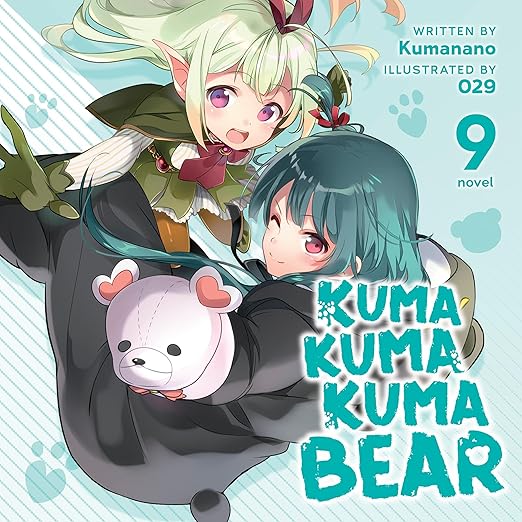
Quick Take
- Voice: Marissa Lenti has now spent nine volumes inside Yuna's head and it shows - she brings the Bloody Bear's reluctant heroism to life with a warmth that makes the character's official denial of caring about anyone completely unconvincing in exactly the right way.
- Big ideas: Reluctant heroism and accumulated found family, kidnapping rescue and earned fury, elven country and expanding world geography
- Atmosphere: Light and warmhearted throughout, with action sequences that never sacrifice the series' cozy foundational register
- Worth it?: Kuma Kuma Kuma Bear Vol. 9 delivers precisely what its established audience wants - Yuna refusing to admit she cares, then saving everyone anyway, in new territory with new characters who fit the series' emotional logic naturally.
Yuna, the bear-suited gamer who has spent eight volumes accumulating friends she officially does not care about and problems she officially did not ask for, enters Volume 9 of the Kuma Kuma Kuma Bear light novel series mid-crisis. This audiobook, narrated by Marissa Lenti, opens in the aftermath of Misa's party - an event that ends in kidnapping rather than celebration - and the Bloody Bear's response to her young friend's abduction is one of the series' clearest demonstrations of what that nickname actually means. Lenti's narration has been consistent across all nine volumes, and the rendering of Yuna's controlled fury here draws on nine volumes of established character voice to make the shift from habitual exasperation to genuine anger specific and audible.
First, the Big Picture
The kidnapping rescue arc that opens Volume 9 handles escalation efficiently. The kidnappers chose the wrong target in Misa, and the wrong person to antagonize in Misa's protector. Lenti voices Yuna's anger in a register that distinguishes it from her characteristic deadpan - a subtler achievement than it sounds, because the character's full-capability response to genuine threat is always more interesting when it is audibly different from her baseline irritation at minor inconveniences. The rescue itself is rendered with the compressed effectiveness appropriate to an overpowered protagonist who is not performing heroism but genuinely angry at people who have hurt someone she cares about, despite her official position that she does not care about anyone.
The second arc introduces a young elf character who arrives at Yuna's doorstep exhausted and in need of help for her imperiled village. This is the structural move the series has used reliably across its run: a new person with a genuine need, Yuna who could theoretically decline, and the complete absence of any suspense about what actually happens. The charm of this formula is not in the outcome but in its specific execution each time - the elf's particular situation, the village's particular threat, the new geography of elven country, and the specific ways Yuna's bear magic and bear equipment function in a context that has never encountered her before. Author kumanano uses the new setting to open worldbuilding territory the series has not previously explored, and it works as both fresh location and natural extension of the established world's logic. At 6 hours and 12 minutes, Volume 9 covers both arcs completely without feeling rushed or padded, which is the series' consistent comfortable length across its run.
Lenti's nine-volume continuity is the audiobook's most significant single asset. Voice consistency across a series of this length - the way she holds Yuna's particular internal voice steady while very gradually aging the character's emotional register as the series accumulates experience - is genuinely rare in translated Japanese light novel audio. Series veterans will hear the relationship between Lenti's Vol. 9 Yuna and her performances in earlier volumes in each small inflection. The accumulation rewards the long-term listener in ways that cannot be replicated by entering mid-series. One reviewer's note about tracking whether the bear gate's protective magic extends to a newly acquired property - watching for whether the narrative will expose that gap - reflects the kind of attentive engagement with the series' internal consistency that Kuma Kuma Kuma Bear has built across its run. That level of reader investment is what the series has earned over nine volumes, and Vol. 9 sustains it.
Things to Know Before Starting Kuma Kuma Kuma Bear, Vol. 9
The elven country setting gives this volume a distinct flavor compared to earlier entries, which have been primarily set in and around the human towns and regions Yuna has established a presence in. The new geography brings new characters who respond to Yuna's unusual combination of overwhelming capability and relentless informality in ways that feel fresh rather than like repetitions of established reactions. The series' tonal commitment to warmth and low-stakes comfort is fully maintained in Vol. 9. Listeners who have been waiting for the series to introduce significant darkness, meaningful character loss, or a pivot toward harder fantasy should note that this volume is not that moment. Kuma Kuma Kuma Bear knows precisely what kind of series it is and what its audience values, and it continues to deliver on that understanding with craft and consistency. The relationship between Yuna and the young elf she helps develops at the series' characteristic pace - connection established through action and shared crisis rather than through explicit declaration.
The elven country arc in Vol. 9 introduces social and political dimensions specific to the elf community that Yuna has not previously encountered. The imperiled village and the power dynamics behind the threat give the second arc more political texture than the series typically develops, without displacing the warmth-and-competence formula that has defined the series from Vol. 1. Lenti handles the new supporting characters - the young elf at Yuna's doorstep and the village community she represents - with the same careful differentiation she has applied to the series' expanding cast across nine volumes, which keeps each new introduction from feeling like a generic fill-in for the standard character slots.
Is This One for You?
This audiobook is for the established Kuma Kuma Kuma Bear audience. The light novel format assumes familiarity with Yuna, her bear equipment and its capabilities, her accumulated relationships including the specific significance of Misa, and the world's geography and social structure - all built across eight previous volumes that are available in audio with the same narrator. Newcomers to isekai fantasy looking for an accessible entry point would benefit from starting at Volume 1. For the series' existing listeners, Vol. 9 is exactly what they have come for: a reliable, warmhearted continuation that expands the world without disrupting the tonal balance that has made the series worth following across nine installments. Lenti's performance remains one of the more accomplished in translated Japanese light novel audio.