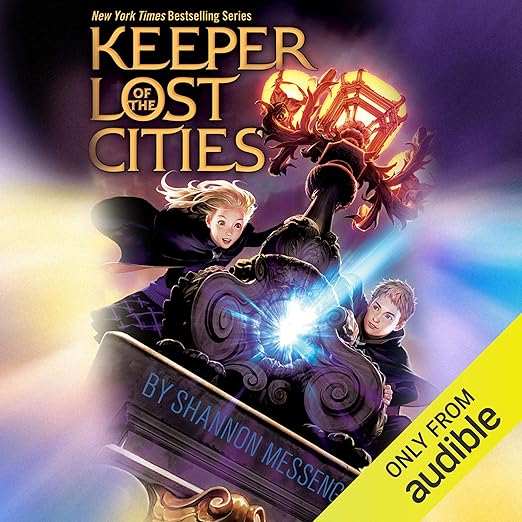
- Narration: Caitlin Kelly reads it unaccompanied across 12 hours and 40 minutes of telepaths and hidden cities.
- Themes: a hidden identity, telepathy and secrecy, belonging in the wrong world, a mystery with a deadline.
- Mood: bright and busy, with an emotional undertow that surprises people.
- Verdict: a well-built series opener for Percy Jackson graduates, with one dissent worth reading first.
Lois Fisher gave Keeper of the Lost Cities four stars and then spent the review explaining why the book deserved one. Anyone about to spend a credit on 12 hours and 40 minutes of audiobook should read that response first. A husband found it riveting. Fisher did not, objecting to a heroine of twelve or thirteen racing off with a cute fifteen year old boy, and to a scene where a jogger described as weird tries to talk her into going with him and she only then remembers the rule about strangers. The closing line settles it: he recommends it, I do not.
A Fifth-Grade Teacher Puts This Beside Percy Jackson
Sophie is twelve, has skipped multiple grades, does not connect with the older kids at school and is not comfortable at home either. The reason is that she can read minds, a secret she believes nobody knows about. Then she meets Fitz, who turns out to be a Telepath as well, and the explanation for a lifetime of not fitting in arrives all at once: she was hidden among humans, her real identity is dangerous, and other people want the answer before she gets it. The setup is efficient enough that a listener is fully oriented inside the first hour, which matters for a series that goes on to build a large amount of invented machinery on top of it.
Kim D., a fifth grade teacher who came to the book because a class handed it over, files the comparison that sells this series to parents. World-building, impossible mysteries, characters both lovable and loathe-worthy, a plot that keeps moving. Set beside Percy Jackson and Harry Potter, the review says, this belongs in the same conversation, and picking a winner among the three is genuinely difficult. Coming from someone who watches a classroom of readers choose books all day, that carries weight.
Rachel M. supplies the more measured version and it is the more useful one. The opening did not land: not enough setup, something faintly off about the first stretch. Sticking with it paid off anyway, to the point of tears twice, which the review notes is rare and says something about the emotional depth underneath the adventure machinery. The mystery and the pacing get specific praise once the book finds its footing.
Twelve Hours Where No One Mentions the Voice
Twelve hours and 40 minutes is substantial for a middle grade opener, and the length is the first honest signal about what you are entering. This is book one of a long-running series, and it spends its time building a hidden society with its own rules, hierarchies and vocabulary. Audio handles that kind of accumulation well, because a listener absorbs invented terminology through repetition without stopping to reread. Evelyn's response calls it nice and long, and means it as praise.
Corey Beth makes the case for adult listeners, and for a series this popular that is not a trivial audience. Nearly forty years old at the time of writing, Corey Beth enjoyed it completely, notes that the writing is not dumbed down, and had only stumbled on the first book because it turned up free on a subscription tier. That discovery route says something about how this series grew: not through marketing but through readers handing it sideways to other readers.
Caitlin Kelly reads it unaccompanied, holding the sole performance credit on this listing. A first-person-adjacent middle grade fantasy with a twelve year old at its center needs a narrator who can play a child without condescending to one, and who can keep an invented society's names and titles consistent across nearly thirteen hours. All five people who wrote here discuss the story and none of them the voice, so the audio sample carries the whole burden of proof. Twelve hours is long enough for a mismatched narrator to become a real problem, and long enough for a good one to disappear into the book entirely.
Two Reviews Contradict Each Other on Suitability
That four-star dissent deserves unpacking, because it raises the question most parents will ask. Fisher's complaints are about judgment, not content: a young heroine leaving with an older boy she barely knows, and a stranger-danger scene where the danger is recognized late. Whether that reads as sloppy modeling or as an accurate portrait of a sheltered kid making sheltered decisions is a fair argument. What is not in dispute is that the review awards four stars while arguing for one.
Evelyn takes the opposite position outright, calling the book perfect for anyone over seven and reporting nothing inappropriate anywhere in it. So the review column contains two direct contradictions on the same question of suitability, from responses filed months apart, and the listing offers no content guidance of its own to break the tie. Parents of younger listeners are better served sampling the early chapters than trusting either verdict on its own.
Ten people voted and the badge reads 4.8, so the pile of stars behind it comes to 48 and stops two short of 50. Four fives and a four are visible, adding to 24, which means the half of the electorate that wrote nothing contributed the other 24, one star shy of unanimous. One more wrinkle: Corey Beth opens with four and a half stars in the text while the grade attached to that same response is a full five.
Reluctant Readers Get the Names Pre-Pronounced
Young listeners who came off Percy Jackson wanting the next thing are the obvious fit, and a fifth grade teacher on this page confirms the handover works. Adults who read middle grade without apology get a series opener with real construction behind it, as Corey Beth's response demonstrates. Families with long car journeys ahead will appreciate a story that builds a world slowly enough to survive interruption, and a runtime that covers most of a road trip. Reluctant readers who find a printed fantasy series intimidating often get further with the audio version, since the names and the hierarchy arrive already pronounced and nothing has to be decoded in print.
Hold off if a twelve year old making risky decisions around older boys and strangers is something you would rather preview yourself, since one reviewer objects to exactly that and another sees nothing wrong. Hold off too if you want a self-contained adventure, because this book opens a series and behaves like it. Twelve hours and forty minutes is a long first date with a run that continues well past this volume.
Common Questions
What does the four-star review actually say about Keeper of the Lost Cities?
It argues for one star. Lois Fisher objects to a twelve or thirteen year old leaving with a fifteen year old boy, and to a stranger-danger moment recognized too late, then reports quitting the book. A husband liked it enough to want the sequel. The written verdict and the awarded grade point opposite ways.
How old should a listener be for this audiobook?
The record gives no guidance and the reviews split hard. One response recommends it for anyone over seven, while another flags the heroine's choices around older boys and strangers as a problem. Most listeners land in the nine to twelve range. Sampling the opening chapters is the practical way to decide.
Is the Keeper of the Lost Cities audiobook a complete story on its own?
It resolves its central mystery but plainly opens a series, and this page lists it as the first entry under a series name identical to the title. Reviewers describe wanting the next volume immediately, and one mentions a spouse asking for book two. Expect to continue.