The Short Version
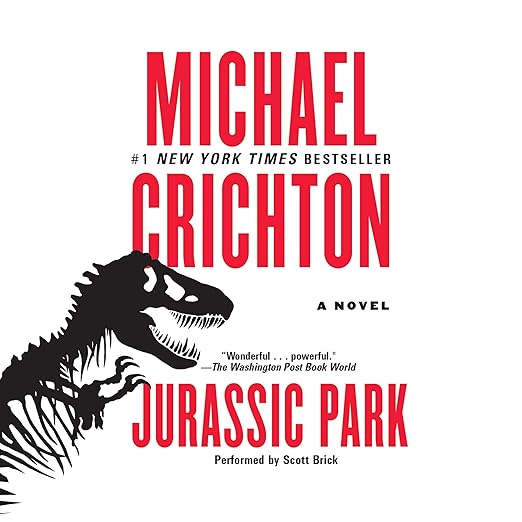
- Narrator: Scott Brick brings authority and technical precision to Crichton's dense scientific passages, and sustains momentum through the thriller sequences without tipping into melodrama.
- Subjects: Scientific hubris and systemic failure, chaos theory versus the illusion of control, the ethics of genetic technology
- Tone: Tense, intellectually grounded, and propulsive once the park begins to fail
- Bottom line: A novel that holds up better than most of its contemporaries because its science asks real questions - Scott Brick's narration serves it with the seriousness it deserves.
I first encountered Jurassic Park when I was twelve, which means I came to it with the film's architecture already in my head. Steven Spielberg's 1993 adaptation was so visually definitive that it is difficult to disentangle the novel from those images. Coming back to it as an adult listener, with Scott Brick narrating, was the first time I was able to really hear what Michael Crichton was doing with the material - and what he was doing is considerably more interesting than the film had the room to show.
The novel that became one of the most influential science fiction stories of the twentieth century is, at its core, an argument about systems. Specifically, it is an argument about what happens when human beings build systems of enormous complexity and then convince themselves those systems are under control. The chaos mathematician Ian Malcolm is not a supporting character in the book - he is the novel's moral and intellectual center. His critique of John Hammond's park is not simply that it is dangerous; it is that the danger is inherent, structural, and predictable to anyone who is paying attention to the mathematics of complex systems. Hammond's hubris is not that he played God. It is that he thought being God was a manageable project.
Featherless Dinosaurs and Crichton's Real Science
Crichton writes techno-thrillers that take their science seriously in a way that distinguishes them from the thriller genre at large. The DNA recovery and cloning mechanism at the center of Jurassic Park is explained in enough detail to be intellectually satisfying, though some of the specific scientific claims have been revised by subsequent paleogenetics research. The dinosaurs themselves are described with the contemporary scientific understanding of the early 1990s - featherless, mostly cold-blooded - rather than the revised paleontology that came later. None of this undermines the reading experience, because Crichton is not asking you to accept his science as literal fact; he is using it to build a plausible enough world that the ethical questions feel real.
One reviewer described it as writing "like someone who actually cares about the details" and noted that "the science doesn't feel slapped on." That is accurate, and it is the distinguishing feature of Crichton's approach. He was trained at Harvard Medical School, and the procedural density he brings to the science feels earned rather than decorative. The thriller mechanics - the park's sequential failures, the velociraptors' growing comprehension of the control systems, the children in increasingly impossible situations - are exciting because the stakes have been established by the science, not despite it.
Scott Brick Doesn't Soften the Science
Scott Brick is a reliable narrator for material that requires technical authority. He does not soften the denser mathematical and biological passages into approachable vagueness - he reads them as written, which is the right choice for a book that needs its science to feel real. The thriller sequences, particularly the raptor pursuit scenes and the failures of the park's systems one by one, move with the pace the material demands. At fifteen hours and ten minutes, the novel is longer than the film suggests it would be, and the additional texture in the book - Malcolm's extended chaos theory lectures, the more developed subplot involving the dinosaur population reproducing off the island - benefits from Brick's willingness to sit with the complexity rather than skim over it.
Darker Endings and a Bigger Role for Malcolm
Listeners who come from the film will encounter significant structural differences. Several characters have different outcomes in the novel. Malcolm's role is larger and more philosophically developed. The park's failures follow a different sequence. And the ending is considerably darker than the film's resolution. Readers who found the film's climax deeply satisfying may need a moment to adjust, but the novel's version is truer to the argument Crichton was making throughout - about the limits of human control over complex biological systems. One reviewer compared the novel unfavorably to the film; several others found it superior. That division tracks along the lines of whether you came primarily for the spectacular imagery or for the ideas underneath it.
CRISPR Makes Hammond's Hubris Feel Current
Anyone who read this as a teenager and wants to return to it as an adult will find the novel has aged better than expected. The ethical questions it raises about genetic technology, intellectual property in biological research, and the consequences of commercializing science are more current in 2026 than they were in 1990 - CRISPR and gene editing have made Hammond's project feel less like science fiction and more like a near-future cautionary tale. Listeners who have never read it and know only the film will find the experience richer and stranger than they anticipate. If you want primarily spectacle, the film remains the more efficient delivery mechanism. If you want the ideas behind the spectacle, the novel is where they live, and Brick's narration gives them the room they need.
Frequently Asked Questions
How does Scott Brick handle the Ian Malcolm chaos theory lectures, which are dense and extended?
With the same technical authority he brings to the thriller sequences. He does not simplify or rush the mathematical discussions, which is the right call - Malcolm's arguments are the intellectual spine of the novel, and they land harder when they are given their full weight. Listeners who want to engage with the ideas will find Brick's pacing serves them well.
At fifteen hours, does the pacing hold throughout, or does it drag in the middle sections?
The early sections, which establish the park and its personnel in detail, move more slowly than the thriller sequences that follow. This is intentional - Crichton is building the world before dismantling it - but listeners who want immediate action may find the first few hours slower than expected. The payoff in the park's collapse is earned by that buildup.