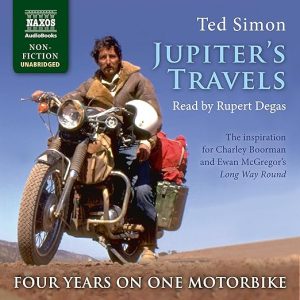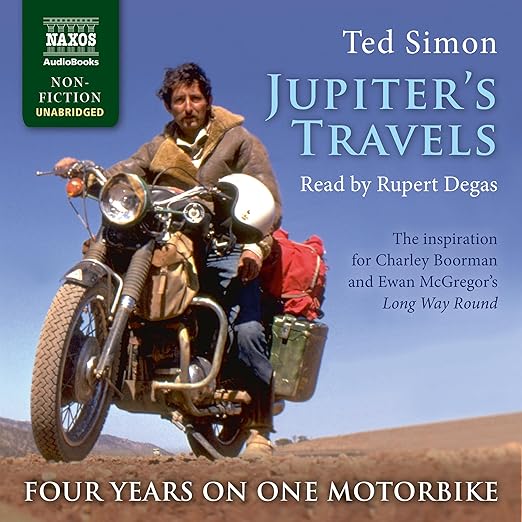
Sixty-four thousand miles over four years, on a 500cc Triumph Tiger loaded up in pouring rain outside London on October 6, 1973. That is the whole proposition of this audiobook, and the description does not oversell it: breakdowns, revolutions, a war, a spell in prison and a Californian commune all turn up along the way, and Ted Simon is treated in turn as a spy, a god, a welcome stranger and a curiosity. Sixteen hours and fifty-one minutes is what it takes to get round. The book has been feeding motorcycle daydreams ever since, including, the copy notes, those of Charley Boorman and Ewan McGregor.
What Ted Simon Delivers
Jupiter is Ted, not the motorcycle, and one June 2021 response makes that correction before doing anything else, insisting this is not a nerdy bikers book and praising the eloquence with which Simon transmits what he was seeing and feeling. The distinction decides whether you will enjoy sixteen hours of this. Machine detail exists but never dominates; the bike is used the way a bike is supposed to be used, ridden hard and left unpolished, so that it can carry a man far enough from himself to be worth writing about. Readers who want maintenance schedules and specifications will feel underfed, and readers who came for a portrait of the world in the middle of the 1970s will feel very well served indeed.
Breakdowns are where the book keeps finding its material, which is the oldest lesson in travel writing and one most modern accounts have engineered away. A rider stranded outside a village for three days meets people a rider passing through never will. Simon is candid that the trip swung between utter despair and unimaginable joy, and the description's claim that the journey turned into one into his own soul is the kind of line that usually signals padding. Here it earns itself, because the interior movement is reported with the same flatness as the mechanical failures and never given special lighting. Simon was a working journalist before he was a traveler, and the discipline shows in what he refuses to dramatize.
What Ted Simon Gets Right
Distance is a difficult thing to convey and this is the book that solved it for a generation. Writing in September 2010, one reader who had spent over two years riding a bicycle around the world says Simon captures the feelings of long-distance travel exactly, and mentions having reread the book more times than they could count, with the ending known in advance and the pull undiminished. Testimony from somebody who has actually done the equivalent is worth more here than any number of enthusiastic responses from armchairs, and it points at the specific thing this book does well. Long distance is mostly boredom, weather and paperwork, and a writer who can make those interesting without inflating them is doing something genuinely difficult.
Praise for the reading on this page comes from the publisher rather than from any listener. The description quotes The Times calling Rupert Degas the most versatile of narrators, then asserts that the reading captures the thrills and spills along with the timeless charm. That is marketing copy doing what marketing copy does, and a buyer should weigh it accordingly, given that the house selling the file is also the house choosing which review to quote. The job itself is demanding: a world's worth of accents encountered by a reporter who left London in 1973, in a first-person account that runs sixteen hours and swings between comedy and genuine peril without changing gear.
Where Ted Simon Loses Some Ground
One vote is what the counter beneath this listing reports, and a single vote can only ever be a whole number of stars. The badge says 4.7. No lone grader has ever been offered that option, which means the average and the counter are describing different populations, and five separate written entries dated between 2007 and 2025 are sitting right there to prove the column is bigger than the count. Read the number as decoration. The entries themselves are far more informative than the badge that sits above them.
Photographs get graded in that column too, which tells you where these responses came from. One entry complains that the pictures are only black and white and of poor quality, while allowing that they still add a great deal. No audio file contains photographs. The most substantial criticism on the page is more useful: a four-star from March 2011 finds the opening eloquent enough to quote aloud, then reports that the book falls apart after twenty thousand miles or so and reads by the end like a tamer, equally fragmented Fear and Loathing in Las Vegas. That is a fair warning about a long second half, and it is the only sustained criticism the page contains. Everything else in the column is affection.
Who Should Pick Up Jupiter's Travels
Riders are the obvious constituency and the least necessary one, since anybody already planning a long trip has probably been handed this book twice. The listener who gains most is the one with no intention of ever doing it: somebody who wants to know what four years alone on a road does to a person's sense of who they are. Armchair travelers, readers of 1970s reportage, and anyone drawn to accounts of a world before satellite navigation and constant contact will find the period detail as valuable as the adventure. Borders that took days to cross, letters collected at post offices, and whole countries about to change government while the rider is somewhere in the middle of them.
Go in expecting the pace of 1973, not the pace of a modern adventure documentary. The prose is unhurried, the digressions are frequent, and the second half asks more patience than the first. Sixteen hours and fifty-one minutes is a real commitment for a book whose own admirers concede it loosens toward the end. What holds it together is the voice on the page: a reporter who set out to write about a motorcycle trip and ended up writing about being a stranger everywhere, which is a considerably rarer book.
Before You Listen
Does the audiobook require any interest in motorcycles?
Very little. The description frames the Triumph as the means and the journey into his own soul as the point, and what it advertises is upheaval: political turmoil, jail, and a stretch of communal living in California. What fills the sixteen hours is people, borders and weather. Anyone who reads travel writing will be at home.
How much of the four-year journey does the audiobook actually cover?
All of it, from the departure from London in October 1973 through sixty-four thousand miles and back. The description flags the set pieces: breakdowns, revolutions, a war, time in prison and a spell on a Californian commune. Expect coverage to be uneven, with some countries given weeks of detail and others a paragraph.
Why do long-distance riders keep naming this book?
Because it arrived before the genre existed and set its terms. The description credits it as pure inspiration for later travelers including Charley Boorman and Ewan McGregor, and its reputation rests on treating the road as the subject and the machine as incidental. Almost every circumnavigation account written since is answering it in some way.