Quick Take
- Narration: Virtual Voice narration is workable for a practical guide, though the frequent second-person sales register reads oddly without a human voice behind it.
- Themes: Cultural fluency versus tourist ignorance, Italian daily rhythms, navigating bureaucratic pitfalls
- Mood: Encouraging and practical, occasionally preachy
- Verdict: A genuinely useful preparation tool for first-time Italy travelers, despite a marketing-heavy synopsis that oversells what is essentially a solid etiquette primer.
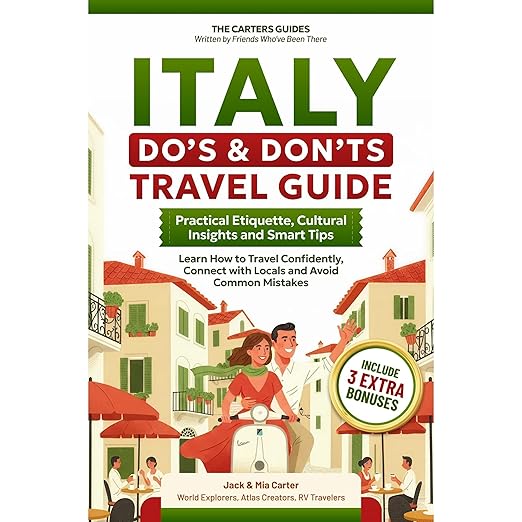
I want to separate the book from its synopsis here, because they are genuinely different objects. The synopsis for Italy Do’s and Don’ts reads like a late-night infomercial, with emoji flags and rhetorical questions and the phrase “smartest investment you can make,” none of which represents the actual content of the guide. The book itself is considerably more useful and less frantic than the packaging suggests, and Jack Carter is not without insight into the practical realities of traveling in Italy. The marketing has done him a disservice by making the guide look like a confidence scheme rather than the competent pre-trip primer it is.
What Carter covers is real: coffee bar etiquette, the timing of meals, the ZTL restricted traffic zones that have triggered fines for countless unsuspecting tourists months after their trips, how to validate train tickets, how to request the check without appearing rude, how to dress appropriately for churches. These are genuine friction points for American travelers, and Carter addresses them with enough specific detail to be genuinely useful. The cross-body bag safety tip is standard, as one reviewer noted, but it is there because it matters.
Our Take on Italy Do’s and Don’ts Travel Guide
The book’s strongest chapters are the ones on restaurant etiquette and the ZTL zones. The restaurant material is particularly good because Carter understands that Italian dining operates on a different temporal logic than American dining, slower, more sequential, more resistant to the quick-turnaround assumptions visitors carry with them. Understanding that ordering a cappuccino after noon signals tourist immediately, or that sitting down at a bar costs more than standing, is the kind of knowledge that shifts a trip from uncomfortable to comfortable. The chapter on Italian hand gestures, which Carter describes as illustrated, is more effective in the print version than on audio.
Why Listen to Italy Do’s and Don’ts Travel Guide
Several reviewers who have visited Italy multiple times found the book useful as a refresher and as preparation for regions they had not previously explored. The section on what happens when you make a mistake, which frames cultural missteps as opportunities for connection rather than sources of shame, is one of the more gracious passages in the guide, and reflects an understanding that etiquette guidance should empower rather than terrify. For first-time Italy travelers specifically, the coverage of train ticket validation and ZTL zones alone justifies the listen. These are the two most common sources of unexpected fines, and Carter explains both clearly.
What to Watch For in Italy Do’s and Don’ts Travel Guide
The Virtual Voice narration is a limitation for a guide that is partly trying to convey cultural enthusiasm alongside practical information. Carter’s enthusiasm for Italy does come through in the writing, but the AI narration flattens it. The “three exclusive bonuses” described in the synopsis, the phrase list, the cheat sheet, and the guide to being an Italian house guest, are genuinely useful additions, though they work better in the written format where you can reference them quickly. The book skews toward American travelers, which is not a flaw exactly, but listeners from other English-speaking countries may find some of the cultural calibration less directly applicable to their own travel assumptions. The book’s second-person address, which permeates the guide, reads more naturally in print than on audio. Statements like “you feel Italy” and “you experience Italy” require a human warmth behind them to avoid sounding mechanical. The Virtual Voice narration amplifies this problem. Listeners who know they respond well to practical travel guidance regardless of format will adapt. Those who need emotional engagement to retain information may find the audio version works against the book’s actual value.
Who Should Listen to Italy Do’s and Don’ts Travel Guide
Listen to this in the weeks before a first Italy trip. It is at its most valuable as a pre-departure orientation rather than an in-country reference. Experienced Italy travelers will find less new information, though the ZTL and train sections are worth revisiting for anyone who has not driven in Italian cities before. Skip this if you are expecting cultural history or deep regional analysis. This is an etiquette and logistics guide, and it is most honest about that scope in its actual content if not in its marketing language.
Frequently Asked Questions
Does the book cover all of Italy’s regions, or is it primarily focused on major tourist destinations like Rome and Florence?
The guide covers Italy at a general cultural level rather than region by region. The etiquette and logistics advice applies broadly, but listeners looking for specific guidance on lesser-visited regions will need supplementary resources.
Is the information about ZTL zones and train tickets still accurate?
The fundamental principles are stable, but specific zone boundaries and ticket validation procedures can change. Use this as an orientation and verify current details with official Italian transportation and municipal sources before travel.
How does the Virtual Voice narration handle the guide’s more conversational sections?
Adequately for the informational content, but the occasional humor and enthusiasm in Carter’s writing does not land as well without human delivery. The practical sections work better on audio than the motivational passages.
Is the guide aimed specifically at American travelers, or is it useful for other English speakers?
Primarily American travelers. The cultural calibration is built around American assumptions about dining, tipping, service, and driving, and some of the guidance will be less relevant for British or Australian visitors who already have different baseline habits.