Quick Take
- Narration: Vikas Adam’s measured, clear delivery suits the documentary quality of the material, bringing gravity to the portraits of individual activists without overwhelming the historical detail.
- Themes: AIDS activism and art, queer solidarity across difference, the power of collective creative action
- Mood: Urgent and elegiac in equal measure, the kind of history that feels immediately relevant
- Verdict: One of the finest pieces of AIDS history to appear in audio form, essential for anyone interested in activist art, queer history, or the relationship between aesthetics and political change.
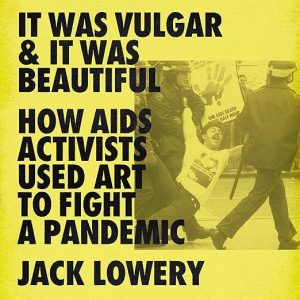
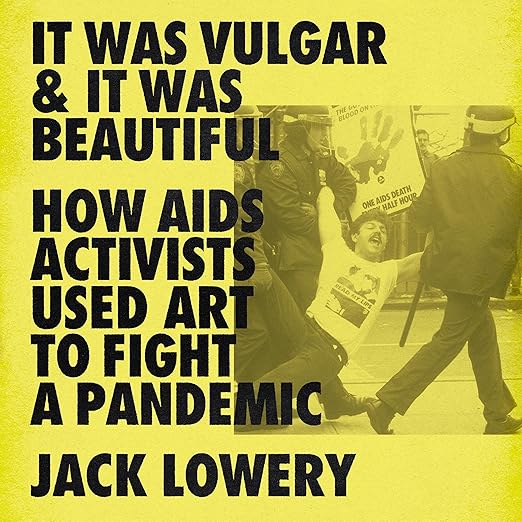
I was halfway through my second cup of coffee on a quiet Sunday morning when I started this one, expecting to listen for an hour and set it aside for later. Fourteen hours later I had not set it aside. It Was Vulgar and It Was Beautiful is the kind of history book that colonizes your thinking while you are doing other things. You close it and then find yourself staring out a window, replaying a particular scene or a particular face. Jack Lowery has written a book about Gran Fury, the art collective that emerged from ACT UP in the late 1980s, that manages to be rigorously documented and genuinely moving in the same breath, which is harder than it sounds and rarer than it should be.
NPR called it an unsparing account, and that is the right word. Lowery does not soften the scale of the dying or the depth of the institutional indifference that the activists were fighting. The government was not simply slow. Corporate greed was not simply unfortunate. The book maintains throughout that what was happening to queer people, intravenous drug users, and communities of color during the AIDS crisis was a choice made by people with power, and it keeps that charge in view without reducing the book to a polemic.
Our Take on It Was Vulgar and It Was Beautiful
Gran Fury’s work is documented here in the fullness of its ambition and its contradictions. The Kissing Doesn’t Kill poster, which appeared on New York City buses in 1989, was simultaneously a public health intervention, an act of queer visibility, and a direct provocation to the corporations and government agencies that Fury blamed for the crisis. Dropping bundles of fake bills onto the New York Stock Exchange trading floor to protest Burroughs Wellcome’s pricing of AZT was street theater, economic critique, and media strategy simultaneously. Lowery is good at showing how Gran Fury’s members understood that art made in crisis had to operate on multiple registers at once, and how that understanding shaped every design decision they made. The book is as much about the aesthetics of political urgency as it is about the AIDS crisis specifically.
Why Listen to This Fourteen-Hour Account
Vikas Adam narrates with a precision that honors the documentary quality of the material. He does not editorialize. He reads the accounts of loss and of fight with the same attentiveness, which creates an odd cumulative effect: the restraint becomes its own form of tribute. Reviewers describe the book as both personal and clinical in equal measure, and Adam’s narration achieves that balance. He handles the names of those who died with care. He handles the anger of those who survived with equal care. Fourteen hours is a significant commitment, but it reflects the scope of what Lowery has done. This is not a summary of Gran Fury’s work. It is an account of the people who made it, the relationships within the collective, the internal arguments about strategy and representation, and the daily texture of creative work conducted in the context of an ongoing catastrophe.
What to Watch For in the Historical Scope
The book covers Gran Fury’s full arc, from its formation within ACT UP through its eventual dissolution, and tracks individual members beyond the collective years. Lowery draws on interviews and archives to reconstruct conversations and decisions in detail, and the result is somewhere between biography, social history, and cultural criticism. One reviewer who came of age as AIDS was taking hold described it as sometimes painful to revisit. That response is worth noting for listeners who have personal connections to the crisis, either through their own experience or through loss. The book does not provide emotional distance. It removes it deliberately. The material about those who died, and about the grief of those who survived them, is handled with seriousness rather than sentiment, but it is present throughout.
Who Should Listen to It Was Vulgar and It Was Beautiful
This is essential listening for anyone interested in the history of activist art, in queer history, in the AIDS crisis specifically, or in the relationship between aesthetics and political change. It is valuable for younger listeners who know the AIDS crisis as history rather than lived experience, because Lowery restores the specificity and human scale of events that risk becoming abstracted over time. Listeners who remember those years directly will find it opens old grief alongside old admiration. It is not light listening, and it is not intended to be. What it is, as multiple reviewers have noted, is among the finest AIDS-era histories in print, and the audio version does full justice to that assessment.
Frequently Asked Questions
Do I need prior knowledge of ACT UP to follow this book, or does Lowery provide context?
Lowery provides the historical context needed to understand Gran Fury’s emergence from ACT UP without requiring prior knowledge. The book situates the collective within the broader AIDS activist landscape, so listeners coming in without background will be oriented quickly.
How does the book handle the individual members of Gran Fury, and are they given full biographical treatment?
Lowery tracks individual members through and beyond the collective years, drawing on interviews to give each person a recognizable life beyond their roles in Gran Fury. Some members who died during the crisis are documented through the accounts of those who knew them, which is among the most affecting material in the book.
Is this appropriate for listeners who find detailed accounts of the AIDS crisis distressing?
The book does not soften the scale of the loss or the conditions the activists were working in. It is historically honest about the dying, the government inaction, and the grief of those who survived. Listeners with personal connections to the AIDS crisis should be prepared for material that is deliberately non-distancing.
How does Vikas Adam’s narration handle the range of voices and tones across fourteen hours?
Adam’s approach is measured and consistent, suited to the documentary register of the book. He does not attempt character voices or dramatic variation, which is the right call for this type of non-fiction. The evenness of the narration becomes a virtue over a long runtime: it keeps the listener’s attention on the material rather than the performance.