Quick Take
- Narration: Amir Haidar brings a measured, scholarly register to the text that suits the academic tone without alienating general listeners.
- Themes: Transnational LGBTQ activism, intersectionality and competing liberation struggles, Palestinian queer identity
- Mood: Dense and demanding, but deeply humane in its treatment of the people at the center of the story
- Verdict: Essential listening for anyone working in queer studies, human rights, or Middle Eastern politics, and genuinely valuable for thoughtful general readers willing to sit with complexity.
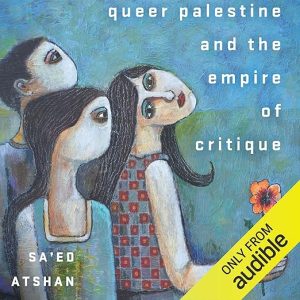
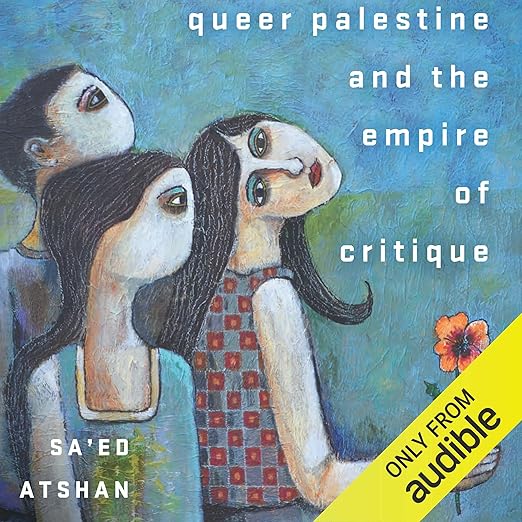
There are books that exist to comfort and books that exist to complicate. Queer Palestine and the Empire of Critique, by Sa’ed Atshan, is unambiguously the second kind. I came to this audiobook having followed coverage of Palestinian LGBTQ activism peripherally through human rights reporting, and I was not prepared for how thoroughly Atshan would challenge the frameworks I had been using to think about it. Nearly twelve hours later, I had a substantially different and more uncomfortable picture of how progressive social movements can constrain the very people they claim to support.
The central concept, the empire of critique, describes the extraordinary pressure that Palestinian LGBTQ activists face from all sides: Israeli institutions engaged in pinkwashing, Palestinian institutions enforcing patriarchal and religious norms, Western academics imposing their theoretical frameworks, journalists and filmmakers projecting narratives, and even fellow LGBTQ activists policing the movement’s priorities. Atshan is Palestinian, queer, and a trained anthropologist, and that triple positioning gives him access to perspectives and arguments that a purely external academic study could not achieve.
Our Take on Queer Palestine and the Empire of Critique
The book’s most bracing argument is the one about anti-imperialism crowding out the struggle against homophobia. Within Palestinian LGBTQ activism, Atshan shows, there is enormous pressure to foreground resistance to Israeli occupation as the primary struggle, with LGBTQ rights framed as a secondary or deferred concern. That pressure comes from Palestinian civil society, but it is also reinforced by Western solidarity movements that use Palestine as a site of political projection. The resulting bind, where activists are criticized for focusing on homophobia by people who want them focused on imperialism, and criticized for opposing occupation by people who want them to celebrate Israel’s relative LGBTQ freedoms, is what Atshan calls the empire of critique. The concept is analytically rigorous and morally serious.
Why Listen to This as an Audiobook Over Twelve Hours
The twelve-hour runtime reflects the book’s academic origins, and Amir Haidar’s narration handles the scholarly register well. One reviewer noted that the intellectual content sometimes required them to look up terminology, which is an honest appraisal of the book’s demands. This is not a popular non-fiction book that has been given an academic veneer. It is a scholarly work that is accessible to engaged general readers, and there is a meaningful difference. The audio format works because Atshan’s arguments are built through narrative and autoethnographic reflection as much as through citation, and that narrative quality translates well to listening. The personal accounts of Palestinian LGBTQ activists that thread through the analytical sections are the most powerful material in the book and land with full force in the audio format.
What to Watch For in the Political Framing
Atshan is a Palestinian scholar writing with a clear positional commitment to Palestinian liberation, and readers should approach the book understanding that framing. This does not diminish the scholarly integrity of the work, but it does mean the book is not a neutral survey of competing perspectives. The critique of pinkwashing is thorough and compelling. The analysis of Western academic frameworks imposing themselves on Palestinian activism is among the sharpest sections of the book. Readers looking for a more explicitly balanced treatment of Israeli-Palestinian politics will need to supplement this with other sources. The book’s scope is the Palestinian LGBTQ movement and the pressures it navigates, not a comprehensive account of the broader conflict.
Who Should Listen to Queer Palestine and the Empire of Critique
This is essential for students and academics working in queer studies, postcolonial theory, human rights, or Middle Eastern politics. It is also genuinely valuable for activists engaged in transnational solidarity movements who want to interrogate how their frameworks may be constraining rather than supporting the people they seek to stand with. General readers with an interest in how progressive movements handle competing liberation struggles, and who are willing to sit with twelve hours of demanding material, will find it broadening in the way the best academic non-fiction is. It is not suitable as an introductory text for either Palestinian politics or LGBTQ studies; prior familiarity with both is helpful.
Frequently Asked Questions
What does Atshan mean by the empire of critique, and is it explained clearly in the audiobook?
The concept is introduced early and returned to throughout, so listeners will have a clear picture of it by the end. Briefly, it describes the multilateral pressure that Palestinian LGBTQ activists face from institutions and movements across the political spectrum, all of which criticize them for prioritizing the wrong struggle. The audiobook builds the concept progressively rather than defining it once and moving on.
Is this book politically one-sided, and does that affect its usefulness as a scholarly text?
Atshan writes from a positional commitment to Palestinian liberation, which is transparent throughout the book. Within that frame, the scholarship is rigorous and the analysis is carefully supported. Readers seeking a neutral survey of Israeli-Palestinian politics should look elsewhere, but within its stated scope the book is analytically serious and methodologically sound.
Is this accessible to listeners without an academic background in queer theory or Palestinian politics?
One reviewer noted needing to look up terms occasionally. The autoethnographic and narrative sections are accessible to engaged general readers, but the theoretical frameworks draw on queer theory, postcolonial studies, and anthropology in ways that benefit from some prior exposure. It is a demanding but not impenetrable listen.
Does the book address the current situation in Gaza, or is it focused on an earlier period?
The audiobook was released in September 2022 and the book reflects conditions up to that point. The analytical frameworks Atshan develops remain relevant to understanding the current moment, but listeners seeking analysis of events after 2022 will need to supplement this with more recent sources.