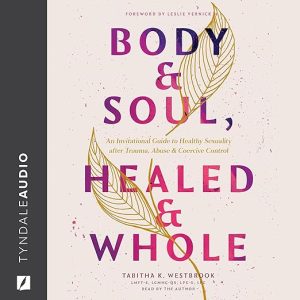
Listening to Tabitha Westbrook narrate her own book is an experience that changes the audiobook in ways that are difficult to articulate precisely but easy to feel. Westbrook is both the author and a survivor of the sexual abuse she writes about, and she is transparent about that from early in the text. When she describes the devastating and lasting effects of sexual trauma on a person's ability to experience healthy sexuality, she is not speaking from a clinical distance. She is speaking from her own history as well as her professional expertise as a certified sex addiction therapist and trauma specialist, and the combination of those two registers in audio, delivered in a voice that is hers, is powerful in a way that a third-party narrator simply could not replicate.
This is not an easy listen. That is not a caution against it. It is an acknowledgment that Body and Soul, Healed and Whole covers material, including sexual abuse, coercive control, and childhood trauma, that deserves to be approached intentionally rather than casually. Westbrook builds the audiobook as a deliberately safe space, and she succeeds. But safe does not mean light, and listeners who are themselves survivors should be aware that the content is specific and personal in ways that may require pacing.
Clinical Expertise, Personal Story, and Scripture
The framework Westbrook uses is integrative in a genuine way. She draws on her clinical expertise as a CSAT, her personal story, and a deep engagement with Scripture to create an approach to sexual healing that is simultaneously therapeutic and faith-rooted. This combination will not be for every listener: the Christian framework is not incidental to the book's method but central to it. Westbrook believes that healthy sexuality is something God designed and intends, and that sexual abuse is not only a psychological wound but a spiritual one. If that theological framework resonates with you, this audiobook offers a resource that is rare in its specificity and honesty.
One reviewer who works alongside survivors described the book as offering 'something rare and desperately needed: a safe, scripture-rooted space to explore sexuality after abuse.' That framing is precise. The rarity is not the information, some of which overlaps with secular trauma therapy frameworks, but the integration of that information with an unashamed faith perspective. For survivors within a Christian context who have found the church's silence on sexual abuse to be its own form of harm, Westbrook's willingness to name both the harm and the path through it in scripture-rooted language is meaningful.
Westbrook Speaks Plainly, and It Lands Harder
Westbrook's narration of her own material is one of the more affecting self-narration performances in the therapeutic nonfiction space. Her voice carries authority without coldness, and when she shares from her own story of abuse, you will find a quality of courage in the delivery that no hired narrator could manufacture. She does not dramatize the difficult passages or make them theatrical. She simply speaks them, and the plainness of that delivery makes the content land harder, not lighter.
At eight hours and twenty-four minutes, this is a substantial audiobook, and the length reflects the comprehensiveness of what Westbrook is attempting. She covers the processing of abuse stories without shame, the development of healthy relationships with God and self and others, the reconnection with one's body, the identification of spiritual abuse within sexually abusive relationships, and practical self-care skills for the healing process. Each section builds on the previous one, and the audiobook has the structure of a therapeutic journey rather than a collection of chapters.
Central Christian Framework, No Secular Code-Switching
As noted above, the Christian framework is central, not peripheral. Westbrook draws on Scripture throughout, and the book's vision of sexuality and healing is explicitly theological. Listeners outside a Christian faith tradition will find much of the psychological content applicable, but they will be working alongside a framework they may not share, and Westbrook does not code-switch for secular readers. That transparency is appropriate for the book's integrity, but it is a consideration for listeners approaching from different faith backgrounds or from outside faith altogether.
The content is specific about experiences of abuse, including descriptions of different forms of abuse and coercive control, that may be activating for some listeners. Westbrook is careful and compassionate in how she handles this material, but the specificity is deliberate. This is not a book that gestures toward trauma from a safe distance. It names things precisely, because precision, as any trauma therapist will tell you, is part of what enables healing rather than avoidance.
Christian Survivors, Therapists, and Clergy Alike
The primary audience is Christian survivors of sexual abuse, including abuse that occurred in childhood, within marriage, or from someone in a position of power or spiritual authority. Westbrook is particularly attentive to survivors within religious communities where the language around abuse has often been inadequate or actively harmful. Therapists, counselors, and clergy who work with survivors will also find this audiobook a useful resource for understanding how faith and healing can be integrated rather than placed in tension. Listeners outside a Christian framework who are drawn by the therapeutic content should know that the integration with Scripture is thoroughgoing rather than incidental. Westbrook narrating her own work in audio makes this a different kind of resource than the print version, and it is worth choosing audio specifically for that reason.
Is this audiobook suitable for listeners who are not Christian?
The therapeutic frameworks Westbrook uses overlap with secular trauma therapy in many areas, and the practical self-care content is broadly applicable. However, the book's integrating structure is explicitly Christian and Scripture-rooted throughout. Listeners outside that framework will need to work alongside content that is not designed for them.
Is this audiobook appropriate for therapists and counselors to recommend to clients?
Reviewers who work professionally alongside survivors have recommended it. The clinical content is grounded in CSAT training and trauma therapy. It is particularly well-suited for clients within a Christian context who need a resource that does not treat faith as an obstacle to healing.
Does listening to Westbrook narrate her own story in this audiobook affect the experience differently than reading the print version?
Significantly. Her self-narration carries authority and vulnerability that print cannot convey in the same way. When she references her own history of abuse, the delivery is plain and direct rather than theatrical, and that plainness is itself a form of modeling the kind of unsham-filled processing the book advocates.
Does this audiobook address spiritual abuse specifically, or only sexual abuse?
Both receive dedicated treatment. Westbrook specifically addresses spiritual abuse that occurs within sexually abusive relationships, including abuse by figures in religious authority. This is one of the more underserved areas in the broader sexual abuse recovery literature, and her treatment of it is careful and specific.