Quick Take
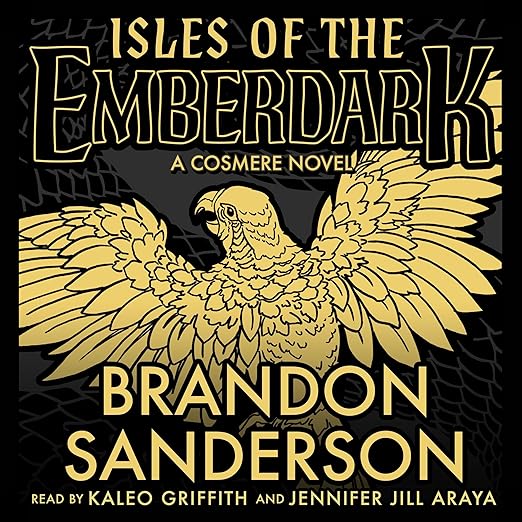
- Narration: Kaleo Griffith anchors the Dusk storyline with quiet authority, and the dual narrator credit with Jennifer Jill Araya for Starling’s sections gives the cosmic scope of the story its proper voice range.
- Themes: technological displacement and cultural survival, the cost of independence, unlikely alliance across worlds
- Mood: Epic, expansive, and emotionally grounded
- Verdict: Sanderson expands a beloved novella into a novel that earns the extra weight, for Cosmere readers, essential; for newcomers, a surprisingly accessible entry point into a very large universe.
I had been meaning to return to Brandon Sanderson for years, my relationship with the Cosmere has always been intermittent rather than comprehensive, and I came to Isles of the Emberdark knowing the novella Sixth of the Dusk but without the deep series background that some of the five-star reviews suggest is part of the experience. What I found was a book that worked for me anyway, and a more emotionally engaged reading than I expected from a Sanderson novel set in the far-future of a universe I know only in fragments.
The premise requires some orientation. Sixth of the Dusk is a traditional trapper on the deadly island of Patji, bonded to supernatural birds called Aviar in a culture that has existed in dangerous isolation for generations. When invaders from the stars, the Ones Above, arrive with technology and economic leverage, Dusk propels his people into a race to modernize before they are conquered. The race is one they are losing. A chance to sail into the emberdark beyond a mystical portal becomes the unlikely possibility of salvation. Elsewhere in that same emberdark is Starling: a young dragon chained in human form, captain of a ragtag crew of exiles, deep in debt and navigating the galaxy’s political machinery for survival.
Our Take on Isles of the Emberdark
Sanderson’s signal strength is the magic system, and Isles of the Emberdark offers multiple, each distinct to its world and logical within its own parameters. What surprised me here was the emotional intelligence of the central character work. Dusk’s sense of obsolescence, a man whose skills feel irrelevant in a world being remade by technology he did not ask for, is developed with more nuance than Sanderson’s reputation for plot architecture sometimes suggests he cares about. One reviewer described the book as a character study set to a grand adventure, and that framing is accurate: the adventure is tremendous, but the internal stakes feel real.
Starling’s dragon-in-human-form situation provides tonal contrast and a different kind of freedom, she operates in the political realm of the Cosmere’s galactic powers with a scrappiness that offsets Dusk’s stolid dignity. Their alliance, when it comes, is earned rather than convenient, and the book’s best scenes are the ones where two people with completely different orientations toward the universe find themselves solving the same problem from opposite directions.
Why Listen to Isles of the Emberdark
Kaleo Griffith is a long-established narrator for Sanderson’s work, and his handling of Dusk’s POV has the quality of someone who understands the character from the inside. The dual narration with Jennifer Jill Araya for Starling’s sections is a structural choice that pays off, the two narrative voices reinforce the tonal distinction between the two main storylines without making the transitions jarring. At 16 hours and 53 minutes, this is a substantial audiobook, and the pacing is classic Sanderson: building steadily toward the climactic convergence that readers have come to call a Sanderlanche.
One reviewer who had not read the Cosmere beyond The Emperor’s Soul found the book fully accessible without prior context, which is meaningful data. The universe-building required to understand the Ones Above, the emberdark, and the various magic systems is integrated into the narrative rather than front-loaded, and Sanderson trusts readers to assemble their understanding as they go.
What to Watch For in Isles of the Emberdark
Deep Cosmere readers have noted that the novel’s far-future setting allows Sanderson to include cameos and references that imply the survival of characters from other series. One reviewer flagged this as a potential minor spoiler for readers who have not yet reached the later entries in Stormlight Archive or the Ghostbloods storylines. If you are moving through the Cosmere in publication order and want to avoid information about which characters survive into the far future, this is worth knowing before you begin.
The convergence that has characterized Sanderson’s recent Cosmere work, the gathering of multiple storylines across books and series into a larger narrative structure, is present here in early form. For readers tracking that architecture, this book is a significant piece. For readers who simply want a good standalone science fantasy adventure, it also works on those terms.
Who Should Listen to Isles of the Emberdark
Mandatory for Cosmere completionists and a strong recommendation for any Sanderson reader who enjoyed the original Sixth of the Dusk novella and wants to see that world opened into something larger. A genuine entry point for science fantasy listeners who have been curious about Sanderson but intimidated by the series depth, the standalone status and far-future setting make this more accessible than a mid-series Stormlight entry. Those who need their epic fantasy firmly rooted in medieval-analog settings rather than space opera may find the science fiction elements jarring, but the emotional core of the novel is classic Sanderson regardless of the setting.
Frequently Asked Questions
Is Isles of the Emberdark accessible to readers with no prior Cosmere knowledge?
Yes, one reviewer with only The Emperor’s Soul as background found it fully enjoyable without prior context. The universe-building is integrated rather than assumed, and the story works as a standalone science fantasy adventure.
Should I read the original Sixth of the Dusk novella before this expansion?
Helpful but not required. The novella provides backstory for Dusk and Patji that enriches the novel, but Sanderson provides enough context within Isles of the Emberdark itself. Reading the novella first deepens the reading rather than enabling it.
How does the dual narration with Kaleo Griffith and Jennifer Jill Araya divide between the two main characters?
Griffith handles the Dusk storyline and Araya the Starling sections, which maps the vocal distinction onto the tonal distinction between the two narratives, Dusk’s grounded, traditional worldview against Starling’s more improvisational galactic existence.
Does this book contain significant Cosmere spoilers for other series still in progress?
Reviewers note that the far-future setting allows for cameos implying character survival from other series, including Stormlight and the Ghostbloods storyline. If you are mid-series in those works and want to avoid this information, it is worth noting before you start.