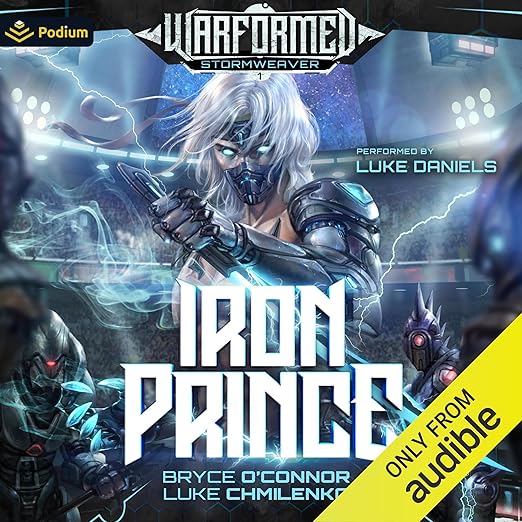
Key Details
- Read by: Luke Daniels brings his characteristic energy and range to a cast of distinct characters across nearly 34 hours, maintaining momentum through the book's considerable length.
- At its heart: perseverance against systemic disadvantage, found friendship under pressure, the ethics of engineered power
- Vibe: Epic in scale and propulsive in pace, with genuine warmth beneath the competition mechanics.
- Short version: One of the more assured debut entries in progression fantasy, with character work that earns the genre's considerable length demands.
I came to Iron Prince knowing I was walking into approximately thirty-four hours of material, which is a significant commitment for an opening novel in a new series. What I didn't expect was how quickly that length stopped feeling like a feature to manage and became the point. Bryce O'Connor is doing something in this book that requires time to work: he is building a system, a world, a character, and a friendship with the kind of patient accumulation that compressed storytelling cannot accommodate. By hour eight I had stopped counting hours.
The setup belongs to a genre that goes by several names, progression fantasy, LitRPG-adjacent sci-fantasy, but the labels don't fully capture what O'Connor is doing. Reidon Ward is born with a disease that marks him as physically inferior in a society where combat ability is the primary measure of worth, abandoned by his parents, surviving through persistence and intelligence in a world that has written him off. When the most powerful artificial intelligence in human history notices him and grants him a Combat Assistance Device, or CAD, with terrible starting specs but theoretically infinite potential, he earns a place at the Galens Institute, a military academy, where he ranks at the very bottom of his class.
Is Iron Prince Worth Your Time?
The underdog-at-military-academy structure is familiar, and O'Connor is self-aware enough about the tropes he's deploying that one reviewer could list them in a mildly critical review and still rate the book five stars. Poor, abandoned, sickly protagonist with one loyal friend and secret potential: yes, we've seen this. What matters is execution, and the execution here is considerably above average. Reidon doesn't gain power through sudden revelation; he gains it through specific, documented, believable work. The CAD system's mechanics, the combat tournament structure, the school ranking dynamics: all of this is built out with enough internal consistency that the competitive scenes have genuine stakes.
The friendship between Reidon and Viviana Arada is the book's emotional core, and O'Connor invests in it with the same care he gives the world mechanics. Viviana is not a supporting character who exists to believe in Reidon when no one else does; she has her own ambitions, her own frustrations, and her own arc across the novel's considerable length. One reviewer specifically called out the character work as the best element, noting how satisfying it is to watch Reidon claw his way upward through consistent effort. That satisfaction is built on both the world mechanics and the relationships, and separating them would weaken either.
Luke Daniels is a known quantity in genre audio, particularly in progression fantasy and LitRPG, and his work here reflects his understanding of what this kind of story needs: momentum, clarity across a large cast, and enough vocal distinction between characters that listeners can track who is speaking without constant attribution. Across nearly thirty-four hours, he maintains the book's energy without the kind of narrator fatigue that can make long genre listens drag in their middle sections.
The chapter epigraphs, described by one reviewer as references at the start of most chapters that add to the sense of a living world, are particularly well-handled in audio. They function as mini-documents from this world's history, and Daniels delivers them with a slightly different register that helps orient the listener before each section begins. It's a small touch that pays dividends across a book this long.
Before You Commit to Iron Prince
The opening tropes are real, and if your resistance to the unloved-prodigy archetype is high, the first several hours may test your patience before O'Connor demonstrates what he's doing with the material that is genuinely his own. The book also does not attempt a tidy single-volume resolution; it is the opening of a series, and while the immediate conflicts are resolved, the larger arc is clearly just beginning. Listeners who prefer their very long audiobooks to feel complete in themselves may find this structure frustrating.
The world-building is dense enough that the early hours require sustained attention rather than passive listening. O'Connor explains the CAD system, the military hierarchy, and the Galens Institute's ranking structure incrementally, but there is a real learning curve for the first quarter of the book before the mechanics become second nature.
Should You Listen to Iron Prince?
Readers who enjoy progression fantasy and LitRPG-adjacent science fiction and want an entry that takes its character work seriously alongside its systems mechanics will find this among the stronger options in the genre. The length requires genuine commitment, but the payoff in character development and world-building is proportionate. Skip it if you need your genre fiction to be structurally efficient or if very long audiobooks that are explicitly opening volumes in a series don't suit your listening habits.
Good to Know
How does Iron Prince handle the LitRPG and progression fantasy genre conventions, does it add anything new?
O'Connor works within established conventions, including the underdog protagonist, the school ranking system, and the gradual power accumulation, but executes them with more character depth than is typical in the genre. The friendship between Reidon and Viviana and the ethical dimensions of the AI-human relationship are more developed than most progression fantasy entry points.
Is 34 hours a reasonable commitment for a first book in a new series?
If you enjoy the genre, yes. The length allows O'Connor to develop both his world mechanics and his characters with a thoroughness that shorter genre fiction can't achieve. Multiple reviewers who started skeptically noted that the length stopped feeling excessive once the world became familiar. That said, listeners who prefer efficient genre storytelling should calibrate their expectations accordingly.
Does Luke Daniels's narration suit the Warformed: Stormweaver series?
Yes. Daniels is an experienced genre narrator with a particular facility for progression fantasy and military SF, and he keeps a large cast distinct across a very long runtime. His energy matches the book's escalating competitive sequences well.
Does Iron Prince resolve as a standalone, or does it end on a cliffhanger requiring the next book?
The immediate storyline of Reidon's first year at the Galens Institute resolves, but the larger arc is explicitly ongoing. It is an opening volume rather than a complete story, and readers who go in knowing that will find the ending satisfying; those expecting closure on all threads may be surprised.