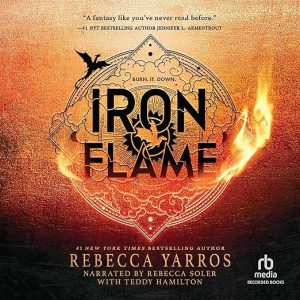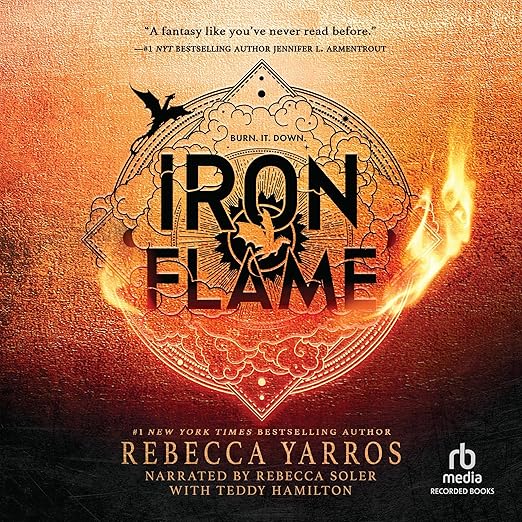
I finished the final chapter of Iron Flame on a Saturday night and sat with it for a while before doing anything else. That does not happen often. Rebecca Yarros has built something in the Empyrean series that operates on the kind of emotional frequency that is very difficult to sustain across a sequel, when reader expectations are higher and the discoveries of a first book cannot be replicated by their nature. That she largely pulls it off in this second installment is a genuine achievement, though the path to the final act requires patience that not every listener will bring to it after the more propulsive experience of Fourth Wing.
The setup is clear from the synopsis: Violet Sorrengail has survived her first year at Basgiath War College, which was designed to kill her. Now she knows the secret that Basgiath has been hiding for centuries, a secret that reframes everything about the war the riders believe they are fighting. The second year brings a new vice commandant who has made it his personal mission to break her, a mate bond with Xaden Riorson that has turned complicated in ways neither of them fully understands, and the question of whether surviving the first year has left enough of the original Violet intact to make continued survival meaningful rather than just mechanical.
Violet Turns From Survivor Into Deliberate Agent
The emotional core of Iron Flame is the transformation of Violet from survivor to agent. In Fourth Wing, her survival was the victory, and readers could celebrate it as such. In this book, Yarros raises the stakes by asking what it costs to keep surviving once you know the truth about what you are surviving for. One reviewer described Violet's evolution as haunting, noting that she now chooses her path with a fierce intentionality that transforms her fragility into something formidable. That is a precise observation. Yarros does not soften the character growth by making it painless; Violet's second year asks more of her than the first did, which is saying something considerable given how brutal the first year was.
The Xaden storyline, which runs throughout the book and reaches its critical point in the final act, is the romantic element that most reviewers discuss with the highest emotional investment. One reviewer described the series as making them fall in love with Violet and Xaden in a way that survived across both installments. The emotional payoff of the Xaden arc in this installment justifies the wait for readers who are already invested in these characters from the first book.
Soler Is a Favorite for the Hardest Scenes
Soler is specifically credited in multiple reviews for the quality of her handling of the most emotionally demanding scenes. One reviewer described her as one of their absolute favorite narrators and noted that she does an amazing job with this series specifically. For a book where the impact depends so heavily on timing and vocal commitment, having the right narrator is not a small thing. Soler manages Violet's interiority with a precision that keeps the character sympathetic even when she is at her most closed off, which is the hardest thing a narrator can do in a first-person fantasy series that asks readers to spend nearly thirty hours inside one perspective.
The running time of just over twenty-eight hours is significant and should be acknowledged clearly. Soler earns every one of those hours, but the listening commitment is real and should be factored into any decision about whether to start the series in audio form or switch to audio for the second installment.
Fourteen Measured Hours Before the Real Acceleration
Multiple reviewers, including enthusiastic ones, note that the first two-thirds move more deliberately than Fourth Wing. One reviewer called it slower while insisting the pace felt purposeful, describing the world-building as necessary for answering lingering questions about the war, the venin, and the geography beyond Basgiath. That is the correct read. The introduction of the griffin riders, the expansion of the world's political geography, the revelation of what the war has actually concealed for centuries, these elements require time that Iron Flame takes seriously rather than summarizing or rushing past.
The payoff is a final act that lands with real force and sets up the third book in ways that keep the series's momentum intact for committed listeners. But the path there requires approximately fourteen to sixteen hours of more measured storytelling before the acceleration begins, and listeners who went into this expecting the propulsive, front-loaded energy of Fourth Wing should calibrate expectations accordingly rather than abandoning the book during the slower middle sections.
Trust the Slow Middle if Xaden Already Won You
Listen if: you have already finished Fourth Wing and are invested in Violet and Xaden's relationship, and you are prepared to trust a slower middle section that is building toward a rewarding and emotionally forceful final act. Rebecca Soler's narration makes the audio format preferable to the ebook for this series across both installments. Pass if: you have not started with Fourth Wing first, or if the first book's pacing already felt borderline and additional deliberateness in the sequel will be a significant barrier.
Questions Listeners Ask
Can I listen to Iron Flame without having listened to Fourth Wing first?
No. Iron Flame is the direct continuation of Fourth Wing, and knowledge of the first book's events and world is essential. The Empyrean series should be listened to in order.
Is Iron Flame significantly slower than Fourth Wing, and does it affect the listening experience?
The first two-thirds are more deliberately paced than Fourth Wing, with substantial world-building. Most reviewers describe the slower middle as purposeful rather than padded, and the final act accelerates considerably.
How does Rebecca Soler handle the emotional complexity of the Violet-Xaden relationship in this installment?
Multiple reviewers specifically praise Soler's work in Iron Flame, particularly her handling of the relationship's most difficult moments. She is widely considered one of the stronger narrator-to-material matches in recent fantasy audio.
Is there a free audiobook version of Iron Flame available?
Yes, Iron Flame is listed at $0.00 on Audible for eligible members, making it accessible as a free audiobook under current membership tiers. Confirm availability on the Audible product page as pricing can vary.