Before You Press Play
- Voice: R.C. Bray handles Hell Divers with the authority of a narrator who has lived in Smith's universe for years, switching cleanly between Tyron Red's boardroom tension, Santiago's soldier-without-a-war restlessness, and Cecil's street-level dread.
- Big ideas: Origins and myth-making, the cost of institutional power, humanity at the edge of extinction
- Atmosphere: Propulsive and layered, with real geopolitical weight beneath the action
- Worth it?: Fans of the Hell Divers series get a genuinely substantive origin story, and newcomers get one of the more accessible entry points into Nicholas Sansbury Smith's post-apocalyptic universe.
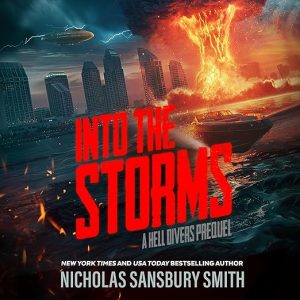
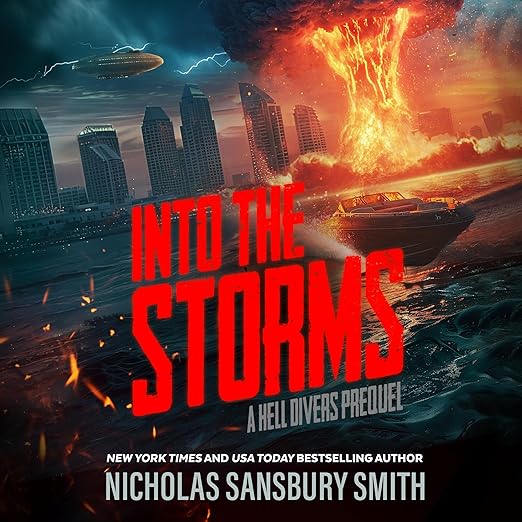
Tyron Red does not inherit an empire in the opening pages of this audiobook. He inherits a crisis. Nicholas Sansbury Smith's Into the Storms: A Hell Divers Prequel, narrated by R.C. Bray, opens two and a half centuries before the events of the main Hell Divers series, placing three men at the epicenter of the Machine War, the conflict that set humanity on its slow path toward the sky. That structural decision, beginning not with the Hell Divers themselves but with the people who made them necessary, turns out to be one of the smarter choices Smith has made in this universe.
The premise centers on the Industrial Tech Corporation's role in the aftermath of autonomous killer robots tearing through Korea. Tyron Red, forced into the CEO chair after his father's death, is trying to reverse what his company helped unleash. Sergeant Santiago Rodriguez returns home to San Diego without a war to fight, only to be pulled back to a Korea that has become radioactive and full of secrets. Corporal Cecil Pepper works Charlotte crime surveillance until a raid goes wrong and sends him and his wife toward North Carolina's mountains. Three men, three entry points into the same catastrophe.
How Into the Storms: A Hell Divers Prequel Holds Up
R.C. Bray has narrated enough of Smith's work to understand the rhythms the author relies on: the short chapters designed to end on a beat of acceleration, the alternating perspectives timed to deny the listener any single thread long enough to become comfortable, the way action sequences carry a kind of kinetic weight that benefits from Bray's particular register. He does not perform this material so much as inhabit it. His Tyron Red sounds like a man who has read too many board memos and not enough field reports; his Santiago carries the specific quiet of a soldier who knows the next mission is already waiting regardless of what his discharge papers say. These are not neutral vocal choices, and they improve the book considerably.
As an origin story, Into the Storms succeeds because Smith resists the temptation to foreground the mythology. Longtime readers of the Hell Divers series will recognize certain names and understand the resonance of certain decisions, but the prequel earns its stakes independently. The Machine War is rendered as a geopolitical and corporate failure with human faces rather than as a tidy backstory delivery mechanism. Reviewer Tim noted that Smith consistently highlights the scenes that matter with fully realized characters, and that assessment holds here. Cecil's domestic life, the specific weight of what he has to leave behind, makes his later choices register as loss rather than plot convenience.
Why Into the Storms: A Hell Divers Prequel Works as an Audiobook
The case for this audiobook over the print edition is straightforward: Bray's control over the three-thread structure keeps the narrative coherent across its 14-hour runtime in a way that the page does not automatically deliver. Smith writes in short, punchy chapters that, in prose form, can feel like controlled interruption. In audio, with Bray as the throughline, those interruptions become rhythm. The Machine War sequences in Korea carry genuine dread partly because Bray knows how to modulate anticipation over long stretches, pulling back slightly before the acceleration rather than delivering uniform intensity.
There is also something specific to this universe that benefits from audio: the worldbuilding is cumulative rather than explanatory. Smith does not stop to deliver lore. The Industrial Tech Corporation's reach, the political structure being dismantled by autonomous weapons, the way civilian and military lives intersect around a catastrophe that nobody officially caused, all of this accretes across scenes rather than arriving through exposition. A narrator who can carry that accumulation without letting it become noise is essential, and Bray does it reliably.
Weak Spots in Into the Storms: A Hell Divers Prequel
Listeners who come to this prequel without prior familiarity with the Hell Divers series may find the early chapters require patience. Smith establishes three parallel timelines quickly, and the first hour asks you to hold Santiago's domestic San Diego life alongside Tyron's corporate boardroom maneuvering alongside Cecil's street-level surveillance work without much narrative scaffolding connecting them. The structure rewards patience, but it demands some upfront trust.
Reviewer AReader flagged this as an excellent entry point for newcomers, and while that is true by the final third, the opening is more demanding than that assessment suggests. Characters described in the synopsis as standing at crossroads of humanity's fate begin their arcs in deliberately modest circumstances. Tyron is dealing with board politics, not killer robots. Santiago is worried about paying bills. Cecil is running surveillance on gangs. The prequel's thesis is precisely that catastrophes arrive through ordinary failures, which makes the early chapters principled rather than slow, but listeners expecting immediate apocalyptic scale may need to recalibrate.
The Charlotte section following Cecil and his wife into the North Carolina mountains also does something the other two storylines do not: it makes the threat personal in a domestic register. Cecil's surveillance work against city gangs and the raid that goes wrong are rendered with the specificity of a writer who understands that the stakes of an apocalyptic prequel are only credible when the people losing their ordinary lives are credible first. Smith uses that section to establish what civilian survival actually costs before the forgotten machines reactivate and the scale of the threat becomes planetary.
The Right Listener for Into the Storms: A Hell Divers Prequel
Existing Hell Divers readers will want this without qualification. The origins of the ITC, the shape of the Machine War, and the human decisions that made the sky-colony future inevitable carry the weight of retroactive significance across the series. For newcomers to Smith's work, Into the Storms functions well as a standalone entry point into a richly constructed post-apocalyptic universe, provided the parallel three-protagonist structure is a format you find compelling rather than fragmenting. Listeners who prefer single-viewpoint narratives, or who want their SF prequels to deliver immediate action rather than earned catastrophe, will find the pacing tests their commitment in the first several hours. Those who stay get one of the more substantial origin stories Smith has built in this universe.
A Few Questions About Into the Storms: A Hell Divers Prequel
Is R.C. Bray's narration consistent with his work on the main Hell Divers audiobooks?
Yes. Bray has narrated extensively in Smith's universe and brings the same controlled, rhythmically aware performance that defines the main series. His ability to differentiate Tyron Red, Santiago Rodriguez, and Cecil Pepper across a 14-hour runtime is one of the audiobook's genuine strengths.
Is this audiobook appropriate for listeners who are new to post-apocalyptic science fiction?
Yes, with the caveat that the first third is more character-study and corporate-political thriller than immediate apocalyptic action. The Machine War escalation arrives with real weight precisely because Smith takes time establishing the ordinary lives that the catastrophe will upend. The genre conventions are present but the book earns them through accumulation rather than assumption.