Quick Take
- Narration: Cindy Kay’s performance carries the wuxia atmosphere with poise; she handles Chih’s gender-neutral identity with naturalness that the story requires.
- Themes: The unreliability of legend, multiple truths within a single story, loyalty and identity
- Mood: Lyrical and swift, steeped in invented mythology
- Verdict: The most richly constructed entry in the Singing Hills Cycle – short, but dense with the kind of storytelling intelligence that makes Vo’s novella format feel genuinely new.
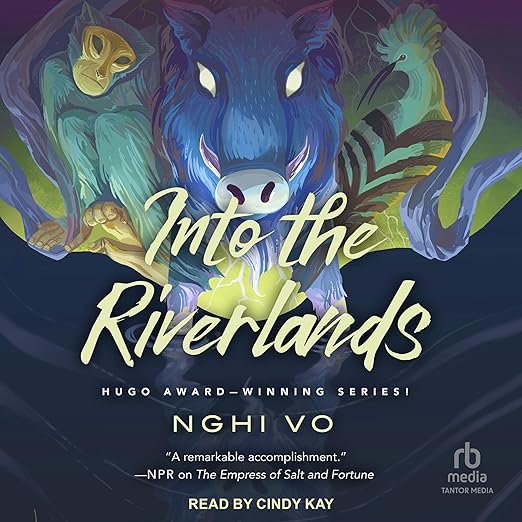
I started Into the Riverlands on a Saturday afternoon and finished it before dinner, which with a two-hour twenty-minute audiobook is not a feat. What surprised me was that I spent the next hour sitting with it rather than moving immediately to something else. Nghi Vo’s Singing Hills novellas have a quality that is rare in short-form fantasy: they are over before you have fully inhabited them, and the incompleteness is part of the design. The third installment in the cycle understands its own scale better than any of its predecessors.
The cleric Chih, accompanied by the talking bird Almost Brilliant, travels to the riverlands specifically to gather stories about the region’s legendary martial artists. On the road to Betony Docks they acquire traveling companions – two young women far from home and an older couple who are rather more than they initially seem – and they stumble into an ancient feud that makes story collection suddenly dangerous. The premise is a frame tale, a structure Vo has used across the cycle, but in Into the Riverlands the frame and the stories it contains are more tightly integrated than in the earlier books.
Our Take on Into the Riverlands
Vo is working in a specific tradition here – the wuxia genre of Chinese martial-arts narrative, with its near-immortal fighters, ancient vendettas, and codes of honor that coexist with spectacular violence. The riverlands setting is explicitly modeled on this tradition, and one reviewer identified it as a total wuxia landscape: martial artists who are basically flying non-celibate monks, suspected immortals, and love. That description captures the genre pleasure the book offers. But Vo is not simply writing wuxia; she is writing about what wuxia stories do, how they circulate and change, and whose perspective they encode when they do.
The book’s central argument, delivered through Chih’s professional curiosity about how legends form and who controls them, is that every story has more than one face. The same events appear differently depending on who survived them, who benefited from a particular version of events being preserved, and what the act of remembering asks you to forget. This is not a new idea, but Vo embeds it in the narrative structure so thoroughly that the argument and the story are the same thing rather than the story being an illustration of the argument.
Why Almost Brilliant Matters to This Entry
The hoopoe Almost Brilliant, absent from the second novella in the cycle, returns here, and the return matters more than a bird’s reappearance might suggest. Almost Brilliant functions as an indelible memory – a creature that records without interpretation, preserving exactly what was said without caring what it meant. Chih, by contrast, must decide what to record and how to frame it. The tension between these two modes of archiving, and the question of which is more honest, is the epistemological concern that runs beneath the plot of the whole cycle, and it is sharpest in this installment.
Cindy Kay’s narration handles the interplay between Chih’s narrating voice and the embedded stories Chih hears and records with clear tonal distinction. The wuxia passages – which contain the genre’s expected physical extravagance – are read with the slightly elevated register that the legendary material requires, while Chih’s framing observations carry a quieter, more analytical tone. This is not easy to do well in audio, and Kay does it consistently across the novella’s runtime.
What to Watch For in the Stories Within the Story
The inner stories in this novella are more closely related to the outer story than in the earlier Singing Hills books. The legends about the riverlands’ notorious fighters directly bear on the identity and history of the older couple traveling with Chih, and the reader assembles this connection at roughly the same pace as Chih does, which creates a particularly satisfying structural experience. One reviewer noted that the last two chapters are just so good, and they are – the convergence of the frame and its embedded material is the book’s payoff, and Vo earns it without the kind of revelation-as-spectacle that lesser novellas rely on.
The note about beautiful versus ugly characters that one reviewer appreciated – Vo complicates the wuxia convention of physical appearance indicating moral status – is woven throughout the martial artist legends in ways that comment quietly on how genre encodes values. It is the kind of observation that rewards readers who are paying attention to the stories within the story as arguments rather than just as entertainment.
Who Should Listen to Into the Riverlands
Listeners who have read the earlier Singing Hills novellas will find this the most rewarding entry and should listen having Vo’s recurring structural concerns in mind. New readers can start here – the novella is largely self-contained – but will miss the satisfaction of seeing the cycle’s concerns develop across three books. Fantasy readers interested in East Asian literary influences and wuxia genre traditions will find the setting richly realized. Those who need substantial plot momentum across long runtimes should note that at two hours twenty minutes this is a novella in the precise sense, and its pleasures are contemplative and structural rather than narrative. Anyone who has ever loved a frame tale told well should listen to this.
Frequently Asked Questions
Do I need to have read the previous Singing Hills novellas to follow Into the Riverlands?
The novella works as a standalone, with enough context provided for Chih’s role as a cleric and Almost Brilliant’s function as a memory-keeper. However, readers familiar with the first two novellas will recognize the cycle’s recurring concerns about storytelling, memory, and what history preserves, which deepens the experience considerably.
Is the LGBTQ+ classification primarily about Chih’s gender identity, and is this central to the plot?
Chih uses they/them pronouns and their gender identity is not specified further, which is consistent across the Singing Hills cycle. This is not a plot point but an aspect of the world-building that the narrative treats as unremarkable. The story’s primary concerns are with legend, memory, and the reliability of inherited accounts.
How does Cindy Kay handle the wuxia action sequences in audio?
Kay distinguishes the legendary martial-arts passages from Chih’s framing narration through tonal register, giving the embedded stories a slightly more elevated quality while keeping Chih’s observations grounded and analytical. The physical sequences are short but vivid, and Kay’s pacing through them is well calibrated.
Is two hours and twenty-one minutes really long enough to tell a satisfying story?
Vo has built a genuinely original novella format across the Singing Hills cycle, and Into the Riverlands demonstrates it at its most developed. The short runtime is the result of compression rather than incompletion – the frame and its embedded stories converge with real precision. Multiple reviewers described the final chapters as particularly strong, which suggests the pacing earns its ending.