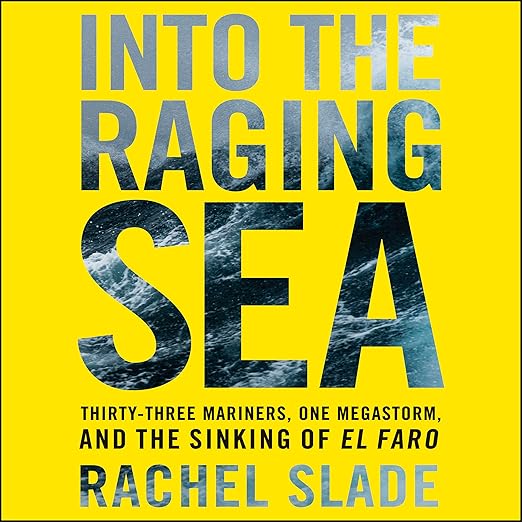
The first thing that struck me about the Into the Raging Sea audiobook was how specific its horror is. Rachel Slade does not give us a vague sea disaster; she gives us thirty-three names, a ship's data recorder, and the words of crew members who knew they were sailing toward their deaths. I came to this one after reading a newspaper account of the El Faro sinking and wanting something more thorough. I got far more than I expected.
First, the Big Picture
On October 1, 2015, Hurricane Joaquin swallowed the container ship El Faro whole in what became the worst American maritime disaster in thirty-five years. Slade, a journalist who spent years piecing together hundreds of exclusive interviews with surviving family members and maritime experts, reconstructs the final twenty-four hours aboard with an intimacy that is almost unbearable. The ship had satellite communications. It had sophisticated navigation tools and cutting-edge weather forecasting. None of it saved Captain Michael Davidson from his own increasingly inexplicable decisions, and none of it saved the thirty-three people who served under him.
What makes Slade's account more than disaster journalism is her structural choice to embed the tragedy inside a larger argument about America's aging merchant marine fleet. The razor-thin profit margins, the deferred maintenance culture, the institutional pressure on captains to make schedule at all costs, these are not background details. They are the root cause. Slade argues, persuasively, that El Faro was not just sunk by a hurricane. It was sunk by a system. That distinction between the immediate cause and the underlying conditions is the book's central analytical move, and it is executed with genuine rigor.
Why Listen to Into the Raging Sea
Erin Bennett's narration is the right kind of invisible. Her voice carries the text without inflecting it unduly, which matters enormously here because the material is emotionally charged enough without a narrator adding dramatic pressure. When she reads the crew's final recorded conversations, her restraint is not coldness; it's respect. Listeners who have noted that the writing can be "overly dramatic in parts" (and a few reviewers make this observation) will find that Bennett tends to moderate those moments rather than amplify them. Over nearly twelve hours, that steadiness becomes a genuine asset.
Slade's reporting methodology is also worth acknowledging. The ship's voyage data recorder, the maritime equivalent of a flight data recorder, captured crew dialogue in the hours before the sinking. Slade uses these transcripts carefully, giving us the officers' fear and their recognition that Davidson's commands were leading them straight into the eye of Joaquin. That the crew knew and said so, and still could not stop the ship from going in, is the devastating core of this book. The data recorder's existence transforms this from a mystery into something more painful: a documented catastrophe.
A Few Reservations
A handful of listeners have noted that Slade's prose occasionally shifts into territory that feels heightened beyond what the facts require. The reviewer who described the writing as "overly dramatic at times" was not wrong. Occasional passages reach for a poetic register that can feel slightly misaligned with the precision of the investigative reporting surrounding it. This is a minor issue and does not undermine the book's authority, but listeners expecting pure documentary detachment should know that Slade has an authorial voice and deploys it.
The book's treatment of the maritime industry, while well-argued, covers some ground that will feel familiar to anyone who has read deeply in this area. The parallels to Deepwater Horizon, to Boeing's safety culture failures, to any number of institutional disasters driven by cost pressure, are implicit throughout. Slade does not explicitly draw these comparisons, which is partly a strength (the focus stays on El Faro) and partly a missed opportunity for listeners who might benefit from that wider frame.
One more note: the audiobook is nearly twelve hours long and the pacing is deliberately cumulative. The first several hours establish the shipping industry, the crew's histories, and the voyage's early course before the final approach to the storm. Listeners who prefer immersive, detail-heavy reconstruction will find this deeply satisfying. Those who want the narrative to move quickly toward the disaster itself may find the early hours slower than they expect. Slade's method requires that the full system be visible before the catastrophe lands; she is not writing for impatience. The payoff, when it comes, justifies the setup.
Should You Listen to Into the Raging Sea?
This audiobook is built for listeners who want investigative narrative nonfiction at its most rigorous, people who read Colson Whitehead or Erik Larson for the research depth, or who still think about Sebastian Junger's A Perfect Storm decades after encountering it. The comparison to Junger, offered by blurb writer Ben Mezrich, is accurate in the sense that both books use a specific disaster as a lens onto a broader world. Slade's world is the American merchant marine, and she renders it with genuine authority. Sea lovers and maritime history readers will find plenty to engage with, as will anyone drawn to disaster investigation, workplace safety failures, or American industrial decline. Listeners with no interest in the mechanics of shipping or the institutional sociology of maritime regulation will still find the human drama compelling, though the middle section requires patience from anyone outside those interests. This is serious, purposeful journalism in audiobook form, and it rewards the investment fully.
At a Glance
- Read by: Erin Bennett's controlled, unshowy delivery is ideally suited to material this emotionally loaded, she never pushes for effect where the facts already provide it.
- At its heart: institutional failure and cost-cutting culture, maritime disaster investigation, the human cost of deferred accountability
- Vibe: Methodical and sorrowful, with an undercurrent of controlled fury
- Short version: A rigorously reported account of the El Faro sinking that uses one maritime disaster to expose the systemic failures of American commercial shipping.
Frequently Asked Questions
Does the audiobook cover the Coast Guard investigation into the El Faro sinking?
Yes. Slade draws on the Coast Guard Board of Inquiry findings as one of several investigative threads, alongside family interviews, maritime expert testimony, and the ship's own data recorder transcripts. The investigation's conclusions, and their limits, are addressed directly.
Is the Into the Raging Sea audiobook suitable for listeners unfamiliar with sailing or maritime navigation?
Largely yes. Slade explains technical elements clearly without condescending to non-specialist readers. The book is primarily a work of investigative journalism rather than a technical manual, and the human and institutional dimensions are accessible regardless of maritime background.
How does Erin Bennett handle the crew's final recorded conversations in the audiobook?
With considerable restraint. Bennett does not theatricalize these passages; she reads them steadily, letting the content carry its own weight. Several reviewers have noted that this approach makes the transcripts more affecting rather than less.