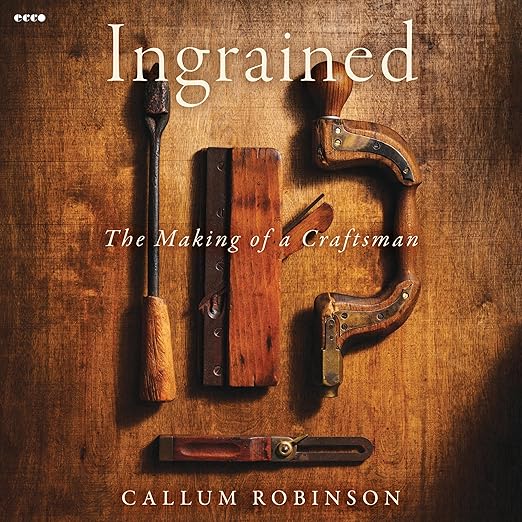
- Voice: Callum Robinson self-narrates with a Scottish cadence that grounds the memoir's nature writing in its specific geography, giving the voice a texture that enriches the material considerably.
- Big ideas: Craft and inheritance, Scottish nature writing, the ethics of making things by hand
- Atmosphere: Quiet and meditative, with an undercurrent of economic anxiety that keeps the memoir honest
- Worth it?: A woodworking memoir that earns its place alongside the best of British nature writing through the precision of its attention and the honesty of its reflection.
Callum Robinson's workshop in Scotland is where this audiobook of Ingrained begins and where it keeps returning, and Robinson's self-narration brings the physical reality of that space into the listening experience in ways a third-party narrator simply could not. At just over eight hours, this National Bestseller and Carnegie Medal-longlisted memoir is about woodworking the way Annie Dillard's Pilgrim at Tinker Creek is about insects: the craft is the lens, not the subject. What Robinson is actually examining is inheritance, responsibility, and what it means to make something with your hands in a culture where disposability has become the default. That the book found a wide audience beyond the woodworking community is a sign that he is asking questions people recognize beyond the workshop.
Robinson grew up in his father's workshop, the son of a master woodworker who shaped both the furniture he made and the way his eldest son understood work, material, and skill. The memoir moves between Robinson's childhood apprenticeship, his departure to pursue larger commercial projects, the near-collapse of his own business, and his return to bespoke hand-crafted furniture made for people who will pass it on to the next generation. That arc has the clean shape of a reckoning, and Robinson earns it by not smoothing the difficult parts into inspiration. The failure of his business is not a narrative device. It is the event that forced the question the book is actually asking.
Ash, Oak, and a Father's Lessons in Grain
Robinson's prose, rendered in his measured Scottish voice, has the quality of someone who has spent years attending to the grain and figure of wood and has applied that same patience to sentences. He writes about specific timber species, ash and oak and elm, with the particularity of someone who knows what each demands of the maker and gives back to the eye. These are not decorative descriptions. They carry the argument Robinson is making about what it means to choose a material with a history and a future rather than one optimized for production efficiency. The description of working a piece of figured walnut, attending to how the grain changes direction mid-panel, is a lesson in attentiveness that applies well beyond the bench.
The father-son dynamic is the book's emotional spine. Robinson writes about his father without sentimentality, which is why the passages about returning to the workshop after his business crisis land with real weight. The question of what we inherit from people who teach us to make things, what we owe them and what we owe the thing itself, is one Robinson circles throughout and never reduces to a tidy answer. A reviewer who was himself a woodworker described Robinson's account of the emotional reality of the craft, the sweat and doubt alongside the skill, as spot on, noting the envy of reading a life that had been lived in wood rather than dreamed about it.
Robinson's Own Voice Roots This Book in Scotland
Self-narration is often merely acceptable. Here it is essential. Robinson's Scottish accent and particular rhythm locate the memoir in its geography in a way that serves the book's argument about local knowledge and specific materials. He is not performing Scottishness. He is simply speaking as himself, and that specificity makes the nature writing passages, the sections where he attends to the trees he works with and the landscape they grow in, feel observed rather than composed. The Carnegie Medal longlisting and the National Bestseller status signal that the book found readers who do not particularly care about woodworking, which confirms that Robinson is writing about something larger than craft.
The book belongs to the tradition of British nature writing that includes Robert Macfarlane, Roger Deakin, and Richard Mabey, writers who use close attention to the physical world as a method for thinking about culture, memory, and ecological relationship. Robinson's contribution to that tradition is specific: where Macfarlane goes into the landscape as a walker, Robinson enters it as someone who uses its materials. The tree is not only a subject of contemplation for Robinson. It is a potential collaborator, and that relationship gives the nature writing a different tension than the observer's relationship alone.
Recursive Pacing That Skims the Business Collapse
The book's pacing reflects the pace of hand-crafted work: unhurried, occasionally recursive, committed to following a grain of thought wherever it leads even when that means circling back to a previous chapter's question. Listeners who prefer narrative momentum and clear forward propulsion will find some sections slower than they expect from a memoir with this level of critical recognition. The consolation is that the writing rewards the slower pace: passages that seem like digressions often turn out to be where the argument is actually being made, and the recursion is structural rather than accidental.
The account of Robinson's business near-collapse is present but not extensive. Readers hoping for a detailed account of the economics of contemporary craft business will find a sketch rather than a full picture. Robinson is more interested in what the crisis revealed about his values than in the mechanics of what went wrong, which is a legitimate choice but worth knowing in advance if you are listening primarily for the entrepreneurial arc.
Craft Memoir Fans Over Woodworking Instruction Seekers
Readers drawn to British nature writing and craft memoir will find Ingrained a natural addition to that shelf. Working woodworkers and craftspeople will recognize the specific emotional truth of Robinson's account in ways that non-practitioners will not, though non-practitioners have clearly found the book compelling on its own terms. Listeners interested in thinking about consumerism, inheritance, and the ethics of making things that last will find this audiobook more substantive than most environmental or anti-consumerist nonfiction manages to be. Those looking for technical woodworking instruction should look elsewhere entirely: this book is about the meaning of the craft, not its execution.