- Voice: Michael Neeb delivers the Spatesmith's fractured moral voice with quiet intensity, keeping the dread simmering beneath every scene.
- Big ideas: moral collapse under crisis, institutional complicity, survival without purpose
- Atmosphere: Suffocating and morally unsettling
- Worth it?: A short but genuinely disturbing mid-apocalyptic debut that earns comparisons to Fahrenheit 451 through moral weight rather than imitation.
I almost passed on this one. At under three hours it sits in that awkward zone where I tend to wonder whether a story has room to breathe. I put it on during a late-night walk, expecting something quick and forgettable. I was still thinking about it the next morning.
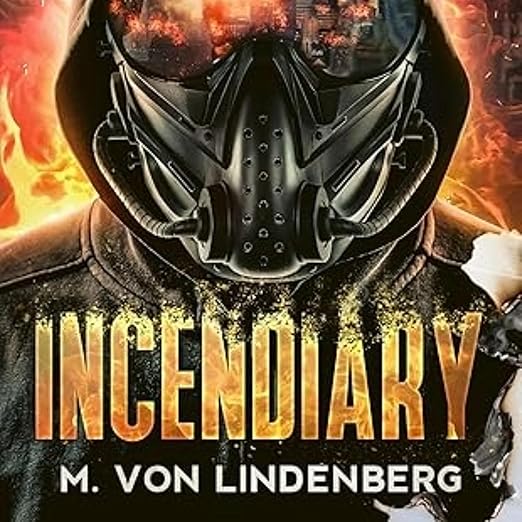
Incendiary by M. von Lindenberg is set not after the apocalypse but during it, a distinction the book earns rather than announces. Whole cities are falling to a plague that causes spontaneous human combustion, and the Spatesmiths, a last-ditch containment force, are sent in to manage what cannot actually be managed. The protagonist Deacon follows orders because the alternative is asking questions that have no answers. That is not a comfortable position to inhabit for nearly three hours, and the book does not let you look away from it.
The Review
The most remarkable thing about this audiobook is how much moral weight it packs into its short runtime. Reviewer James R. called it the only book he would classify as Mid-Apocalyptic, and that framing is exactly right. This is not a story about survivors rebuilding or heroes resisting. It is a story about people who are supposed to be the line between order and collapse, slowly realizing that the line was always a fiction. Deacon's detective-style narration, as one reviewer describes it, gives the story an investigative texture that keeps the pacing taut without feeling rushed.
The comparisons to 1984 and Fahrenheit 451 come up in multiple reviews, and they are not wrong, but they can be misleading. Those books are parables. Incendiary is something rawer. It is less interested in systems of control as ideology than in the small, daily compromises that make those systems possible. Deacon is not a rebel. He is someone who keeps showing up and doing the job until the job becomes something he cannot recognize.
Why Incendiary Works as an Audiobook
Michael Neeb's narration is well-suited to this material. He does not dramatize or overplay the horror, which is the right call. The dread in this story lives in understatement, in the hiss and crackle of fires that no one talks about directly, in orders followed without explanation. Neeb keeps a steady, slightly hollowed-out quality to Deacon's voice that matches the synopsis's phrase: every step forward feels like sinking deeper into the ruins. At under three hours, it is a performance that has to establish character quickly and it does.
Publisher Re-Memory Publishing released this in March 2026, and the five-star reader response suggests an audience that found exactly what they did not expect to find. One reviewer noted that she could not predict where the story was going at any turn. That unpredictability is real. The plot pivots in its final act in ways that reframe what came before without cheating the setup.
The Caveats
The short runtime is both the book's strength and its most significant limitation. Some readers will find the character depth satisfying within that constraint. Others will want more time inside the world and the relationships. Reviewer CWilke observed that the world feels bereft of hope on its surface but that something deeper is still present, and that tension is genuine, but it is developed quickly and some threads feel abbreviated rather than resolved. If you go in expecting the expansive worldbuilding of a full-length dystopian novel, you will finish wanting a second volume. If you go in ready for a contained, pressurized story, the runtime feels intentional rather than insufficient.
The moral ambiguity is also not softened. There are no clean resolutions here about what Deacon should have done differently. The book challenges you, as one reviewer put it, to think long, and then it ends before you have finished thinking. That is not a complaint, but it is worth knowing.
Should You Listen to Incendiary?
This audiobook will land hardest with listeners who gravitate toward literary speculative fiction where the interior experience of a character under pressure matters more than plot mechanics. If you appreciated the moral claustrophobia of Station Eleven or The Road without needing those books' scale, Incendiary will suit you. It is also a strong choice if you want something that can be finished in a single sitting but leaves residue. Listeners who prefer clear heroes, resolution, and redemption arcs will find it frustrating. This is a book about what survival costs, not what it earns.
What does Spatesmith mean in the context of this story?
In Incendiary, the Spatesmiths are a specialized containment unit tasked with managing the fallout from a plague that causes spontaneous human combustion. They function as a kind of last line of defense between order and collapse, erasing evidence and maintaining the illusion of control even as the world disintegrates around them.
Is this a standalone story or part of a series?
Incendiary is currently a standalone release by M. von Lindenberg published through Re-Memory Publishing in March 2026. There is no announced sequel, though the ending leaves room for the world to continue.
Is the mid-apocalyptic setting handled differently from typical post-apocalyptic fiction?
Yes, and that is one of the book's distinguishing qualities. Rather than placing the story after civilization has already fallen, Incendiary sets itself during the collapse, focusing on characters who are still trying to perform institutional roles in a world that is actively coming apart beneath them. The horror comes from that institutional persistence, not from survival in a ruined landscape.
Does the short runtime affect the story's impact?
Reader responses suggest the nearly three-hour runtime is enough for the story being told, though some listeners will want more time in the world. The brevity keeps the pacing pressurized and intentional, but listeners expecting deep worldbuilding or an expansive cast should know they are getting a tightly contained narrative rather than an epic-scale dystopia.