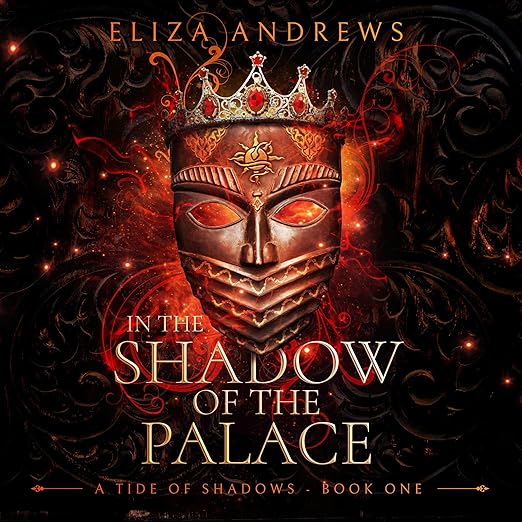
Quick Take
- Narration: Elizabeth Saydah handles Cara’s trajectory from the brothel to the palace with tonal discipline, she does not oversell the vulnerability, which makes the moments of genuine fear more affecting.
- Themes: Survival and reinvention, desire as risk, political education through experience
- Mood: Slow-building and atmospheric, with accelerating intensity in the final third
- Verdict: An ambitious sapphic fantasy debut that earns its lengthy runtime through careful character work, though it asks for patience before it delivers its full rewards.
I came to In the Shadow of the Palace as someone who had not read the Chronicles of Dorsa, the series this prequel precedes. Eliza Andrews is careful to note that prior knowledge is not required, and that is accurate, but it also means I was reading this purely on its own terms, without the additional pleasure of recognition that comes with knowing what these characters eventually become. On those terms, it works. It takes its time working, but it works.
Cara’s situation at the opening is established with stark economy: she is the daughter of a sex worker in a cheap brothel in the most dangerous district of Port Lorsin, and the expectation that she will join that work once she enters puberty is presented not as melodrama but as the simple, grinding logic of her circumstances. The chance friendship that redirects her trajectory, the arrival at the House of Dorsa with its smiles hiding knives, and the gradual deepening of her relationship with Fin, the stable master’s daughter who dresses and carries herself like a boy, are handled with the patient, accumulating attention of a writer who trusts her characters to be interesting without forcing them to be exciting.
Our Take on In the Shadow of the Palace
At twenty-one hours and twenty-three minutes, this is a long listen, and the investment the runtime requires is real. One reviewer described it as starting super slow but perpetually accelerating to the last page, that is an accurate characterization, and it means the experience of the book changes considerably between its first hours and its final ones. The political intrigue of the House of Dorsa, which initially feels like backdrop, gradually reveals itself as the actual terrain of the novel: the place where Cara’s survival skills, developed in the brothel, turn out to be precisely the skills palace politics demands.
The sapphic romance between Cara and Fin is handled with the restraint the setting requires. Desire in the palace is deadly, Andrews establishes this early and means it, and the careful, fearful quality of Cara and Fin’s growing attachment reflects that reality rather than eliding it. Elizabeth Saydah’s narration is excellent in these scenes: she reads Cara’s wanting as something Cara is managing rather than expressing, which is the emotionally honest version of the dynamic.
Why Listen to In the Shadow of the Palace
What Andrews does exceptionally well is the social texture of the palace world. Multiple reviewers praised the worldbuilding and character development, and the representation of characters with disabilities is handled with a specificity that suggests genuine thought rather than gesture. The House of Dorsa is a place where every relationship is partly political, and Andrews tracks that complexity without letting it overwhelm the personal story at the center.
For readers who have completed the Chronicles of Dorsa, this prequel apparently delivers the additional pleasure of seeing how the pieces fit together, one reviewer described understanding foretelling events from the Chronicles after reading this. For newcomers like me, the book stands on its own as a careful, serious fantasy about a young woman who survives through intelligence in a world designed to limit her options.
What to Watch For in In the Shadow of the Palace
The slow opening is the primary challenge. Andrews is building a character and a world simultaneously, and she is not in a hurry. Listeners who need external plot momentum from the first hour will struggle. One reviewer also raised a legitimate concern about the characters being written very young while dealing with very mature issues, the child prostitution context is handled with more care than exploitation, but it is present and some readers will find it uncomfortable regardless of execution.
The 4.7 rating across 232 reviews suggests this has found its audience and is delivering for them. The relatively small review count for a twenty-one-hour listen probably reflects the commitment required to get to the point where the book reveals its full quality, listeners who abandon it in the first few hours will not have experienced what the final third offers.
Who Should Listen to In the Shadow of the Palace
This is for readers who enjoy sapphic fantasy with genuine political complexity and are willing to invest in a slow opening that pays off over a long arc. Fans of the Chronicles of Dorsa will have additional reasons to engage, but newcomers who enjoy fantasy with social realism at its core, who liked, say, Robin Hobb’s patient character-building or Katherine Addison’s layered political worlds, will find this worth the commitment. Listeners who need faster pacing or are uncomfortable with mature content involving minors should look elsewhere.
Frequently Asked Questions
Do I need to have read the Chronicles of Dorsa to enjoy In the Shadow of the Palace?
Andrews explicitly states that prior knowledge is not required, and new readers confirm the story works as a standalone entry point. Existing fans of the Chronicles will have the additional pleasure of recognizing how events here connect to the later series.
How is the sapphic romance between Cara and Fin developed across the twenty-plus hours?
The romance develops slowly and carefully, with both characters acutely aware that desire in the palace carries real danger. Andrews does not rush the arc, it builds alongside Cara’s political education rather than driving the plot independently.
How does the book handle the child prostitution setting, is it graphic or implied?
Andrews handles the context with restraint rather than exploitation, but it is present. One reviewer flagged that characters are written very young while dealing with very mature issues, which some readers found uncomfortable. It is not gratuitous, but it is not softened either.
How does Elizabeth Saydah’s narration handle the tonal range from Cara’s origins to the palace intrigue?
Saydah maintains tonal consistency throughout, she reads Cara as someone managing rather than displaying her emotions, which suits a character who has learned that showing vulnerability has consequences. The palace scenes benefit from that discipline.