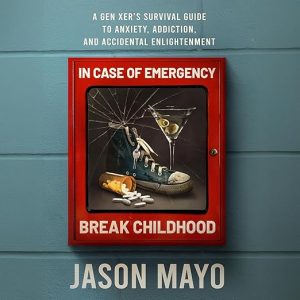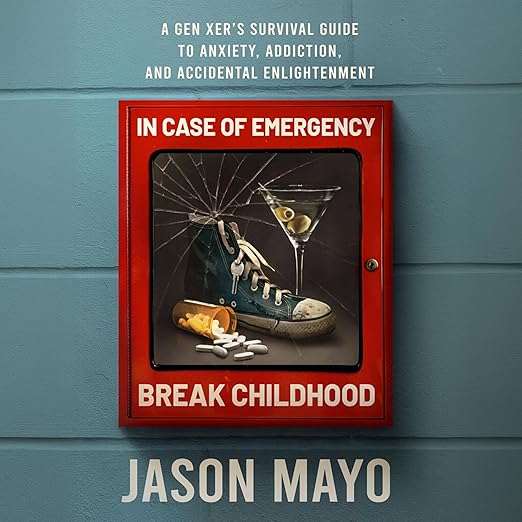
Jason Mayo's craft announces itself in the title of this audiobook, which manages to be funny, ominous, and strangely tender simultaneously. In Case of Emergency, Break Childhood, narrated by Mayo himself across seven hours and forty-one minutes, is part addiction memoir, part Gen X time capsule, and part survival guide for people who spent their adolescence quietly falling apart while appearing mostly fine. That combination of registers, the funny and the desperate operating in close proximity, is what gives this memoir its particular texture and distinguishes it from the crowded recovery narrative shelf.
Mayo opens with coordinates that a certain generation of American will recognize viscerally: a latchkey, a bottomless bowl of Honeycombs cereal, and the particular freedom-that-is-actually-neglect of being unsupervised too young for too long. He is not interested in assigning blame for what came after. He is interested in the mechanisms, in tracing how self-sabotage and emotional landmines and a slow descent into alcohol and pills made a kind of internal logic given what preceded them. That rigorous self-examination, holding himself accountable without self-pity, is the backbone of the memoir.
Humor That Never Deflects From Real Pain
What separates this from comparable recovery memoirs is Mayo's comedic sensibility, which never functions as deflection. Reviewer Tamara Brown describes blowing through the memoir in two sittings because Jason's 'wit and optimism make it an easy read that pulls you right in.' That pull is real in the audio format specifically, because the humor lives in Mayo's delivery. He is not simply writing jokes onto the page. He is performing them as someone who understands that laughter and grief are not opposites but neighbors who share a wall and hear everything through it. Reviewer K Lembo describes the experience of the memoir's early sections as almost physical, the feelings and images from that era rendered with such precision that they become sensory rather than simply intellectual. That level of specificity, the accuracy of depicting a particular American childhood in a particular decade, is what lifts this above generic recovery narrative.
The trading-away passages are where Mayo's honesty is most demanding. He is specific about what he was exchanging: the people he loved for the numbness he craved. He describes that process without self-exculpation and without false retrospective wisdom, acknowledging that at the time the trade felt necessary rather than destructive. He also describes multiple false starts before genuine recovery, the snooze-alarm relationship with rock bottom that many people in addiction will recognize with uncomfortable clarity. Reviewer Demian Boroff calls this 'unflinching awareness of his own flaws,' and that quality is the audiobook's most valuable contribution to the genre.
Mayo's Timing Carries Decades of Lived Experience
The self-narration is essential to how this audiobook works. Mayo's voice carries decades of lived experience in its timing and texture in ways that a hired narrator simply could not replicate. When he pauses before a painful disclosure, you feel the actual weight of that decision. When the joke lands, it lands because you already trust the person making it after hours of accumulated honesty. That earned trust is the audio-specific advantage this memoir holds over the print version. Reviewers consistently describe the book as feeling like he is speaking directly to you, which is exactly what great memoir narration achieves and rarely does.
The audiobook also functions as a kind of generational document. If you grew up in the eighties and nineties with a latchkey and a television for company, large portions of Mayo's story will feel less like reading and more like a recovered memory. The cultural specificity, the particular texture of that era's unsupervised American childhood, is rendered with enough precision to feel like recognition for people who shared those conditions and like illuminating social anthropology for those who did not. The memoir places individual experience within a broader generational context without ever losing its specific, personal grounding.
Tonal Shifts That Some Listeners Find Jarring
Listeners who find comedy-adjacent recovery memoirs tonally jarring, who want addiction stories presented with unbroken seriousness, will find this audiobook's tonal shifts occasionally disorienting. Mayo uses humor the way some people use silence: as a way of approaching something too painful to approach directly. Understanding that the jokes are part of the grief rather than a departure from it is the key to receiving the full weight of the audiobook. Listeners who need content warnings should be aware that the memoir covers addiction, depression, and substance abuse in specific and unsparing detail throughout.
At seven hours and forty-one minutes, this is a substantial listening commitment. Multiple reviewers describe completing it in two sittings because the narrative momentum makes stopping difficult, but it can be listened to across shorter sessions. The arc Mayo builds rewards longer continuous listening where possible, because his structure accumulates emotional weight in ways that reset awkwardly if sessions are too brief and too widely spaced.
Gen X Listeners Will Recognize Every Touchstone
This audiobook is for anyone who grew up as a latchkey kid in the eighties or nineties and has complicated feelings about it, and for anyone who has lived alongside addiction, whether their own or someone they loved. Gen X listeners will find the cultural touchstones feel personally accurate rather than historically reconstructed. Recovery community members will find Mayo's account of the long road to self-acceptance resonant and, according to multiple reviewers, surprisingly hopeful. People who have never struggled with substance issues but want to understand the internal logic of addiction as it actually develops will find this more illuminating than most clinical accounts. Those wanting a straightforward clinical recovery narrative without the humor or the generational framing should look elsewhere.
Key Details
- Narration: Jason Mayo narrating his own memoir is the only correct choice here. His comic timing lands because the pain underneath it is clearly real, making the humor feel earned rather than deployed.
- Themes: Gen X latchkey culture and its aftermath, addiction as internal logic and slow-burn self-destruction, redemption through radical honesty
- Mood: Funny, raw, and quietly triumphant
- Verdict: A Gen X addiction memoir that earns its laughs honestly because Mayo never lets the humor become a shield against the harder truths he is actually telling.
Before You Listen
Does Jason Mayo narrate this audiobook himself, and why does that matter for the listening experience?
Yes, and it is essential to how the audiobook works. His comic timing and emotional honesty make the memoir feel like a direct conversation rather than a reading. The humor lands specifically because the pain underneath it is clearly real, not performed for effect.
Is this audiobook appropriate for listeners in recovery or currently struggling with addiction?
Many listeners in recovery find Mayo's unflinching account and eventual redemptive arc both relatable and encouraging. The audiobook covers substance abuse, depression, and self-destruction in specific detail throughout, so listeners who find that content triggering should approach with awareness of their own limits.
How does this audiobook compare to other Gen X addiction memoirs?
It stands out through its comedic voice and its insistence on locating addiction within a specific generational and cultural context. Where many recovery memoirs aim for universal resonance, Mayo leans into the particular texture of eighties and nineties latchkey-kid culture, making it feel less like a genre exercise and more like a real person's specific story.
How long is this audiobook and is it designed to be listened to in sections or in larger blocks?
The audiobook runs 7 hours and 41 minutes. Multiple reviewers completed it in two sittings because the narrative momentum makes it hard to stop. It can be listened to in shorter segments, but the accumulating emotional weight Mayo builds rewards larger listening blocks where possible.