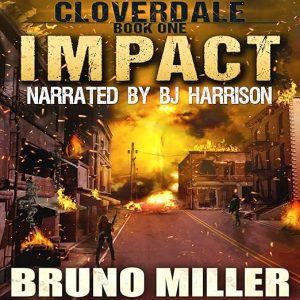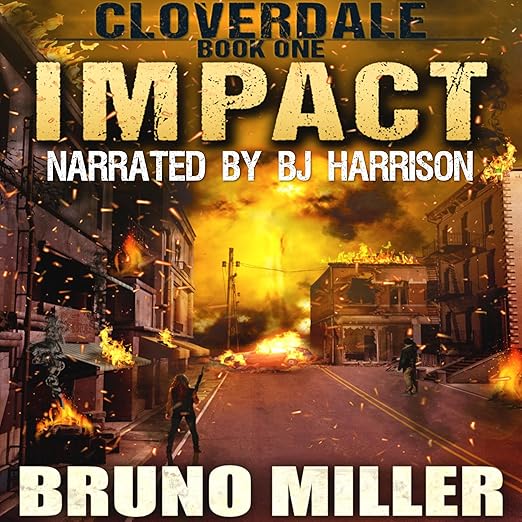
I have a specific soft spot for apocalyptic fiction that cares more about its characters than its disaster-scale world-building. The EMP thriller subgenre tends toward two poles: the survivalist technical manual (meticulously detailed, emotionally cold) and the action-propulsive thriller (emotionally efficient, factually loose). Bruno Miller's Impact, the first book in his Cloverdale series, positions itself closer to the first pole while trying to stay warmer than the archetype usually allows. I listened to it during a long drive home from a visit to family, which felt appropriate in a way I did not fully register until I was about an hour in.
The setup is precise and effective. Vince Walker is at Indianapolis airport picking up his son Cy for the beginning of summer when multiple EMPs detonate across the country. The electrical grid collapses. Fires start. Emergency services vanish. A city of hundreds of thousands suddenly becomes a trap, and Vince, Vietnam veteran, competent in the ways that matter, carrying both the skills and the stubbornness of a generation trained by hard experience, has to get his son home to Cloverdale, Indiana through what is already becoming a wasteland.
Miller's genuine strength is in the father-son relationship. Vince and Cy are not a simple hero-and-dependent pairing; Cy has his own presence, his own reactions to the collapse of the world he grew up in, and the book benefits from treating him as a character rather than a plot function. The scenes where father and son are forced to reckon with violence and loss together carry more weight than the disaster mechanics surrounding them. One reviewer who bounced off an earlier Miller series specifically praised this book for characters who feel real, and that assessment is accurate.
The criticism that appears in several reviews, that Miller has a tendency toward implausible disaster scenarios, particularly around burning buildings blocking streets, is worth noting. The EMP mechanics are handled with reasonable care, but the physical consequences of infrastructure collapse are sometimes amplified past what the science supports. Readers who need technical precision in their apocalyptic fiction may find this aggravating; readers who prioritize emotional plausibility over physical plausibility will be more forgiving.
What Bruno Miller Gets Right
B.J. Harrison is one of the workhorses of the audiobook world, and his narration of Impact is characteristic of his approach: clear, paced for comprehension, emotionally present without being theatrical. Harrison suits the Cloverdale series' register well, this is survivalist fiction that wants to feel grounded rather than cinematic, and his delivery reinforces that tone. At four hours and one minute, this is one of the shorter Audible novels in its genre, and Harrison moves through it efficiently without sacrificing character moments.
The brevity is both a feature and a limitation. If you want a quick, satisfying taste of the subgenre, father-son dynamics, EMP chaos, midwestern America as an apocalyptic setting, Impact delivers exactly that without requiring a major time commitment. If you want a fully developed world and sustained suspense, the series needs to be treated as a unit rather than an individual volume.
Where Bruno Miller Loses Some Ground
The short runtime means the book ends when it is just finding its rhythm. Several reviewers specifically criticized the length, and one long-time Miller fan noted that brevity is a recurring pattern in his work. The Cloverdale series is designed to be read as a continuous narrative, and book one reads more like an extended prologue than a complete story arc. If cliffhanger-ish endings frustrate you, be prepared for Impact to stop at a point that demands the next installment.
The characterization of Vince as a Vietnam veteran also draws some scrutiny in the reviews. One reader found the framing unrealistic given the timeframe, a Vietnam vet of the right age for the action would be quite elderly. This is a credibility concern that surfaces if you think about it, though it does not significantly damage the listening experience if you do not.
Who Bruno Miller Is Writing For
EMP-apocalypse fiction fans who want a quick, character-focused entry in the subgenre that does not dwell on grimness for its own sake will find Impact a comfortable listen. Readers who have enjoyed Miller's other series and are looking for the character warmth his best work provides should find it here. Listeners who need technical precision in their disaster mechanics or satisfying single-volume resolution may want to approach the series with adjusted expectations.
- Read by: B.J. Harrison handles the father-son dynamic and the post-EMP chaos with his characteristic steadiness, which suits the survival-focused tone more than theatrical intensity would.
- At its heart: Fatherhood under pressure, civic collapse after infrastructure failure, the return to physical competence
- Vibe: Tense and grounded, with a deliberate domestic focus that distinguishes it from grimmer apocalyptic work
- Short version: A fast, competently assembled EMP-apocalypse opener that delivers on its father-son premise, though the short runtime limits its ambition.
Questions Listeners Ask
How realistic is the EMP scenario Bruno Miller constructs in Impact?
Reasonably accurate at the macro level, grid failure, loss of electronics, infrastructure collapse, but several reviewers note that some specific disaster consequences, particularly around burning buildings, are amplified past what the physics supports. It prioritizes narrative tension over technical precision in those moments.
Is Impact a complete story, or does it end on a cliffhanger that requires the next book?
It ends at a stopping point rather than a full resolution. The immediate crisis of escaping Indianapolis is addressed, but the broader survival arc continues. Multiple reviewers characterize it as feeling like a long prologue to the series rather than a standalone novel.
How does the father-son relationship between Vince and Cy drive the story differently from other EMP apocalypse novels?
Miller treats Cy as a genuine character rather than a dependent to be protected. The contrast between Vince's Vietnam-era competence and Cy's more modern formation under a functioning civilization gives the relationship texture that purely action-focused EMP fiction usually lacks.