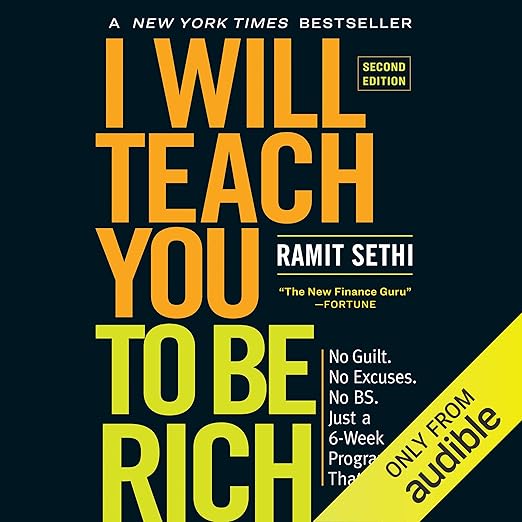
Ramit Sethi does not want you to track every latte. That is not a hook; it is the actual position. The premise of this audiobook, I Will Teach You to Be Rich, now in its completely updated second edition, is that most personal finance advice is structured around deprivation when it should be structured around automation and intentionality. Sethi argues for a six-week system that handles the fundamentals without requiring you to think about money constantly, which frees up psychological bandwidth for spending deliberately on the things that actually matter to you. I came to this one as someone who had already read broadly in the personal finance space and wanted to see if the Sethi approach had anything genuinely new to add. It does.
Credit Cards as a System That Pays You
The book covers four core areas: banking (choosing the right accounts and why most people have the wrong ones), investing (setting up long-term automated contributions that require no ongoing attention), credit cards (squeezing every legitimate benefit out of the system rather than avoiding it out of misplaced fear), and guilt-free spending through the conscious spending plan, which is Sethi's practical alternative to the traditional budget. The second edition also adds material on psychological barriers to financial action, love and money conversations, and updated investment options, which gives the core system more behavioral depth than the original had a decade ago.
The credit card section is particularly sharp. Sethi's argument is that credit cards, managed properly, are a system that pays you rather than one you pay into. The rewards optimization he describes is not about obsessing over point values but about setting up a single card that captures your spending and routes value back systematically. For listeners who have been conditioned to treat credit cards as inherently dangerous, the reframe is useful and the implementation advice is specific enough to act on immediately after the listen.
The conscious spending plan deserves particular attention. Rather than a conventional budget that tracks every category in detail, Sethi suggests allocating percentages of income to fixed costs, savings, investments, and guilt-free spending, then automating as much as possible and not monitoring it obsessively. The behavioral logic is sound: willpower-dependent systems fail when willpower runs out; automated systems run regardless of your mood or your schedule. One reviewer quoted Burton Malkiel calling the book "serious advice on personal-finance decisions" dressed in "breezy, irreverent style," and that description captures the book's particular trick accurately.
Sethi's Combative Directness Sounds Almost Conversational
Sethi's self-narration is one of the strongest arguments for the audiobook format of this title specifically. The voice is direct and occasionally combative in a way that translates the written no-BS register into something almost conversational. He does not perform enthusiasm he does not feel, and he does not soften advice to avoid sounding judgmental. When he tells you that spending three hours researching bank account fees is a worse use of your time than spending thirty minutes setting up automation, he sounds like he means it because he does.
Several reviewers described buying multiple copies and giving them to people they care about, which is a real-world signal of how the book's directness lands with people who put the advice to use. One reviewer noted returning to the book repeatedly and giving it most frequently as a gift, which points to a rereading quality that audio format also supports: the chapters are structured for selective return visits rather than requiring cover-to-cover engagement every time.
The twelve-hour runtime allows Sethi to develop each area with genuine depth. The credit card optimization, investment account setup, and salary negotiation advice are each rendered with enough specificity that you can act on them without supplementary research. The included PDF, available alongside the audio in the library, supplements the listening experience with tables and worksheets referenced throughout the recording.
US-Centric Tools, Portable Principles for Others
The book is explicitly US-centric in its financial infrastructure. The specific bank account recommendations, credit card suggestions, and investment vehicles like the Roth IRA and 401k structures are American products. International listeners or those in different financial systems will find the principles portable but the specific tools inapplicable without local adaptation. The update to the second edition addresses some dating issues, but the specific financial product landscape shifts faster than book publishing cycles.
Sethi's tone is also calibrated for younger earners with some financial slack to work with. The six-week program assumes you have income to automate and debt that is manageable rather than overwhelming. Listeners in genuine financial crisis may find the framing of guilt-free spending premature for their current situation, though the underlying framework of automation over willpower remains useful as a goal to build toward.
Best for Earners in Their Twenties and Thirties
This audiobook is most valuable for people in their twenties and thirties who have income, minimal investment infrastructure, and a sense that they should be doing more with their money but have never gotten around to setting it up. The behavioral approach and automation emphasis will also resonate with people who have tried conventional budgeting methods and abandoned them after a few weeks. Those who are already sophisticated investors with established systems will find less new ground here, though the behavioral chapters and the love-and-money section in the second edition may still offer something worth the listen.
At a Glance
- Performance: Ramit Sethi narrates his own book with the direct, slightly impatient energy of someone who has watched people overthink personal finance for two decades and genuinely wants you to stop.
- What it covers: automation and behavioral finance, credit card optimization, defining a personal rich life
- Feel: Brisk, confident, and occasionally combative in the most useful way.
- Our call: Among the most practically useful personal finance audiobooks available, and the self-narration is a significant part of why it works.