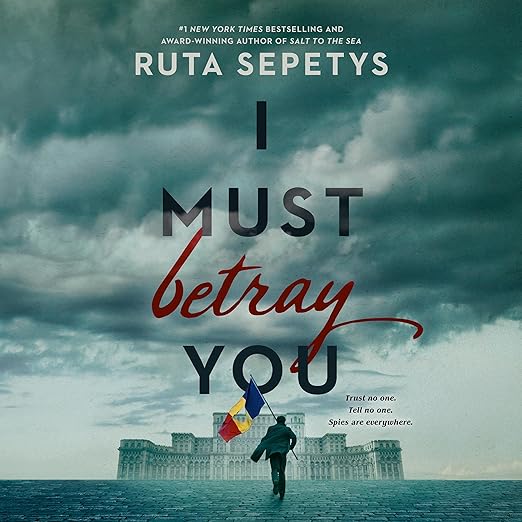
Which shelf does a Carnegie Medal winner about a secret-police informant network belong on? This record files the audiobook under children's audiobooks, adds a teen and young adult category on top of it, and tags the whole thing Mystery and Suspense. The description immediately underneath is about a seventeen-year-old blackmailed into informing on everyone he loves, in a country the copy calls defined by silence and pain. Each of those labels is defensible on its own. Stacked together they will route this title to some listeners who are ready for it and some who are not, and a runtime of seven hours and ten minutes offers no help in telling the two groups apart.
Ballerini's Adult Voice Carries a Teenage Informant
Edoardo Ballerini has those seven hours and one point of view to carry. A reviewer signing as EL describes the book arriving through the eyes of seventeen-year-old Cristian, forced into the role of informant in exchange for leniency over a previous minor infraction, telling the truth through his notebook while staying safe on the surface. That is an unforgiving assignment for a reader. Too much adult polish and the character stops sounding like a boy hiding a notebook; too little and the political weight drains out of the sentences. Listening Library went with an experienced adult voice rather than a young cast, which is the standard call for a narrator this age and the one that loads the whole book onto a single performance.
Cristian's situation is the mechanism, and it is cleaner than most thriller premises. He is blackmailed into informing. He can betray the people he loves, or he can use the position to undermine the regime from inside it. The copy says he takes the second road, joins the revolution when it arrives, and is left with the question of what freedom costs. The copy also asks you to swallow a heavy phrase lightly: he can, it says, creatively undermine the most notoriously evil dictator in Eastern Europe. What that creativity amounts to is where the actual suspense lives. Seven hours and ten minutes is not long for the collapse of a police state, and the compression looks deliberate: the reviewers who describe the experience reach for the same register, hard to put down, very engaging, addicting.
Sepetys Builds Real Research Around an Invented Person
Ruta Sepetys arrives with credentials the copy is glad to list: a number one bestseller banner, the Carnegie Medal, a starred Kirkus notice crediting a blend of research and craft that very few writers can manage, and two earlier titles named in passing, Salt to the Sea and Between Shades of Gray. Nicole Sergov awards four stars and supplies the useful version of that same claim, describing a writer who picks subjects most people know little about and builds genuine research and interviews around an invented person. That is an accurate statement of the contract this book is offering, and it matters to a listener: the boy is fiction, the machinery around him is not.
Carol A. Keljo's entry is the one I would hand to somebody still deciding. It calls the book eye-opening about life under communism, admits to not having realized this was happening so recently, and then does what good reviews do, which is name the cost. Incredibly educational as well as readable, it says, although graphic and painful at times. That final clause is the practical guidance the category fields conspicuously fail to give, and anybody choosing off a children's shelf should read it before reading the stars.
Kyrie Wayment addresses the age question head on, calling this a wonderful piece of historical fiction for teens and young adults that handles difficult themes like grief and oppression well, then closing on a remark about the physical book being of good quality. Print observation, audio page, and the two sit together without comment. Between Wayment's framing and Keljo's warning you can build a usable range: old enough for state violence and betrayal, patient enough for a story where the pressure comes from surveillance instead of pursuit.
Twenty-Four Points, Five Votes, One Missing Star
Add up the stars in the column and you get a number the badge refuses to match. Five people have rated this title and all five of them wrote something: four fives and a four, which comes to twenty-four points across five votes. A 4.6 badge over five votes requires exactly twenty-three. One point has gone missing between the reviews you can read and the figure printed above them, and nothing on the page accounts for it.
Sergov's entry carries a smaller version of the same trouble. The body opens with the number 4.5 while the star field records a four, which is what happens when readers score in halves and a whole-star system rounds them off. The cumulative effect is a book whose written column runs uniformly warm showing up marginally cooler than its readers actually describe it. None of that makes 4.6 wrong. It does mean the badge is not the sum of what you can see, and with only five entries to weigh, that gap is wide enough to notice.
Rene, at five stars, is the outlier worth flagging, because it is barely about the book. It uses the novel as an argument, addressing readers who dislike or fear capitalism, offering this as the flip side, and closing on the observation that the American system of wealth and governance is imperfect but free. Agree with the politics or do not; either way that is a review of a position rather than of a story or a performance, and it carries the same weight in the average as Keljo's careful paragraph about what the book costs to read.
Tension Comes From What Cristian Does Next
Teachers and parents have an easy recommendation here for a listener around high school age, and one reviewer proposes exactly that audience in the title of the entry. It is short, it moves, the moral problem is legible without being simple, and the history sits close enough to the present that a young listener can trace the line forward without help.
Hold it back from the younger child who might reach it through the children's category this record sits in, because the material includes state terror, betrayal inside a family, and what one reviewer calls graphic and painful detail. Anyone expecting the mystery the tag promises should adjust as well. The tension in this book is not who did it. It is what a seventeen-year-old does next with information he never asked to be handed.
Before You Press Play
- Narration: Edoardo Ballerini alone for seven hours, holding a seventeen-year-old's point of view against the adults leaning on him
- Themes: Coerced informing, a notebook as resistance, family loyalty against self-preservation, the price of a revolution
- Mood: Close, watchful, quietly frightening
- Verdict: A short, fast historical thriller with real research behind it, though the children's category it sits in serves nobody well.
Frequently Asked Questions
What age is this audiobook actually appropriate for?
This listing carries children's audiobooks and teen and young adult at once, which is a wide gap to straddle. One reviewer recommends it for teens and young adults; another calls it graphic and painful at times. Treat high school as the floor and expect state terror, coerced informing, and a family under surveillance.
How much of this audiobook is documented history?
The description calls it a historical thriller examining a little-known history, and a reviewer describes real facts and interviews compiled around a fictional person. So the regime, the informant network and the 1989 revolution are documented; Cristian Florescu is invented. Seven hours and ten minutes is brisk for that much ground.