Quick Take
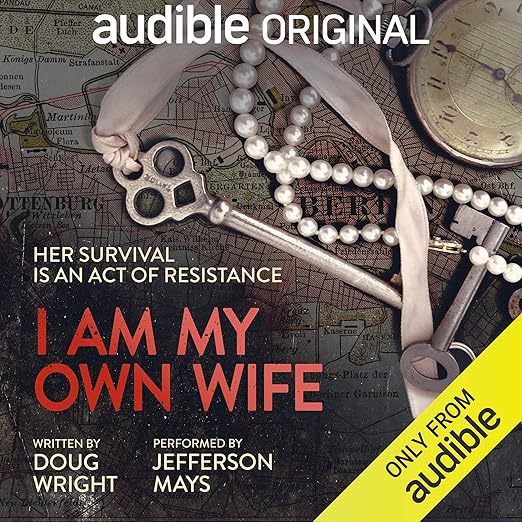
- Narration: Jefferson Mays reprises his Tony Award-winning stage performance, a genuinely extraordinary achievement in single-performer audio drama.
- Themes: Transgender survival under authoritarian regimes, the complexity of complicity, identity as resistance
- Mood: Taut and theatrical, with the intimacy of a solo performance and the moral weight of a true story that refuses easy conclusions
- Verdict: A Pulitzer Prize and Tony-winning drama that translates to audio with full force, one of the most powerful single-narrator performances in the Audible catalog.
I started this on a Tuesday evening, thinking I would listen to the first twenty minutes before bed. Eighty-five minutes later, when Jefferson Mays spoke the final lines, I sat completely still for a moment before I could think of anything else to do. I Am My Own Wife is that kind of experience. It is not long, just over an hour and a half, but it compresses an entire life and several decades of history into a space so tight and so precisely constructed that it expands in the mind long after the audio ends.
Doug Wright’s Pulitzer Prize and Tony Award-winning play tells the true story of Charlotte von Mahlsdorf, a transgender woman who survived both Nazi Germany and the East German Communist regime. Based on interviews conducted by the playwright over several years, the play dramatizes not just Charlotte’s story but Wright’s own process of understanding it, including the moral complications that emerge when the full picture becomes clear. Charlotte survived through a combination of cunning, bravery, and a defiant refusal to be extinguished, and the play holds both the courage and the complexity of that survival without resolving either into comfortable narrative.
Our Take on I Am My Own Wife
The theatrical structure is central to understanding why this work functions as powerfully as it does. Jefferson Mays plays every character: Charlotte, Wright himself, the Stasi officers, the Nazi functionaries, the East German neighbors, and more than thirty distinct voices in a performance that won him the Tony Award for Best Actor. The audio format strips away the visual element of the stage production, but what remains is, if anything, more concentrated. You are left with Mays’s voice and the text, and that is enough. The experience is closer to a great radio drama than to a conventional audiobook, and listeners who approach it with that frame will find it fully realized.
Why Listen to I Am My Own Wife
At 1 hour and 25 minutes, this is among the shortest titles reviewed on this site. But the runtime should not suggest thinness. What Wright and Mays accomplish in that time is something that longer works rarely achieve: they make a historical figure so vivid and so morally complex that you carry the questions the play raises well beyond the final scene. Charlotte’s survival required, at some point, accommodation with the regimes that threatened her. The play does not resolve this into a simple verdict; it presents the complication and asks the listener to sit with it. That refusal of easy answers is one of the things that distinguishes genuine drama from mere storytelling.
What to Watch For in I Am My Own Wife
Because this is a recorded theatrical performance rather than a traditional audiobook narration, listeners should approach it accordingly. There is no narrator explaining what is happening. Mays shifts between characters through vocal transformation alone, and the transitions require a certain kind of active listening. The first ten minutes establish the performance language, and listeners who give it that calibration period will find the subsequent work easy to follow. Those who have seen stage productions of the play will find the audio version a complementary rather than a lesser experience; those encountering the work for the first time have the advantage of coming to Mays’s performance without prior visual associations.
Who Should Listen to I Am My Own Wife
This audiobook belongs in any listener’s collection who cares about LGBTQ+ history, twentieth-century European history, or simply great theatrical performance. It is one of the most powerful documents about transgender survival available in any format, and it handles its moral complexity with a rigor that makes much of the more recent work in this space look simplified by comparison. Listeners who enjoy audio drama will find it among the best examples the format has produced. Those who are new to audio drama and approach it prepared for a different listening experience than conventional audiobooks will find it extraordinary. Brief as it is, it is not forgettable.
Frequently Asked Questions
Does I Am My Own Wife work as an audiobook if you have never seen the stage play?
Yes, and arguably better. Coming to the material without prior visual associations means you encounter Mays’s vocal performance on its own terms. The play is written to be accessible without staging. Wright designed it for the intimacy of a direct encounter between performer and audience, and the audio format preserves that intimacy.
Jefferson Mays plays all the characters. How easy is it to follow who is speaking?
Mays is a technically exceptional performer, and the vocal distinctions between characters are clear. The first few minutes establish the performance language, and listeners who give those minutes the necessary attention will find the transitions between voices easy to follow throughout. The text also signals character shifts explicitly when needed.
What are the moral complications in Charlotte von Mahlsdorf’s story that the play explores?
The play gradually reveals that Charlotte’s survival under both the Nazi and East German Communist regimes may have involved some degree of accommodation or cooperation with those regimes, particularly the Stasi. Wright does not reach a definitive verdict; he presents the evidence and the ambiguity and allows the listener to sit with the discomfort. This moral complexity is central to the work’s power.
Is this audiobook appropriate for listeners who want a comprehensive biography of Charlotte von Mahlsdorf?
No. This is a theatrical drama drawn from Wright’s interviews with von Mahlsdorf, not a biography. It is intensely focused on specific episodes and moral questions rather than comprehensive life documentation. Listeners wanting a fuller biographical account should seek other sources; listeners willing to engage with the dramatic and moral dimensions of a specific slice of that life will find the play extraordinary.