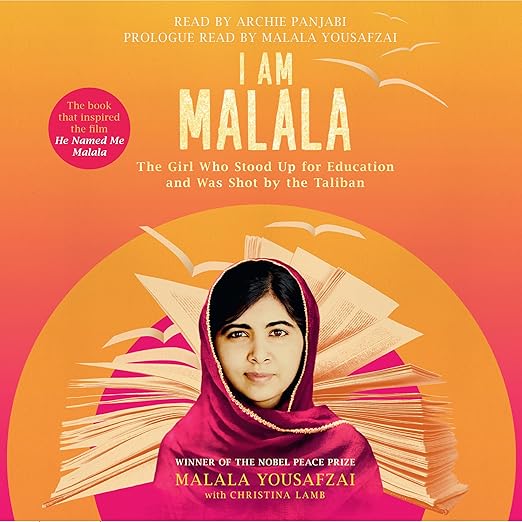
A Taliban gunman boarded Malala Yousafzai's school bus in Pakistan's Swat Valley on October 9, 2012, and this audiobook builds outward from that single afternoon into the fuller story of the girl who nearly died for insisting that girls belonged in classrooms. Archie Panjabi narrates the bulk of the memoir, with Malala herself reading the prologue, so the audiobook opens in the subject's own voice before handing the story to a professional narrator for the long middle stretch.
The memoir was written with journalist Christina Lamb, whose experience covering Pakistan and Afghanistan shapes the book's willingness to sit with political complexity rather than simplify it into a single villain narrative. That collaboration shows in how carefully the audiobook lays out the different factions competing for influence in the Swat Valley before the Taliban's rise, rather than presenting the region's history as a blank backdrop for one girl's courage.
The memoir moves well beyond the shooting that made international headlines. Malala and her co-writer trace her father's own activism running a school in the Swat Valley, the Taliban's gradual takeover of the region and the fear that spread through it, and the political aftermath of her recovery, culminating in her United Nations address and Nobel Peace Prize. The scope is closer to a family and regional history than a single-incident survival story, and listeners expecting only the shooting and its immediate aftermath will find a much wider frame.
Malala's father, Ziauddin, emerges as a central figure in his own right rather than a supporting player in his daughter's story. A poet and educator who ran his own school in defiance of mounting pressure, his conviction that his daughter deserved the same education as any son shapes the family dynamic the memoir returns to repeatedly, and the audiobook makes clear that Malala's activism grew out of a household argument already underway before the Taliban made it a matter of life and death.
Why I Am Malala Works as an Audiobook
Panjabi, known to many listeners from her screen work, brings a controlled clarity to material that could easily tip into melodrama in less careful hands. She lets the facts of Taliban rule in the Swat Valley, the school closures, the public floggings, the fear that kept families indoors, carry their own weight rather than performing outrage on top of them. That restraint matters for a story this serious; it trusts the listener to feel the horror without being told how to feel it.
Panjabi shifts subtly between registers as the story moves from childhood memory to political reporting to the immediate aftermath of the shooting, without ever breaking the sense that a single consistent narrator is guiding the listener through all of it. The hospital chapters, covering Malala's recovery and her family's disorientation in an unfamiliar country, are handled with particular care, neither rushed past nor lingered over for effect.
The prologue in Malala's own voice is a genuine addition rather than a marketing flourish. Hearing her introduce her own story before the narration shifts to Panjabi gives the audiobook a personal frame that the print edition cannot replicate, and it sets a tone of directness that Panjabi sustains through the chapters that follow.
Weak Spots in I Am Malala
One thing worth flagging clearly: this is the original adult memoir edition, not the illustrated Young Readers Edition or the picture book Malala's Magic Pencil, despite a childrens-audiobooks tag attached to this listing. At just under ten hours, with detailed political history and descriptions of Taliban violence, this edition suits older teens and adults far more than young children. Families looking for something for a younger reader should confirm they are getting the Young Readers Edition specifically before pressing play.
The pacing slows during the political history chapters covering Pakistani governance and the region's history before Malala's birth, which some listeners will find essential context and others will experience as a detour from the personal narrative they came for. It rewards patience; the personal story regains momentum once Malala's own adolescence and activism take over.
Listeners used to a faster-moving memoir built around a single dramatic arc may find the density of place names, political factions, and historical detail more demanding than expected going in. Malala and her co-writer are clearly building toward accuracy and context rather than streamlined drama, which is the right choice for the material but does mean the audiobook occasionally reads closer to reported nonfiction than personal narrative in its middle stretch.
The Right Listener for I Am Malala
This audiobook suits older teens and adults interested in memoir, contemporary Pakistani history, or the global education rights movement Malala has come to represent. It also works well for classroom or book club use given the added regional and political context beyond the shooting itself.
Listener reactions bundled with this edition describe the book working across a wide age range, from readers encountering the story fresh to those using it in an educational setting to unpack themes of courage and civic responsibility. That range tracks with the book's actual content: it functions simultaneously as personal memoir, regional history, and a case study in nonviolent political resistance, which gives it more entry points than a narrower survival narrative would offer.
It is a strong pick for discussion groups covering global education, human rights, or contemporary South Asian history, given how much regional and political context surrounds the personal narrative. Listeners specifically seeking content for young children should look for the Young Readers Edition instead, since this full memoir does not soften its account of Taliban violence for a younger audience.
Educators considering this for a classroom setting should note that the full memoir's political detail, floggings, executions, and the specifics of Taliban ideology, requires more preparation and context-setting than the Young Readers Edition would, but rewards that preparation with a far richer discussion of how ordinary civic life erodes under extremist rule.
Key Details
- Narrator: Archie Panjabi narrates with restraint that lets the material's horror speak for itself, and Malala Yousafzai's own voice opens the prologue.
- Subjects: girls' education, Taliban rule in the Swat Valley, activism, survival
- Tone: Sober and ultimately hopeful
- Bottom line: A powerful full-length memoir best suited to teens and adults, not the young children the childrens-audiobooks tag might suggest.
Before You Listen
Is this audiobook edition appropriate for young children, or is it the adult memoir?
This is the original adult memoir edition at just under ten hours, not the illustrated Young Readers Edition, so it suits older teens and adults rather than young children despite how this listing is tagged.
Why does Malala Yousafzai read only the prologue instead of narrating the whole audiobook?
The prologue in her own voice sets a personal frame for the story before Archie Panjabi takes over the narration for the full memoir, a common structure for memoirs read primarily by a professional narrator.
Does this audiobook cover events after the 2012 shooting?
Yes. It follows Malala's recovery, her family's relocation, her United Nations address, and her Nobel Peace Prize, alongside earlier chapters on her father's activism and the Taliban's takeover of the Swat Valley.
Is this the same audiobook as the Young Readers Edition of I Am Malala?
No. This is the original full-length memoir; the Young Readers Edition is a separate, shorter adaptation aimed specifically at younger listeners.