Quick Take
- Narration: Marc Vietor handles the Canterbury Tales-style structure elegantly, differentiating each pilgrim’s voice without overplaying the ensemble nature of the storytelling.
- Themes: The nature of time, human sacrifice and meaning, the tension between civilization and its destroyers
- Mood: Dense, literary, and mythic, rewards patient listeners with one of science fiction’s most satisfying structural payoffs
- Verdict: A landmark of the genre that holds up completely, Vietor’s measured narration is the right vessel for Simmons’s richly layered storytelling.
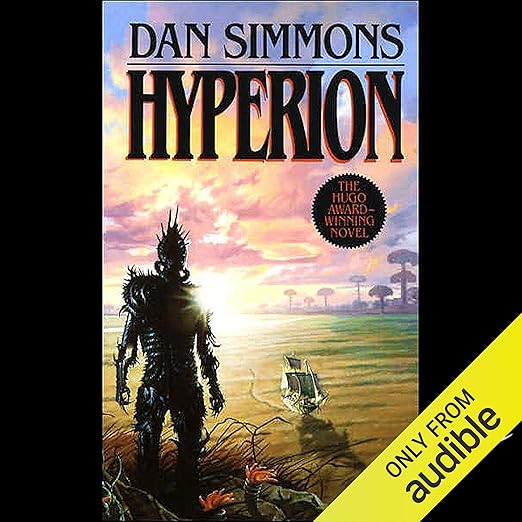
I first encountered Hyperion in print, years ago, and when I returned to it in audio form I discovered something I had not expected: Marc Vietor’s narration does something the print version cannot. The Canterbury Tales structure of the novel, seven pilgrims, each telling the story of their connection to the planet Hyperion and the creature called the Shrike before they reach the Valley of the Time Tombs, becomes more embodied in audio. Each tale has a different genre register, from military thriller to detective noir to pastoral romance, and Vietor navigates those shifts with a restraint that honors the writing rather than performing it. I found myself more moved by the Priest’s Tale than I remembered being the first time, which I attribute partly to the quality of the delivery and partly to having more life behind me to bring to it.
Dan Simmons published Hyperion in 1989, and the reviewer who called it shocking that nothing felt dated is right. The novel’s central concerns, the relationship between human civilization and the forces that might destroy or transform it, the question of what we owe each other and what we would sacrifice for meaning, are as pressing now as they were then. Simmons was operating with a sophistication about the history of science fiction that allowed him to synthesize it rather than merely participate in it, and the resulting novel reads simultaneously as genre entertainment and literary ambition.
Our Take on Hyperion
What Simmons built here is a frame narrative, the seven pilgrims share their stories as they travel to meet the Shrike on the eve of a galaxy-wide war, but each internal story is told in a genuinely different mode. The Priest’s Tale is horror, with echoes of Conrad’s Heart of Darkness transposed to alien jungles. The Soldier’s Tale is military science fiction of the most technically rigorous kind. The Poet’s Tale is Byronic grotesquerie, centering on a character named Martin Silenus whose relationship to pain and creativity is deeply unsettling. The Scholar’s Tale, concerning a man whose daughter ages backwards through time in the vicinity of the Time Tombs, is quiet heartbreak at the scale of a Greek tragedy. These are not merely different perspectives on the same events; they are different literary forms interrogating the same mystery from irreconcilable angles.
The Shrike itself, the creature called by some a god, by others a demon, by others the Angel of Final Atonement, is one of science fiction’s great creations. Simmons keeps it largely offscreen in this first volume, building its presence through what others have survived or failed to survive, and the restraint is perfect. What you imagine is more terrible than any direct description could be.
Why Listen to Hyperion
Marc Vietor narrated the Audible Studios production in 2008, and the recording remains one of the better realizations of classic science fiction in audio form. His voice has the quality of a seasoned reader, measured without being slow, authoritative without being theatrical. At twenty hours and forty-four minutes, this is a committed listen, but the story provides enough structural variety across the seven tales that the length never becomes a problem. Each tale functions as its own discrete experience while contributing to the accumulated weight of the whole.
Multiple reviews note the book’s position on recommended SF lists, and it belongs there. The French reviewer who called it one of his great classics of the genre echoes a consensus that has held across decades and across languages. This is a book that repays attention.
What to Watch For in Hyperion
The novel is the first half of a two-part story. The Fall of Hyperion concludes the immediate narrative, and the two books together constitute the core of the Hyperion Cantos, followed by the Endymion sequence. Hyperion ends not with resolution but with a question, the pilgrims reach their destination, and the reader is left at the threshold. This is an intentional structural choice, not an incomplete novel, but listeners who need closure within a single volume should know that the story demands its sequel.
The Poet’s Tale is genuinely disturbing in a way that the other tales are not. Silenus is an unpleasant character, and his sections are the most difficult to inhabit. Simmons earned this difficulty, the character is doing real thematic work, but it is worth knowing in advance that the reading experience is not uniformly pleasant.
Who Should Listen to Hyperion
Science fiction readers who want a novel that takes the form’s literary possibilities seriously will find Hyperion essential. It sits alongside Ursula K. Le Guin’s The Dispossessed, Samuel R. Delany’s Dhalgren, and Gene Wolfe’s The Book of the New Sun as an example of SF that operates simultaneously as genre entertainment and literary ambition. The audiobook format is an excellent vehicle for the frame narrative structure, and Vietor’s narration makes a demanding text accessible without simplifying it. Those who prefer science fiction with a single strong narrative arc rather than an anthology structure may find the format challenging, but patience is rewarded. Anyone who considers themselves a reader of the genre and hasn’t encountered Hyperion yet should correct that immediately.
Frequently Asked Questions
Do I need to read The Fall of Hyperion immediately after, or can Hyperion stand alone?
Hyperion ends at a significant threshold moment rather than with resolution. It is artistically complete as a first volume but tells only half the story. The Fall of Hyperion is the direct sequel and most readers find them together necessary. Plan to listen to both.
How does Marc Vietor differentiate the seven pilgrims and their tales?
Primarily through pacing and tonal calibration rather than through exaggerated vocal differentiation. Each tale has a different literary register, and Vietor adjusts his delivery accordingly, more measured for the Scholar’s Tale, more taut for the Soldier’s Tale, without resorting to performed character voices that would undermine the literary seriousness of the material.
Is this science fiction, fantasy, or something else?
It is formally science fiction, interstellar civilization, faster-than-light travel, artificial intelligence, advanced technology, but it draws heavily on literary and mythological traditions, including Keats (whose poem Hyperion is woven throughout), Greek tragedy, and Chaucer. The ‘mix of sci-fi and fantasy’ description from one reviewer captures something real about its hybrid character.
How violent and disturbing is the content?
Significantly so in places. The Shrike is a creature of elaborate violence, and several of the pilgrim tales deal with trauma, loss, and horror directly. The Priest’s Tale has strong horror elements; the Poet’s Tale contains disturbing psychological content. This is not gratuitous, but it is not gentle either.