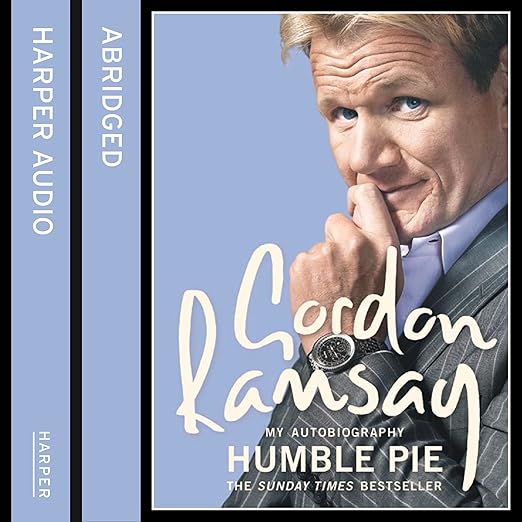
Gordon Ramsay's autobiography arrives as an audiobook with the reader field left completely empty, and that gap is the first thing a buyer should know. Nobody is credited with the performance. Three hours and one minute of a chef's autobiography arrive with a byline, a publisher line reading HarperCollins, an October 2006 date and no answer at all to the most basic question anyone asks about a spoken-word purchase. Whether the voice you hear belongs to Ramsay, to a hired reader or to somebody else entirely is a thing the listing declines to establish.
A Closer Look at Humble Pie
Ramsay's book is a genuinely good one, and its structure is visible right there in the jacket copy, which survives on the record as a run of slash-separated bullets that used to be a printed list. Six subjects: a childhood shaped by a father's alcoholism and violence; a first career as a soccer player, signed by Glasgow Rangers at fifteen and finished by injury three years later; a brother's heroin addiction; the trade learned in Paris and London under Albert Roux, leading to seven Michelin-starred restaurants; life behind the kitchen door; and the cost of fame, including television and the tabloids. The record files all of that under home and garden.
Candor about the unflattering parts is what lifts this above the celebrity-chef shelf. A four-star response puts it plainly, describing a book that gives real insight into the competitive restaurant business and into Ramsay's upbringing, written so it reads easily, with a fair amount of British slang and swearing intact. That same entry lands on the book's actual moral: hard work eventually pays, which is the argument Ramsay has spent a career making in public and is finally making here with evidence attached.
What Makes Humble Pie Worth Hearing
The empty reader slot changes what a sample is for. Normally a credit line settles the format question before you press play, and here the sample is the only place to establish who is speaking and whether the delivery suits a memoir that swings between domestic violence and kitchen comedy inside the same chapter. That range is the real demand this text makes on whoever recorded it: the same voice has to handle a father's drinking, a brother's addiction and a service-time tirade without flattening the three into one tone. Play a passage from the childhood material before buying.
A five-star entry gets closer than the marketing to what people actually come for. Having watched the television shows and wanted to understand where the man came from, its writer describes a management style not for the faint of heart and methods that cross into verbal abuse, then credits the book with showing that this behavior is a direct product of what formed him. That is the useful reading. The book is not a defense and not a takedown; it is an origin story that lets you draw the line yourself.
The 2006 vantage point is worth valuing rather than discounting. Restaurants and kitchens are still the center of gravity in this telling, and fame arrives in the jacket's own summary as something to be coped with, filed alongside the rapacious tabloids rather than alongside the seven starred restaurants. Celebrity memoirs written from the far side of that transition rarely keep the balance this way around, and it makes the book feel closer to the kitchens it describes.
Things to Know Before Starting Humble Pie
Three hours is the number to sit with. Six substantial subject areas across a running time this short works out to roughly half an hour each for a childhood, a professional sports career, a sibling's addiction, a culinary apprenticeship across two countries, seven starred restaurants and a television life. Either the book is genuinely compact, or this recording is a condensed version of a longer text, and the record uses no word one way or the other. Both readings are consistent with what the page shows, and only the sample will separate them.
Nothing in the written column was written about an audio product. One five-star reports buying the book after rewatching a television series, says it reads as though the subject wrote it himself rather than as a biography, calls it an easy read you will want to finish in one sitting, and warns non-British readers that the idioms take a moment to work out from context. Idioms figured out from context are a page reader's problem. Every response on the record is written in the same register, about a text somebody read.
The badge follows the same logic. A 4.6 average sits on top of a single recorded vote, which no lone voter can produce, and the explanation is provenance rather than arithmetic: the score and the responses were gathered on the printed edition and carried across to this listing with the number still attached. The publisher line supports it, naming a print house rather than an audio imprint. So does the shortest entry on the page, five words long, thanking Ramsay for a book that got its writer through a hard time.
Who Gordon Ramsay Is Writing For
Anyone who watches the television shows and wants the biography underneath them is the obvious buyer, along with restaurant workers who will recognize the kitchen material immediately. It also works for readers of sports-to-second-career stories, since the Glasgow Rangers years and the injury that ended them are not a footnote here but the first hinge of the whole life. At this length it is an easy single-sitting listen, which suits a subject who does nothing slowly.
Skip it if you want food writing. Recipes, technique and the pleasures of eating are not the subject; this is a life story that happens to take place in kitchens, and the record filing it beside gardening will mislead anybody browsing by category. Listeners who dislike profanity should note that the description opens by calling its subject rude and loud. Cooks hoping for a masterclass will find an autobiography instead, and a fairly raw one, told by a man whose formative years were harder than his public reputation ever suggested.
At a Glance
- At its heart: a violent childhood, a sports career cut short, ambition as survival
- Vibe: Blunt, fast-moving, more wounded than the reputation suggests
- Short version: A strong short memoir, though the record leaves the reader unnamed and the badge belongs to the printed edition.