Quick Take
- Narration: Nick J. Russo handles the dual perspective structure cleanly, distinguishing Bryce and Kitari’s voices in a way that makes the alternating chapters feel like genuinely different characters rather than the same narrator with minor inflection adjustments.
- Themes: Forbidden interspecies romance and omegaverse dynamics, cultural collision and belonging, found family versus biological duty
- Mood: Action-packed and emotionally warm, with steady romantic tension throughout
- Verdict: A confident sequel that expands the Coveted Bonds universe without losing the character warmth that made the first book work, though new listeners should start with book one.
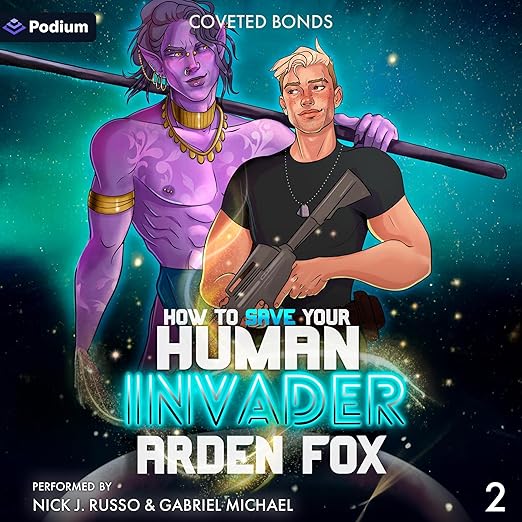
I came to How to Save Your Human Invader having not read the first book in Arden Fox’s Coveted Bonds series, and I want to be honest about that as a starting point for this review. The second book is not, by design, a standalone entry. It assumes you know the world, the Alder as a species, the human omega dynamics that Fox has established, and several returning characters who arrive already carrying the weight of their histories. I spent the first hour or so reading context around the book rather than into it, which is not the author’s problem but is relevant information for any listener considering starting here.
The premise: Bryce, a human military pilot, is part of a rescue team sent to retrieve a captive soldier from the Alder, an alien species depicted as ruthless and physically imposing. When Bryce’s rescue goes sideways and he is stranded in the jungle with an Alder named Kitari, the omegaverse framework kicks in. Bryce, it turns out, is a rare human omega. Kitari, who was sent on a dull administrative duty and ended up investigating the alien crash against orders, recognizes Bryce’s designation and cannot ignore it. Their connection is immediate, involuntary, and inconvenient given that their species are essentially at war.
The Genre Architecture Fox Is Working In
MM sci-fi romance operating with omegaverse mechanics occupies a specific and dedicated corner of the audiobook market. The genre conventions are fairly established: alpha and omega pairings carry biological and social weight that creates both attraction and conflict, the forbidden dimension usually involves external pressure (family, politics, biology working against the pairing), and the resolution requires both characters to choose each other against those pressures. Fox works within this architecture rather than against it, which is neither a criticism nor a compliment, simply an accurate description of what the book is doing.
What distinguishes How to Save Your Human Invader from less effective entries in the genre is the quality of the characterization within those conventions. Reviewer Megan Fisk described Bryce and Kitari as optimistic, chaotic, and fiercely protective of each other, and their playful interactions and mutual support as adding warmth to a plot packed with alien jungle dangers and political intrigue. That warmth is real. Fox writes characters who are entertaining to spend time with independently of the romantic arc, which is harder than it sounds and rarer than the genre’s detractors assume.
Action as Structure, Not Decoration
Reviewer Tricia, who noted the book is jam packed and full of nonstop action that makes it difficult to put down, identified something Fox does particularly well: the action is not pacing filler between romantic beats. The jungle survival sequences, the political maneuvering within Alder society, and the ongoing tension around Bryce’s team’s rescue mission all function as genuine narrative stakes rather than backdrop. This was noted by reviewer Karina Salate, who wrote that the writing has the same depth as the first book and that there is a bit more action, attributing it to Bryce’s tendency toward accidents, which adds an element of self-aware humor that keeps the tension from becoming relentless.
The alien jungle setting is well-constructed. Fox gives the Alder world enough physical specificity that the environment functions as a character: the jungle has dangers, resources, rules of its own. This grounds the romance in a place rather than in an abstracted emotional space, which is one of the ways SF romance can distinguish itself from contemporary romance in the same genre category.
Nick J. Russo and the Dual Perspective Challenge
The book alternates between Bryce and Kitari’s perspectives in alternating chapters, which is a demanding structure for any narrator. Russo handles it with noticeable skill. Bryce’s chapters are narrated with a looser, more colloquial energy that fits the human military pilot archetype. Kitari’s chapters carry a more formal quality that reflects his species’s social hierarchy and his own position within it. These are not dramatically different registers, but they are consistent enough that the chapter breaks feel like genuine shifts in consciousness rather than arbitrary divisions. At nine and a half hours, Russo maintains that distinction throughout without losing momentum.
The mature content signaling in the synopsis is accurate. This is an explicitly romantic audiobook with physical scenes between the main characters. Listeners looking for a closed-door or fade-to-black treatment of the relationship will not find it here. Listeners who have specifically sought out MM sci-fi romance in this format will find the scenes handled with the same warmth and care as the rest of the characterization.
Who Should Listen and Where to Start
Start with book one of the Coveted Bonds series. Fox’s world has enough established context that entering at book two creates unnecessary friction, and the reviewer consensus is that the series is strong enough to warrant the investment from the beginning. Reviewer Mary C. confirmed that both books have been really good and that the humor is present without tipping into slapstick, with a nice plot, lots of adventure and lots of feeling. That is an accurate summary of what the series delivers.
For listeners who enjoy MM romance in science fiction settings, who respond to omegaverse dynamics handled with warmth rather than darkness, and who want the action-to-romance ratio weighted more toward action than the genre average, the Coveted Bonds series is working at a high level. How to Save Your Human Invader is a worthy continuation of what Fox started.
Frequently Asked Questions
Can How to Save Your Human Invader be listened to without reading the first Coveted Bonds book?
Technically yes, but reviewers and the narrative structure both suggest starting with book one. The world-building, character relationships, and omegaverse rules established in the first book are assumed knowledge here, and entering at book two creates a meaningful information gap in the early chapters.
How explicit is the romantic content in this audiobook?
The synopsis marks it as for mature listeners, and the physical scenes between Bryce and Kitari are explicit rather than suggestive. This is consistent with the genre’s conventions for MM romance. Listeners who prefer less explicit content should treat the mature listener designation as an accurate signal.
How does Nick J. Russo differentiate between Bryce and Kitari’s alternating first-person chapters?
Russo uses subtly different vocal registers for each perspective: more colloquial and kinetic for Bryce, more formally structured for Kitari. The distinction is consistent throughout and makes the alternating POV structure clearer to follow than it might be with a less attentive narrator.
Is the alien world-building in the Coveted Bonds series developed enough to satisfy science fiction readers, or is it primarily backdrop for the romance?
The Alder society, the alien jungle setting, and the political tensions between the human military and the Alder are all meaningfully developed rather than purely decorative. Reviewers consistently cite the world-building as one of the series’s strengths. It is still romance-primary, but the SF elements carry real weight.