Quick Take
- Narration: Sarah Kuklis delivers the forty-eight strategies with consistent clarity, maintaining an approachable tone throughout a runtime brief enough for a single listening session.
- Themes: ADHD parenting strategies, emotional regulation, ADHD-friendly home environments
- Mood: Structured and reassuring, built for parents who need practical tools more than emotional depth
- Verdict: A tight, practical introduction to ADHD parenting that does exactly what it promises at a manageable length, without the clinical depth that more advanced readers may need.
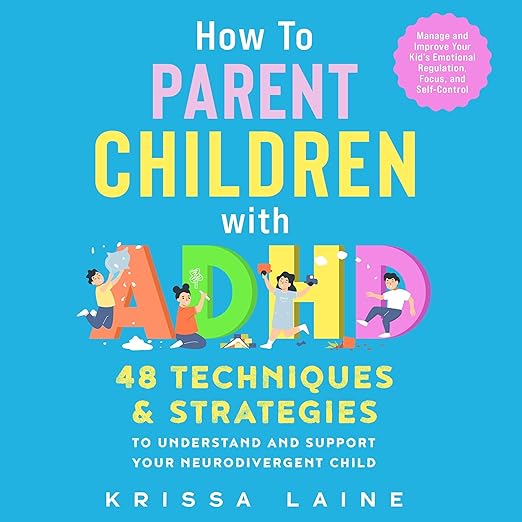
Four hours and thirteen minutes is a specific length for a parenting guide. Short enough to finish in one long drive or two commutes. Long enough to cover forty-eight strategies without compressing them into bullet points. Krissa Laine has made a deliberate structural choice with How to Parent Children with ADHD, and it is one that tells you something about the intended reader: someone who is in the middle of managing a household and a child’s newly identified needs and does not have the bandwidth for a twelve-hour commitment, but who needs more than a listicle.
I listened to this during a research session where I was surveying the parenting-ADHD landscape more broadly, and what distinguishes this book from some comparable titles is how it handles the emotional opening. The scenarios it lists at the start are not examples of what the parent is doing wrong. They are observations about what the parent is experiencing: the looks from strangers, the child labeled unruly rather than hyperactive, the feeling of inadequacy that accumulates when conventional discipline approaches do not work. By naming the parent’s experience first, Laine establishes the book’s orientation clearly. This is not a guide about fixing your child. It is a guide about equipping yourself.
48 Strategies Across Five Core Areas
The forty-eight strategies are organized around five core areas: managing inattention, hyperactivity, and impulsivity; building resilience and problem-solving skills; creating ADHD-friendly physical environments; building sustainable routines; and applying lessons from real-life scenarios. The framework is practical and sequential, which suits audio well. You can follow the logic from one section to the next without a visual index.
The emotional regulation section is the strongest in the book. Laine’s approach to helping children manage intense emotions without defaulting to tantrums draws on behavioral research without presenting it in clinical language. The strategies are specific enough to be actionable. One reviewer noted that she was able to start applying ideas to her son’s daily routine immediately after listening, which is about as practical a validation as a parenting guide can receive.
Sarah Kuklis and the Art of Unhurried Delivery
Sarah Kuklis has a quality that is particularly useful for a parenting guide: she does not sound harried. Given that the book is explicitly addressed to parents who are often operating in a state of fatigue, a narrator who sounds grounded and calm is doing real work. The practical sections benefit from her precision. She does not rush through numbered strategies in a way that blurs them together. Each point lands distinctly.
One reviewer identified herself as both a professional resource and a parent and described the book as useful for both audiences. That crossover is reflected in how Kuklis calibrates the delivery: accessible enough for a parent in crisis mode, precise enough for someone approaching it analytically.
The Honest Ceiling
The book has a ceiling. Reviewers who are further along in their understanding of ADHD will find the strategies less novel, and at four hours there is no room for the kind of depth that more complex situations require. The section on medical and nonmedical interventions covers ground that parents with longer diagnostic histories will have already researched. The book does not pretend to be comprehensive on medication management, co-occurring conditions, or the secondary school transition. It is an excellent starting point and an honest one about what it is and is not. For parents who are early in the process and need a clear, structured framework quickly, it delivers exactly that.
Frequently Asked Questions
Does the book address medication as a management option for children with ADHD?
Yes, briefly. It covers both medical and nonmedical interventions, but the medication section is not detailed. Parents who are in the middle of medication decisions or who have questions about specific medications should consult a prescribing clinician directly rather than relying on this book for guidance.
Is four hours long enough to meaningfully cover forty-eight strategies?
The book manages this by keeping each strategy focused and actionable rather than extensively justified. The tradeoff is depth: each strategy is presented clearly but without the extended clinical context you would find in a longer book. For parents who want to implement ideas quickly, the brevity is a feature.
How does this compare to Raising Superstar Kids with ADHD by Lydia Fields?
Both are parenting guides for children with ADHD at a similar length. Fields’s book spends more time on the neurological and diagnostic background. Laine’s book is more immediately action-oriented, with the forty-eight strategies giving it a stronger practical scaffold. They complement each other rather than duplicate each other.
Does the book address school environments or focus only on the home?
It covers both. There is a dedicated section on setting children up for school success, including guidance on working with teachers and on how to involve classmates in creating a supportive environment. The home environment section on ADHD-friendly physical spaces is one of the more distinctive contributions.