Quick Take
- Narration: Carmen T. McBroom delivers the material with warmth and a clear, unhurried pace that suits parents who may be listening in fragmented stretches between school pickups and bedtime routines.
- Themes: ADHD parenting strategies, emotional regulation for parents and children, school navigation and IEP dynamics
- Mood: Supportive and practical, with the lived-in credibility of someone who has actually been there
- Verdict: A compact, actionable parenting guide whose real asset is its non-judgmental tone, best for parents newly navigating an ADHD diagnosis.
I think about the parents who listen to books like this one. Not in ideal conditions, not with tea and headphones in a quiet room, but in the car, waiting for a school meeting to start, or lying awake at 2 a.m. running through the day’s disasters. Emily Matthews wrote this book for that parent. And Carmen T. McBroom narrates it in a way that feels calibrated for that exact listening context: steady, reassuring, never rushed.
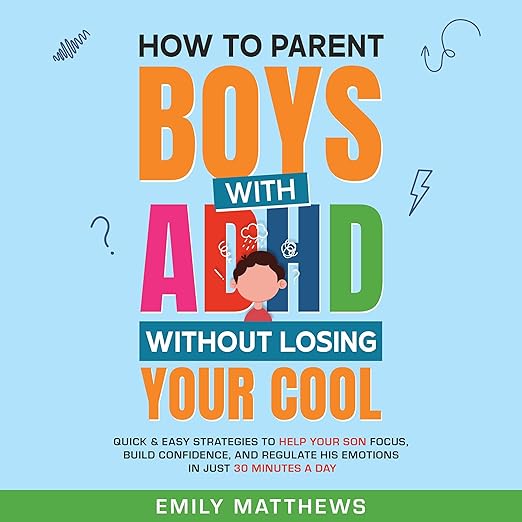
How to Parent Boys with ADHD Without Losing Your Cool is built around a specific premise: that traditional parenting advice systematically misses the mark for boys with ADHD, particularly boys who experience the world through what Matthews describes as high energy, impulsive curiosity, and nonstop movement. The book makes no claim to being a comprehensive clinical resource. Instead it positions itself as a guide written by a mother who has lived it, structured around what it calls 30-minute strategies that work in real life.
The Mom-Who-Lived-It Framework
The most important thing to understand about this book is its register. Matthews is not writing as a clinician delivering evidence to patients. She’s writing as a parent whose credibility comes from experience rather than credentials. That’s not a flaw, it’s the explicit design choice, and it’s why the book has landed as well as it has with readers. One reviewer described it as offering clear and actionable strategies that resonate deeply with parents who understand daily chaos firsthand. Another called it judgment-free and praised its friendly tone.
That friendliness is real. McBroom’s narration amplifies it. There are no moments where the audiobook feels like a lecture or a textbook. It feels, genuinely, like someone who has already been through the fire telling you which exit to use.
Strategies That Survive Contact with Reality
The practical content is organized around several pressure points that will be immediately recognizable to ADHD parents: the attention and emotional-control challenge, the homework and school navigation problem, the meltdown management question, and the routine-building puzzle. Matthews is specific about each. The section on meltdown management doesn’t just say stay calm, it gives parents scripts and tools for de-escalating both the child’s storm and their own. The school section addresses teachers, IEPs, and the daily homework battlefield with language parents can actually use in a meeting.
At three hours and fifty-eight minutes, the book is deliberately compact. This is both a strength and a limitation. The strategies are clear and usable, but parents dealing with co-occurring conditions or teenagers rather than young children may find they need additional resources.
Why the Audiobook Format Works Here
There’s a case to be made that ADHD parenting books belong in audio. Parents of ADHD children frequently don’t have the sustained reading time that a print book demands, and the audiobook format allows for the listening-in-fragments pattern that real life imposes. McBroom’s pacing respects that. She doesn’t rush, but she doesn’t pad either. The listening experience has the quality of a conversation rather than a recitation, which suits both the content and the likely listening context.
Who Should Listen / Who Should Skip
Best suited to parents who are early in their journey with an ADHD diagnosis and need a non-intimidating entry point that gives them practical tools alongside emotional validation. Parents who have already read widely on ADHD, or who are dealing with more complex presentations involving co-occurring conditions, will likely find the scope insufficient. Those looking for peer-reviewed clinical research should look to more academically grounded resources, but that’s not what this book is trying to be, and it succeeds on its own terms.
Frequently Asked Questions
Is this book specific to boys, or is the content applicable to girls with ADHD as well?
Matthews frames the content around boys specifically, including discussion of how ADHD presents differently in boys and the role hormones play. Some strategies will transfer, but listeners seeking guidance on girls with ADHD will want a book aimed at that presentation.
How does this book differ from a clinical guide focused on ADHD research?
The registers are entirely different. This is a parent-to-parent guide with an informal, supportive tone and practical micro-strategies. Clinically grounded resources with evidence-base focus are complementary rather than competing, both are worth having.
Does the book address school systems, IEPs, and working with teachers?
Yes, there is a section specifically on navigating schools, including IEPs and homework battles. It’s not as detailed as a dedicated special education guide, but it gives parents a starting vocabulary and a set of strategies for those conversations.
At under four hours, is there enough depth here to be genuinely useful?
For parents at the beginning of the ADHD journey, yes. The brevity is intentional, the 30-minute strategy framework is designed for parents who don’t have hours to spend implementing complex systems. For parents further along who need more nuance, a longer resource will serve better.